
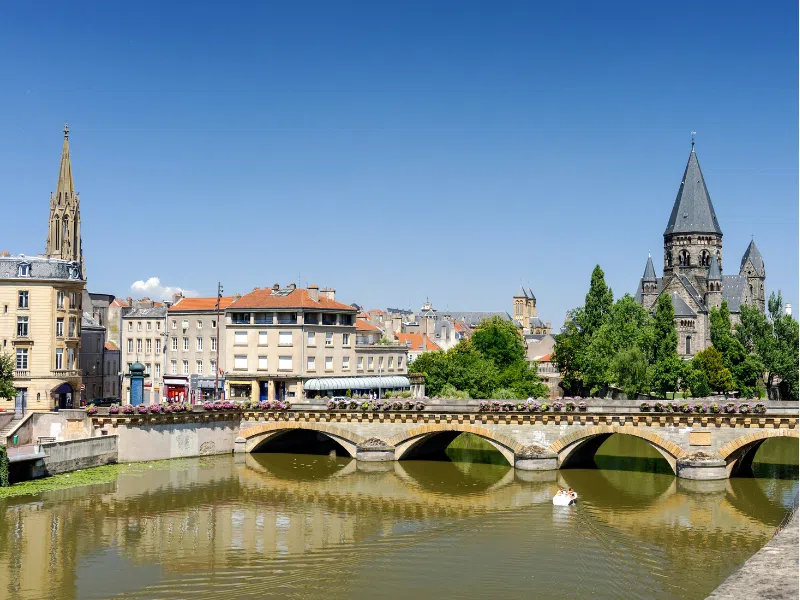
Metz sta da secoli tra Francia e Germania, e lo si legge nelle sue strade: una cattedrale gotica in dorata pietra di Jaumont fronteggia una stazione costruita sotto un imperatore tedesco. La città sorge dove la Seille si getta nella Mosella, con isole, ponti e giardini sull’acqua nel suo cuore. Ecco i fatti e le storie che rendono speciale la città.
10 curiosità su Metz
- God's lantern: the Cathedral of Saint-Étienne has about 6,500 square metres of stained glass, one of the largest expanses in the world, which is why it is nicknamed 'la Lanterne du Bon Dieu'.
- Una navata altissima: iniziata nel 1220 e consacrata nel 1552, la cattedrale ha una navata alta 41,41 metri, la terza più alta tra le cattedrali francesi dopo Amiens e Beauvais.
- Chagall nelle vetrate: tra il 1958 e il 1970 Marc Chagall creò tre serie di vetrate per la cattedrale.
- A castle on a bridge: the Germans' Gate spans the Seille as a fortified bridge, with two round towers from the 13th century and two gun bastions added in the 15th.
- L’assedio fallito: nel 1552 Metz passò sotto il controllo francese, e quell’inverno l’imperatore Carlo V la assediò con un esercito enorme. La città resistette, e nel gennaio 1553 l’imperatore rinunciò.
- Una chiesa per il Kaiser: il Temple Neuf, chiesa protestante in stile neoromanico, fu costruito su un’isola della Mosella quando Metz era tedesca. L’imperatore Guglielmo II partecipò alla sua inaugurazione nel 1904.
- France's oldest working opera house: the Opéra-Théâtre on the Place de la Comédie opened in 1752 and is still in use.
- Una delle chiese più antiche di Francia: Saint-Pierre-aux-Nonnains nacque nel IV secolo come edificio romano e fu poi trasformata in chiesa. Oggi ospita concerti e mostre.
- Plum capital: Lorraine grows about 80 percent of the world's commercial mirabelle plums, and every August Metz holds a festival in their honour.
- Un museo con il cappello: il Centre Pompidou-Metz, prima sede del museo parigino fuori dalla capitale, ha aperto nel 2010. Il suo tetto ondulato, dell’architetto Shigeru Ban, si ispira a un cappello cinese intrecciato.
La leggenda del Graoully
Long ago, legend says, a dragon called the Graoully lived in the ruins of the Roman amphitheatre at Metz, together with a swarm of snakes. Their poisonous breath killed anyone who came near, and the people lived in fear. Then Clement, the city's first bishop, arrived. He walked into the ruins, made the sign of the cross, tied his stole around the dragon's neck and led it like a dog to the river Seille, where he ordered it to disappear. The beast obeyed, and the grateful citizens became Christians. The Graoully has been a symbol of Metz for a thousand years: an effigy of the dragon hangs in the cathedral crypt.
Il Quartiere imperiale in breve
Dopo il 1871 Metz entrò a far parte dell’Impero tedesco, e Berlino volle farne una vetrina. A sud del centro storico sorse un nuovo Quartiere imperiale con ampi viali, un grandioso ufficio postale e la stazione, progettata da Jürgen Kröger in un massiccio stile neoromanico. A differenza del calcare giallo del centro, questi edifici usano arenaria grigia e rosa e granito della Renania. La stazione fu pensata anche per i trasporti militari, con lunghi binari per spostare le truppe verso il confine francese. Metz tornò alla Francia dopo la Prima guerra mondiale, ma il quartiere tedesco resta una delle parti più sorprendenti della città.
Cosa mangiare a Metz
- Quiche lorraine: la versione originale si fa con uova, panna e pancetta affumicata, senza formaggio.
- Pâté lorrain: maiale e vitello marinati nel vino bianco, cotti in pasta sfoglia e serviti caldi o freddi.
- Potée lorraine: un sostanzioso stufato invernale di maiale affumicato, salsiccia, cavolo e ortaggi da radice.
- Tarte aux mirabelles: una semplice crostata con le piccole prugne dorate, migliore a fine estate.
- Acquavite di mirabelle di Lorena: un distillato di prugne limpido, servito tradizionalmente a fine pasto.
Da sapere prima di partire
- Visita la cattedrale in una giornata di sole, quando la luce attraverso le vetrate è più forte. Le vetrate di Chagall sono nel transetto nord e nel deambulatorio.
- Il Centre Pompidou-Metz è proprio dietro la stazione, quindi puoi abbinarlo all’arrivo o alla partenza.
- Walk along the Moselle to the Plan d'Eau and the gardens around the Temple Neuf for the classic views of the city's islands.
- Nancy, con la sua place Stanislas patrimonio UNESCO, e il Lussemburgo sono due gite facili in treno.
Scopri Metz con World City Trail
Our Metz scavenger hunt turns these sights into a game you play on your phone. The route links 10 stops and takes around two hours, with about 47 minutes of walking, and leads you past the Cathedral of Saint-Étienne, the Temple Neuf and the Germans' Gate, among other sights.
A ogni tappa risolvi un enigma e ascolti una breve storia, al tuo ritmo. Puoi iniziare quando vuoi.
Gioca alla caccia al tesoro di Metz →
Fatti verificati a ottobre 2026.