
Bremen has been a proud trading city for more than a thousand years. As a member of the Hanseatic League and later a Free Imperial City, it guarded its independence fiercely, and together with Bremerhaven it is still the smallest of Germany's 16 federal states. Its Market Square, framed by a Gothic town hall and watched over by a giant stone knight, is one of the finest in the country. Here are the facts and stories that make the city special.
10 curiosità su Brema
- Un municipio Patrimonio dell’Umanità: il municipio fu costruito all’inizio del Quattrocento e all’inizio del Seicento ricevette la sua ricca facciata in stile Rinascimento del Weser. Nel 2004 è entrato nella lista del Patrimonio mondiale UNESCO insieme alla statua di Rolando che gli sta davanti.
- A stone knight for freedom: the Roland statue was put up in 1404, and the figure alone is 5.47 metres tall. Legend says Bremen will stay free as long as Roland stands, and a spare Roland is said to be kept in the town hall's vaults, just in case.
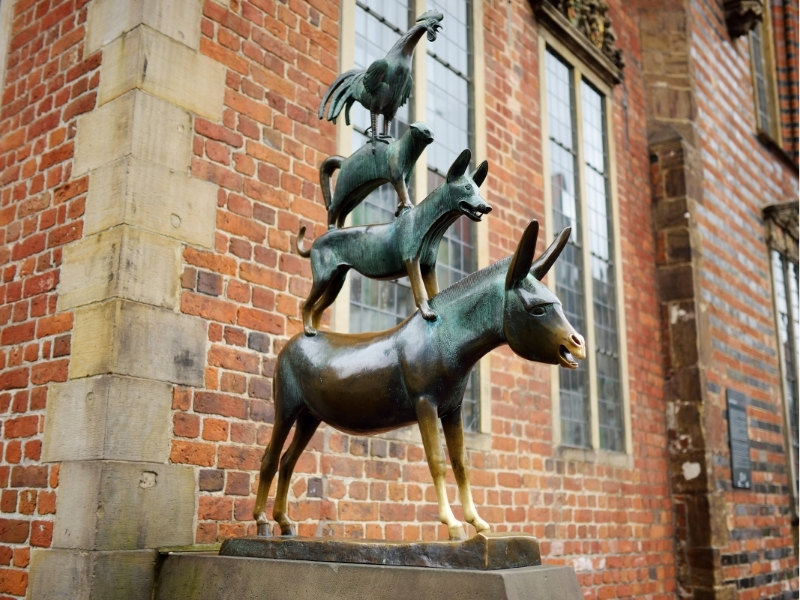
- Musicians who never arrived: in the Brothers Grimm tale, the donkey, dog, cat and rooster set off for Bremen but never get there. Gerhard Marcks's bronze of the four has stood beside the town hall since 1953, and the donkey's front legs are rubbed shiny by visitors hoping for luck.
- Un buco che fa i versi degli animali: lascia cadere una moneta nel Bremer Loch, un’apertura nel selciato della Piazza del Mercato, e sentirai uno dei quattro musicanti. I soldi vanno in beneficenza.
- Una cantina del 1405: il Ratskeller sotto il municipio è una delle più antiche cantine vinicole della Germania ed è noto per servire solo vini tedeschi.
- Una via di mattoni e oro: la Böttcherstraße fu trasformata negli anni Venti e nei primi anni Trenta per il commerciante di caffè Ludwig Roselius, il primo a mettere in commercio il caffè decaffeinato. Un rilievo dorato dell’arcangelo Michele che combatte il drago ne segna l’ingresso.
- Campane di porcellana: sulla Casa del Glockenspiel, nella Böttcherstraße, 30 campane di porcellana di Meissen suonano più volte al giorno, mentre pannelli intagliati ruotano mostrando trasvolatori e navigatori come Cristoforo Colombo e Charles Lindbergh.
- The Schnoor: Bremen's oldest quarter is a maze of narrow lanes and tiny houses, many from the 17th and 18th centuries, where fishermen and craftsmen once lived.
- Una pietra su cui sputare: una pietra nel selciato del Domshof segna il punto in cui l’avvelenatrice Gesche Gottfried, che uccise 15 persone con l’arsenico, fu giustiziata il 21 aprile 1831. Fu l’ultima esecuzione pubblica a Brema, e c’è chi sputa ancora sulla pietra.
- Una fiera dal 1035: il Freimarkt, che si tiene ogni ottobre, risale a un privilegio di mercato del 1035 ed è una delle fiere più antiche della Germania.
I musicanti di Brema
In the tale recorded by the Brothers Grimm, a donkey grown too old to carry sacks runs away to become a town musician in Bremen. On the road he meets a worn-out hunting dog, a cat and a rooster, all about to be got rid of by their owners, and they join him. At nightfall they find a robbers' house in the forest. Standing on one another's backs, they bray, bark, miaow and crow, then crash through the window. The robbers flee in terror. When one creeps back in the dark, he is scratched, bitten, kicked and crowed at, and tells his gang that a witch, a man with a knife, a monster with a club and a judge are waiting inside. The animals like the house so much that they stay, and never reach Bremen at all.
Cosa mangiare a Brema
- Kohl und Pinkel: cavolo riccio stufato per ore e servito con il Pinkel, una salsiccia affumicata di avena o orzo e lardo. Il classico piatto invernale, che si mangia dopo la prima gelata.
- Knipp: una salsiccia di semola d’avena e maiale, tagliata a fette e fritta finché è croccante, spesso con patate saltate e cetriolini.
- Labskaus: the sailors' dish of corned beef mashed with potatoes and beetroot, topped with a fried egg and served with a rollmop herring.
- Beck's: Bremen's best-known beer has been brewed in the city since 1873.
Da sapere prima di partire
- La passeggiata della Schlachte lungo il Weser è piena di birrerie all’aperto e ristoranti, e da qui partono i giri in battello sul fiume e nel porto.
- Il Freimarkt anima la città nella seconda metà di ottobre, e da fine novembre il mercatino di Natale si allarga sulla Piazza del Mercato e lungo la Schlachte.
- Bremerhaven, con il Centro tedesco dell’emigrazione e il Klimahaus, è a meno di un’ora di treno regionale.
Scopri Brema con World City Trail
La nostra caccia al tesoro a Brema trasforma questi luoghi in un gioco sul tuo telefono. Il percorso collega 10 tappe e dura circa due ore, con circa 34 minuti di cammino, e ti porta lungo la passeggiata della Schlachte e attraverso la Böttcherstraße.
A ogni tappa risolvi un enigma e ascolti una breve storia, al tuo ritmo. Puoi iniziare quando vuoi e giocare in italiano, inglese, tedesco, francese, spagnolo o olandese.
Gioca alla caccia al tesoro di Brema →
Fatti verificati a ottobre 2026.