
Table of Contents
Bremen is a historic city in northern Germany, known for its rich cultural heritage, maritime history, and charming medieval architecture. Famous landmarks include the Bremen Town Hall (a UNESCO World Heritage site), the Roland Statue, and the Bremen Town Musicians, inspired by the Brothers Grimm fairy tale.
The city has a vibrant arts scene, a strong economy centered around aerospace, and a picturesque old town with cobbled streets, cozy cafes, and bustling markets. Bremen is also a major port city and a center of trade and commerce.
Key features of Bremen:
- Historic Old Town: Bremen’s Altstadt (Old Town) is home to charming medieval buildings, including the Bremen Town Hall, a UNESCO World Heritage site, and the Roland Statue, symbolizing freedom and independence.
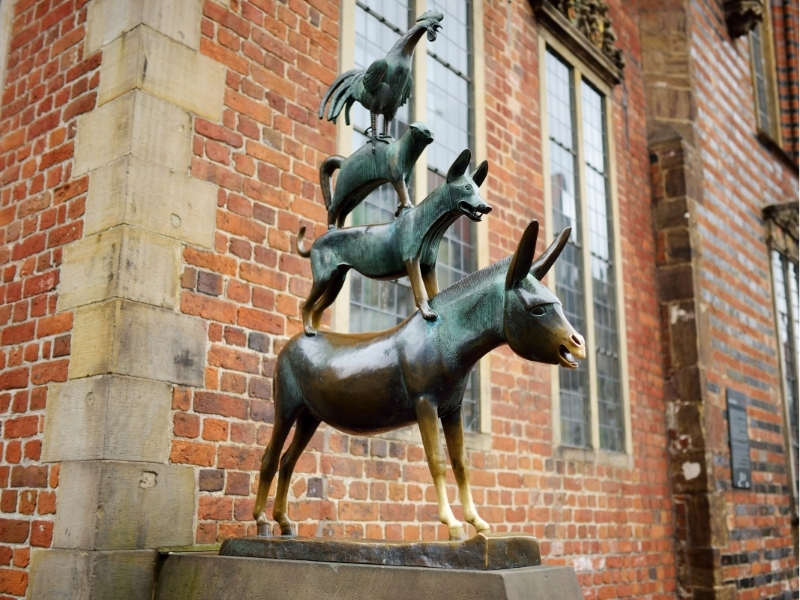
- Bremen Town Musicians: The famous Bremen Town Musicians statue, inspired by the Brothers Grimm fairy tale, depicts a donkey, dog, cat, and rooster standing on each other. It’s a popular landmark and a symbol of the city’s rich cultural heritage.
- UNESCO World Heritage Sites: Bremen’s Town Hall and Roland Statue are part of the UNESCO World Heritage due to their significance in European medieval history.
- Schnoor Quarter: One of the oldest districts in Bremen, the Schnoor is a maze of narrow, cobbled streets lined with historic houses, boutique shops, and cozy cafes.
- Bremen Cathedral (Bremer Dom): A stunning Gothic cathedral with impressive architecture, located in the heart of the Old Town.
- Cultural Scene: Bremen has a thriving arts and music scene, with venues like the Bremen Theatre, Kunsthalle Bremen (an art museum), and Universum Bremen (a science center).
- Maritime Heritage: As a major Hanseatic city, Bremen has a strong maritime tradition, with its historic Schlachte Embankment along the Weser River hosting restaurants, bars, and the Übersee-Museum, which showcases Bremen’s connections to global trade.
- Weser River: The Weser River runs through Bremen, providing scenic views and opportunities for boat tours, as well as contributing to the city’s economic and cultural history.
- Bremen’s Economy: Historically a trading hub, Bremen remains a center for commerce and industry, particularly in aerospace (home to Airbus) and manufacturing.
- Bremen’s Green Spaces: The city is known for its parks and gardens, such as Bürgerpark, offering a peaceful retreat with lakes, walking trails, and open spaces.
Fun facts about Bremen:
- The Bremen Town Musicians Are Everywhere: The famous Bremen Town Musicians statue, featuring a donkey, dog, cat, and rooster, is not just a popular tourist attraction—it’s also featured on various souvenirs, street art, and even in a famous bronze sculpture in the city’s market square. In fact, many believe rubbing the donkey’s legs brings good luck!
- Home to the World’s Oldest Luxury Car Brand: Bremen is home to Mercedes-Benz, one of the oldest and most prestigious car manufacturers in the world. The city’s Mercedes-Benz plant is one of the company’s key production sites, and there’s even a Mercedes-Benz Museum here.
- The Roland Statue’s Mysterious Origins: The Roland Statue, located in the heart of Bremen’s town square, is said to be a symbol of the city’s independence. It stands 10.5 meters tall and is thought to have been erected in the 15th century, though its exact purpose and origins remain a bit of a mystery.
- Bremen’s Own “Little Venice”: The Schnoor Quarter, with its narrow, winding streets and old houses, has earned the nickname “Little Venice” due to its picturesque canals and medieval charm.
- Bremen’s Historic Role in the Hanseatic League: As a major member of the Hanseatic League, Bremen played a key role in medieval trade across northern Europe. The city’s historic wealth and cosmopolitan nature stem from its centuries-old trading connections.
- The Largest Beer Festival in Northern Germany: Bremer Freimarkt is Bremen’s annual fair and one of the oldest festivals in Germany (dating back to 1035). It features a massive funfair, parades, and of course, plenty of beer! It’s a must-see for anyone visiting the city in October.
- A City with a “Bremen Man” Tradition: In Bremen, people take the phrase “Bremen Man” seriously—locals have a tradition of referring to anyone who comes from Bremen as a “Bremen Man” (Bremersmann), regardless of gender. The phrase is part of the city’s identity and pride.
- The “Bremen Jump” Tradition: In Bremen’s central market square, there is a quirky tradition known as the “Bremen Jump.” Visitors are encouraged to jump on the cobblestones of the Marktplatz, and legend has it that if you can jump perfectly, you’ll have good luck for the rest of the year.
- World’s Oldest Working Clock: The Bremen Roland Statue is home to one of the world’s oldest working mechanical clocks, installed in the statue’s base in the 14th century. It’s still functioning today!
- The Bremen Town Hall’s Golden Secrets: The Bremen Town Hall (Rathaus) is not just a UNESCO World Heritage site for its architecture; it is also said to have hidden “golden” secrets. The building’s stunning Renaissance façade hides golden symbols representing the city’s wealth and power during the Hanseatic period.

Local legends about Bremen
1. The Bremen Town Musicians
Perhaps the most famous legend associated with Bremen is the tale of the Bremen Town Musicians. The story, popularized by the Brothers Grimm, tells of four animals—a donkey, a dog, a cat, and a rooster—who are discarded by their masters because they are old or useless. Rather than give up, they decide to head to Bremen to become town musicians. Along the way, they scare off a band of robbers by standing on each other’s backs and making noise, ultimately finding a new home together. Today, the statue of the Bremen Town Musicians stands in the city’s market square, and touching the donkey’s legs is believed to bring good luck.
2. The Legend of Roland
The Roland Statue in Bremen’s marketplace is steeped in legend. Roland is a heroic knight from the medieval period, symbolizing the city’s freedom and independence. According to the legend, Roland was a loyal knight of Charlemagne, and when Charlemagne’s empire expanded into Bremen, Roland fought to protect the city. The statue is said to be a symbol of Bremen’s autonomy, especially in the face of outside control. Some even believe that the statue is a good omen—if the statue’s sword falls, it would be a sign of the city’s downfall, though it has stood for over 600 years without this happening.
3. The Bremen Ghost
A legend about a ghost that haunts the Bremen Cathedral (Bremer Dom) has persisted for centuries. According to the tale, the ghost is the restless spirit of a monk who was sentenced to death for a crime he did not commit. Before his execution, he vowed to return as a ghost to seek justice, and since then, many have claimed to see or hear strange phenomena near the cathedral—particularly during the dead of night. Some say that if you pass the cathedral at midnight, the monk’s spirit will appear to warn you.
4. The Treasure of the Weser
There’s a local legend about a hidden treasure buried along the Weser River, which runs through Bremen. According to the story, a band of robbers, after successfully looting a ship on the river, buried their gold and jewels somewhere near the city before being caught. Some say that if the treasure is ever found, it will bring great wealth to the one who discovers it, but the location remains elusive. For centuries, treasure hunters have searched the area, but the treasure remains lost.
5. The Devil and the Bremen Cathedral
Another interesting tale involves the devil and the Bremen Cathedral. According to local legend, the devil once tried to build the cathedral in a single night. He struck a deal with the town’s people: he would finish the building by morning, but they would owe him their souls.
However, the clever people of Bremen outwitted the devil. They spread out grain on the site, and when the devil saw what appeared to be a field of wheat, he mistook it for an entire city. Believing he had been tricked, the devil left in fury, and the cathedral was never completed by him. Some versions of the story suggest that the devil’s anger can still be felt in the cathedral’s unfinished details.
6. The Ghost of the Schnoor Quarter
The Schnoor Quarter, Bremen’s oldest district, is home to a number of ghost stories. One legend tells of a young woman who was jilted by her lover and committed suicide by jumping into the Weser River. Her restless spirit is said to still wander the narrow streets of Schnoor, appearing to lone passersby at night. Some say she can be heard crying softly in the dark alleys.
7. The Secret Passage of the Bremen Ratskeller
Beneath the Bremen Town Hall lies a hidden cellar, the Ratskeller, where local merchants and townspeople used to meet. The legend goes that the cellar contains a secret passage that leads to the Schnoor Quarter, known only to a select few. Some say that if you know the right words or have the right key, you can still find this passage today. Others claim it was used by the town’s rulers during times of siege to escape undetected.
8. The Bremen Dragon
A lesser-known Bremen legend involves a dragon that once terrorized the region. The dragon was said to live in a cave near the Weser River, and it would swoop down to steal livestock and even people. The people of Bremen finally fought back and defeated the beast with the help of a brave knight. The legend suggests that the dragon’s lair was near where the city now stands, and it was from this event that Bremen’s symbol of strength and resilience came to be.
What about the history of Bremen?
Early History:
- Founding of Bremen (787 CE): Bremen’s history as a city began in 787 CE when it was established as a bishopric by Charlemagne, the King of the Franks and later Emperor of the Holy Roman Empire.
- Charlemagne founded the Bremen Cathedral (Bremer Dom), which became the heart of the city. The bishopric played a major role in spreading Christianity in the region, and Bremen’s religious and political influence began to grow.
Medieval Bremen (9th – 15th Century):
- City Independence (13th Century): By the 13th century, Bremen gained independence from the archbishops who had ruled the city. Bremen was granted imperial free city status by the Holy Roman Emperor, which allowed it to govern itself.
Early Modern Period (16th – 18th Century):
- Bremen as a Port City (18th Century): By the 18th century, Bremen’s economy revived, and the city became an important center for shipping and global trade, especially with the Americas. Bremen’s port grew in significance, and the city saw the rise of merchant families and a thriving economy based on imports and exports.
19th Century – Industrial Revolution:
- The Rise of Industry (19th Century): The 19th century marked the beginning of Bremen’s industrialization. The city became an important center for shipbuilding, brewing (it is home to the famous Beck’s Brewery), and other industries. The arrival of the railroad in the mid-1800s helped Bremen expand its trade links, both within Germany and internationally.
20th Century – Two World Wars and Reconstruction:
- World War I (1914–1918): During World War I, Bremen, like much of Germany, suffered economic hardship. The city’s shipbuilding and trade industries were heavily impacted by the war and the subsequent Treaty of Versailles, which imposed strict reparations on Germany.
Modern Bremen (Late 20th Century – Present):
- Bremen Today: In the 21st century, Bremen continues to be an important regional and global center of trade and commerce, particularly as part of the Bremen/Bremerhaven port complex, one of the busiest in Europe.
- The city also has a strong educational and scientific base, with institutions like Bremen University and the Jacobs University. As a city with a rich maritime and industrial history, Bremen balances its past with a modern and forward-thinking outlook.
Bremen Must-Try Food

Bremen offers a delightful range of regional specialties and traditional German dishes that reflect its rich history and coastal location. One must-try dish is Bremische Knipp, a Bremen-style sausage made from pork, barley, and onions, often served with mustard and sauerkraut.
Being a port city, Bremen’s seafood is legendary, and a Fischbrötchen (fish sandwich) is a must-try. Filled with fresh fish like herring, matjes, or smoked salmon, the sandwich is often topped with onions, pickles, and mustard or remoulade sauce. Another traditional dish is Aalsuppe, a rich eel soup made with smoked eel, vegetables, barley, and sometimes sherry or wine.
When in Bremen, you’ll also want to try Schwarzbrot, a dense black rye bread commonly served with cold cuts, cheeses, or simply butter. It’s a hearty accompaniment to many Bremen dishes.
For dessert, Rote Grütze, a tangy fruit pudding made with red berries like cherries, raspberries, and strawberries, is a refreshing treat. It’s often served with vanilla sauce or cream, making it the perfect end to a hearty meal.
No trip to Bremen would be complete without trying the world-famous Beck’s Beer, a lager brewed in the city since 1873. Whether you enjoy it in a local pub or a traditional beer garden, it’s a staple of Bremen’s drinking culture.
You can also sample Scharfe Bremer Wurst, a spicy sausage made with pork, garlic, and various spices, often grilled and served with mustard or in a sandwich.
Finally, Kartoffelsalat, the classic German potato salad, is a common side dish in Bremen. Made with mayonnaise, mustard, pickles, and vinegar, it accompanies many traditional meals, especially sausages and meats.
To sample these dishes, head to the Bremer Ratskeller, located under the Bremen Town Hall, where you can enjoy Aalsuppe and Fischbrötchen, or explore the charming Schnoor Quarter for bakeries serving Bremer Klaben.
Must Visit Attractions in Bremen
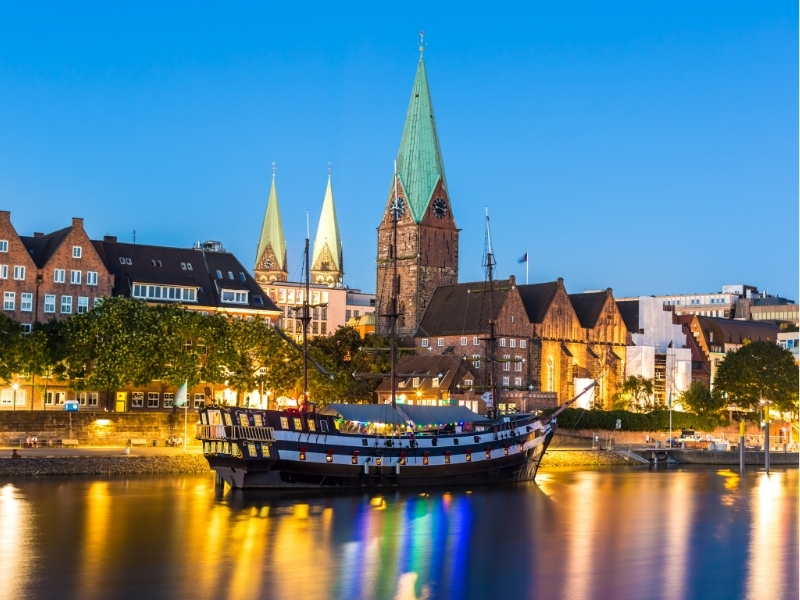
Schlachte is a scenic stretch along the Weser River, lined with restaurants, cafes, and beer gardens.
Martinianleger is a historic quay on the Weser River, situated near Schlachte. It was once a key dock for Bremen’s shipping industry and today serves as a pleasant spot to enjoy the views of the river, its boats, and the nearby maritime culture.
Böttcherstraße is one of Bremen’s most unique streets, famous for its distinctive architecture and collection of art galleries, shops, and cafes.
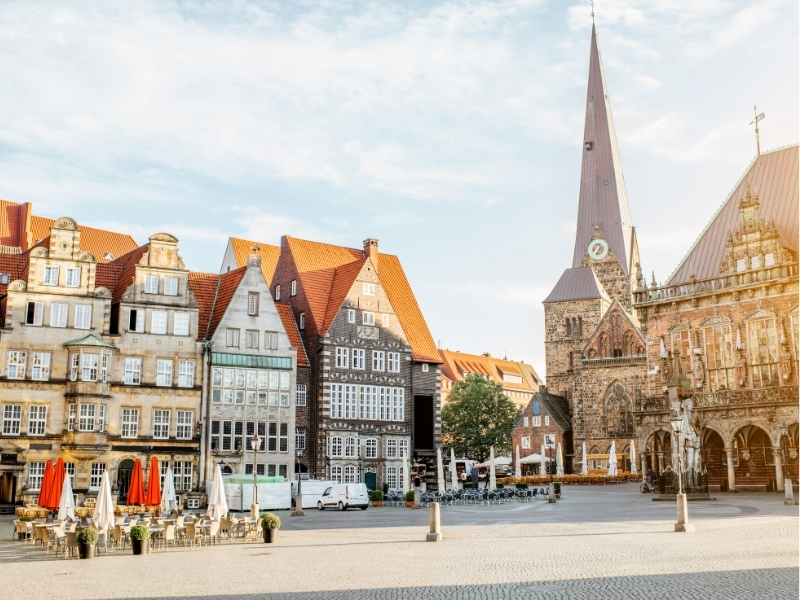
Bremen Market Square (Marktplatz) is the heart of the city, surrounded by stunning medieval buildings and buzzing with life. Dominating the square is the magnificent Bremen Town Hall, a UNESCO World Heritage site, known for its intricate Gothic and Renaissance architecture.
Town Musicians of Bremen refers to the famous statue based on the Brothers Grimm fairy tale. Situated near the market square, it depicts four animals— a donkey, dog, cat, and rooster— standing atop each other. It’s a beloved symbol of Bremen’s rich folk culture.
Bremen Town Hall is a gem of Gothic and Renaissance architecture, with its ornate façade and rich history. The building is not only the seat of the city’s government but also a UNESCO World Heritage Site, famous for its grand interiors and the beautiful “Golden Chamber.”
Holy Cathedral of Bremen (St. Petri Dom) is a stunning medieval church located near the market square. With its towering spires and impressive Romanesque and Gothic elements, it’s one of the city’s most important landmarks, featuring remarkable stained glass windows and a peaceful crypt.
Wallanlagen is a scenic green belt that encircles the old town, where medieval city walls once stood.
Kunsthalle Bremen is an exceptional art museum housing a vast collection of European art, ranging from the Middle Ages to contemporary works. With masterpieces by artists like Rembrandt, Beckmann, and Dalí, it’s a must-visit for art lovers.
Schnoor is the oldest district of Bremen, famous for its narrow, cobblestone streets, small charming houses, and cozy shops. The area offers a glimpse into the city’s past, with its well-preserved medieval architecture and vibrant atmosphere.
This walking tour will take you through the heart of Bremen, allowing you to experience the city’s rich history, stunning architecture, and cultural significance.

Explore Bremen with World City Trail
Embark on an unforgettable journey through the enchanting city of Bremen with World City Trail. Our interactive walking tour combines the thrill of exploration with the rich history and culture of this beatiful city.
Key Features:
Interactive gameplay: Solve engaging puzzles and challenges as you explore the city.
Iconic landmarks: Discover famous attractions like the Wallanlagen or the Bremen Town Hall.
Hidden gems: Uncover lesser-known spots, such as the Schnoor or the Böttcherstraße.
Cultural insights: Learn about Bremen’s fascinating history.
Flexibility: Explore at your own pace and create your own itinerary.
Learn more fun facts about Bremen!
Book your Bremen adventure today and experience the magic of this beautiful city.
Further reading on Wikipedia: Schnoor