
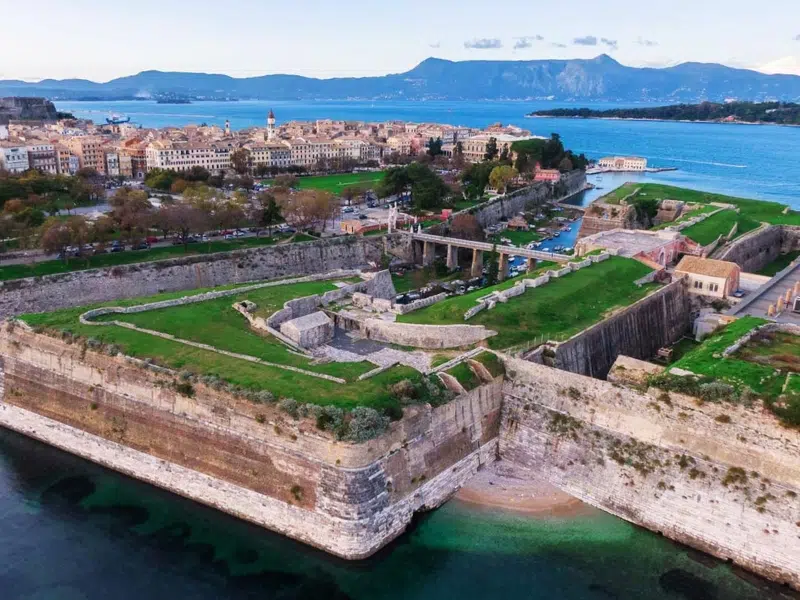
The Old Fortress of Corfu covers the rocky promontory at the eastern end of Corfu Town, cut off from the rest of the city by a sea moat that turned it into an artificial island. Its two peaks, the koryfes, are thought to have given the island its Western name, Corfu. Venetian walls built here held out against three great Ottoman sieges, in 1537, 1571 and 1716.
The Old Fortress at a glance
- Where: at the eastern tip of Corfu Town, across a bridge from the Spianada, between the Gulf of Corfu to the north and Garitsa Bay to the south.
- Built: first fortified around the 6th century; the walls and bastions you see are mostly Venetian, from the 15th and 16th centuries, with later British additions.
- By: the bastions of the 16th century were designed by Venetian military engineers, including members of the Savorgnan and Martinengo families.
- What it is today: a historic site with walks along the walls, the Church of St George, the Public Library of Corfu in the old British barracks, and venues for concerts and exhibitions.
- Time needed: 1 to 1.5 hours, including the climb to the lighthouse.
From Byzantine town to Venetian island fortress
After the Goths destroyed ancient Corcyra in the 6th century, its people took refuge on this promontory, and for several centuries the medieval town of Corfu stood inside these walls. The Byzantines fortified the two peaks, which the Venetians later called Castel a Mare, the castle by the sea, and Castel a Terra, the castle towards the land. From the early 15th century Venice began replacing the Byzantine defences, and dug the Contrafossa, a moat linking the two bays, so that the fortress became an island reached by a drawbridge.
After the first Ottoman siege in 1537, when about 20,000 islanders who could not find shelter were killed or carried off, Venice rebuilt the defences with modern bastions between about 1545 and 1555. The fortress held again in 1571 and in 1716, when Count Johann Matthias von der Schulenburg led a seven-week defence. In 1718 lightning hit the powder store and the explosion destroyed most buildings inside. The British, who ruled Corfu from 1815 to 1864, added barracks and the Church of St George. In June 1944 the Nazi occupiers held the Jews of Corfu in the fortress before deporting them; around 1,800 were taken, and only about 120 came back.
What to look for
- The Contrafossa, the Venetian sea moat between the fortress and the Spianada, where small boats moor today.
- The two peaks: climb Castel a Terra, the higher western one with its lighthouse, for the widest view over Corfu Town, the sea and the Albanian coast.
- The Church of St George, built by the British in 1840 for their soldiers, with a columned front that looks like a Greek temple.
- The massive Venetian bastions and gun platforms, designed in the age of cannon to keep attackers at a distance.
- The former British barracks, now home to the Public Library of Corfu.
How Corfu got its name
The Greek name of the island is Kerkyra, but in the Byzantine period the town on this promontory came to be called after its two peaks, koryfai in Greek. From that word came the Italian Corfù and the name used in most other languages today. So when you look at the fortress from the Spianada, its double summit is the reason the island is called Corfu.
Tips for your visit
- Go in the morning or late afternoon: there is little shade on the walls and the climb to the lighthouse is steep in summer heat.
- Wear shoes with grip; the paths and stone ramps can be slippery.
- For the classic photo of both peaks, walk along the seafront of Garitsa Bay to the south.
- Combine it with the Spianada and the Liston just outside the gate, and end with a drink under the arcades.
Nearby
- Spianada: the large green square in front of the fortress, where cricket is still played, a short walk across the bridge.
- The Liston: the arcaded promenade on the edge of the Spianada, built in the French period, with cafés under its arches.
- Palace of St Michael and St George: the British-era palace at the north end of the Spianada, home to the Museum of Asian Art.
- Church of Saint Spyridon: the island's most venerated church, with its red-domed bell tower, a few minutes' walk into the old town.
See Corfu with World City Trail
Our Corfu treasure hunt turns the old town into a game you play on your phone. The route links 10 stops and takes around two hours, with about 26 minutes of walking. It includes places such as the Spianada and the Liston arcades. You can play in English, German, French, Italian, Dutch and Greek.
If you prefer a different format, Corfu also has a self-guided walking tour and an outdoor escape game.
Play the Corfu scavenger hunt →
Take the self-guided walking tour of Corfu →
Play the outdoor escape game in Corfu →
Facts checked in October 2026.