
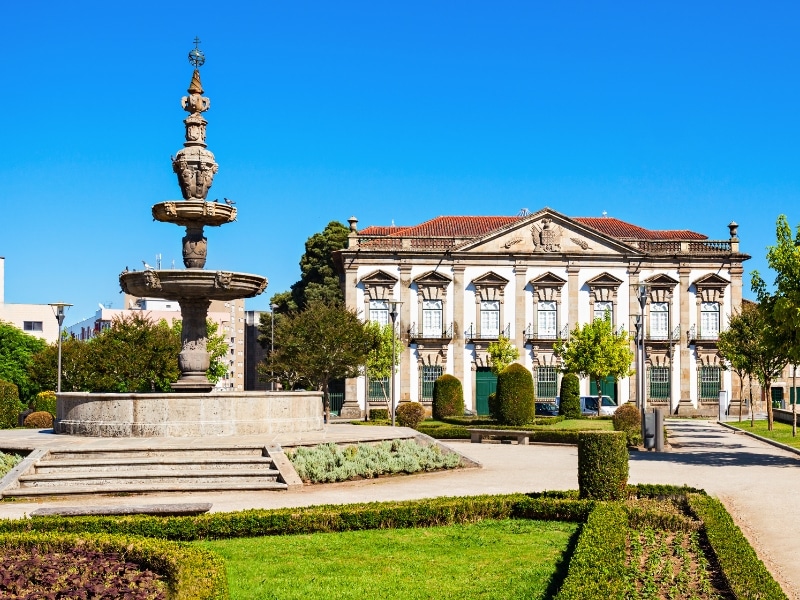
Braga is older than Portugal itself: the Romans founded it more than 2,000 years ago, and for most of its history it has been the country's religious capital. Today it is also a busy university city, where baroque churches, garden squares and historic cafés sit side by side. Here are the facts and stories that make it special.
10 fun facts about Braga
- Founded by the Romans: Braga began as Bracara Augusta around 16 BC, named after Emperor Augustus. You can still visit the remains of its Roman baths and the Fonte do Ídolo, a spring sanctuary carved into the rock.
- Capital of a Germanic kingdom: in the 5th and 6th centuries, Braga was the capital of the Suebi, who ruled much of the north-west of the Iberian Peninsula after the fall of Rome.
- Portugal's oldest cathedral: the Sé de Braga was consecrated in 1089, decades before Portugal became a kingdom. Count Henry and Teresa, the parents of the first Portuguese king, Afonso Henriques, are buried inside.
- An archbishop with a grand title: the Archbishop of Braga is traditionally called the Primate of the Spains.
- Braga prays: an old Portuguese saying goes that Lisbon has fun, Porto works, Coimbra studies and Braga prays. With dozens of churches in the centre, it is easy to see why.
- The oldest of its kind: the funicular up to Bom Jesus do Monte opened in 1882 and is the oldest funicular in the world still in service that runs on a water counterweight system.
- A UNESCO staircase: the sanctuary of Bom Jesus do Monte, with its zigzag Baroque stairway, was added to the World Heritage List in 2019.
- A gate with no doors: the Arco da Porta Nova, given its present Baroque look in the 18th century, never had doors. That is why Portuguese people jokingly ask someone who leaves a door open: 'Are you from Braga?'
- A stadium carved from a quarry: the Estádio Municipal de Braga, built for Euro 2004 by Eduardo Souto de Moura, has a rock face at one end instead of a stand. Souto de Moura won the Pritzker Prize in 2011.
- A café from 1907: Café A Brasileira on Largo do Barão de São Martinho has been serving coffee since 1907 and is one of the city's best-known meeting places.
From Bracara Augusta to the city of archbishops
Bracara Augusta was one of the main Roman towns of the north-west of the Iberian Peninsula and became the capital of the province of Gallaecia. When Roman rule ended, the Suebi made it their capital. In the Middle Ages the archbishops were the real lords of Braga, and the city grew around the cathedral. Many of the buildings you see today date from two later periods of wealth: the 16th century, when Archbishop Diogo de Sousa opened up new squares and streets, and the 18th century, when Baroque churches, palaces and fountains filled the centre.
Bom Jesus do Monte, explained
Bom Jesus do Monte stands on a wooded hill east of the centre. Pilgrims traditionally climb its long Baroque stairway, sometimes on their knees, passing chapels, fountains and statues. The Stairway of the Five Senses has a fountain for each sense, and the Stairway of the Three Virtues represents Faith, Hope and Charity. At the top are a neoclassical church, gardens, a small lake and wide views over Braga.
What to eat in Braga
- Pudim Abade de Priscos: a silky egg pudding made with port wine and a little bacon fat, created in the 19th century by the abbot of Priscos, a parish near Braga.
- Bacalhau à Braga: salt cod fried and served with onions and crisp fried potatoes, a classic of the city's restaurants.
- Frigideiras: small puff pastries filled with seasoned minced meat, a traditional Braga snack sold in the old centre.
- Rojões à moda do Minho: chunks of pork marinated in wine and garlic and fried, often served with potatoes and chestnuts.
- Vinho Verde: the light, fresh wine of the Minho region, best drunk young and cold.
Good to know before you go
- Take the funicular up to Bom Jesus and walk down the stairway: you see the fountains and chapels in the order they were designed to be seen.
- Holy Week is Braga's biggest event, with night processions through the old town. Book accommodation early if you plan to visit then, and also around the São João festival on 23 and 24 June.
- Guimarães, often called the birthplace of Portugal, is a short bus or train ride away and makes an easy half-day trip.
- The Peneda-Gerês National Park, Portugal's only national park, starts north-east of Braga and is good for a day of walking and waterfalls.
Explore Braga with World City Trail
Our Braga scavenger hunt turns these sights into a game you play on your phone. The route links 10 stops and takes around two hours, with about 23 minutes of walking, and includes the fountain on Praça da República and Café A Brasileira.
At each stop you solve a puzzle and hear a short story, at your own pace. You can start whenever you like and play in English, German, French, Italian, Spanish or Portuguese.
Play the Braga scavenger hunt →
Facts checked in October 2026.