
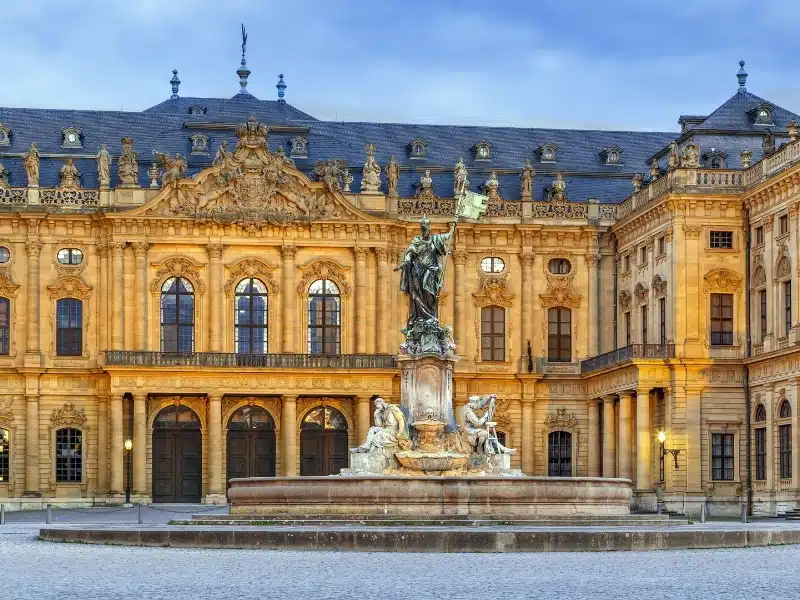
Würzburg was ruled for centuries by prince-bishops who built on a grand scale, and it is surrounded by vineyards that run right down to the River Main. Much of the old town was destroyed in 1945 and carefully rebuilt, but its greatest treasure, the Residence, came through with its famous staircase intact. Here are the facts and stories that make Würzburg special.
10 fun facts about Würzburg
- A palace on the World Heritage List: the Würzburg Residence, built from 1720 for the prince-bishops to designs by Balthasar Neumann, has been a UNESCO World Heritage Site since 1981.
- The largest ceiling fresco ever painted: above the Residence staircase, Giovanni Battista Tiepolo painted a fresco of about 600 square metres in 1752 and 1753, showing the four continents then known in Europe.
- A vault with no supports: Neumann roofed the staircase with a single vault measuring 18 by 30 metres, and it held when the palace burned in the bombing of 16 March 1945.
- X-rays were discovered here: on 8 November 1895 the physicist Wilhelm Conrad Röntgen discovered X-rays in his laboratory at the University of Würzburg. In 1901 he received the first Nobel Prize in Physics.
- Wine on a bridge: the Old Main Bridge was built between 1473 and 1543, and 12 statues of saints were added around 1730. On summer evenings people buy a glass of Franconian wine and drink it on the bridge.
- A bottle shaped like a flask: Franconian wine comes in the Bocksbeutel, a flat, round-bellied bottle that is legally reserved for wines from the region and a few others.
- Two medieval wine estates that help people: the Bürgerspital, founded in 1316, and the Juliusspital, founded in 1576, are charitable foundations that still run care homes funded in part by their vineyards.
- A Romanesque giant: at 103 metres long, St Kilian's Cathedral is considered the fourth-largest Romanesque church in Germany. Its nave collapsed in the winter of 1946, and rebuilding was finished in 1967.
- A sculptor who became mayor: Tilman Riemenschneider, the great late-Gothic woodcarver, was mayor of Würzburg in 1520 and 1521. After he sided with the rebels in the Peasants' War of 1525, he was imprisoned and tortured.
- An Irish patron saint: Würzburg's patron is St Kilian, an Irish missionary, and the city celebrates him every July with the Kiliani festival.
The legend of St Kilian
Tradition says that in the late 7th century three Irish monks, Kilian, Colman and Totnan, came to Würzburg to preach. Kilian baptised the local duke, Gozbert, but then told him that his marriage to Geilana, his brother's widow, was against Church law. While the duke was away, Geilana had the three monks murdered, around the year 689, and their bodies hidden. Their relics were later found, and in 752 they were moved into the city's cathedral. Today the skulls of the three saints are kept in the cathedral, and Kilian's name is everywhere in Würzburg, from churches to the July festival.
The Residence, explained
The prince-bishops had long lived in the fortress on the hill across the river. In 1720 Prince-Bishop Johann Philipp Franz von Schönborn started a new palace in town, and Balthasar Neumann, then a young engineer, became its architect. The building was essentially finished by 1744, and decoration went on for decades. Inside, the staircase leads up to the White Hall and the Imperial Hall, where Tiepolo painted more frescoes. Behind the palace lies the Court Garden, with terraces built against the old town walls.
What to eat in Würzburg
- Silvaner: the classic grape of Franconia, dry and earthy, served in the Bocksbeutel or by the glass in the wine taverns.
- Meefischli: small fish from the River Main, fried whole and eaten with bread and a glass of wine.
- Blaue Zipfel: Franconian sausages poached in a vinegar and onion broth, which turns their skin a bluish colour.
- Schäufele: roast pork shoulder with crackling, usually served with potato dumplings and gravy.
- Zwiebelkuchen and Federweißer: onion tart with partly fermented new wine, an autumn favourite during the harvest.
Good to know before you go
- Some rooms of the Residence can only be seen on a guided tour. The Court Garden behind the palace is free to walk in.
- Walk up to the Marienberg Fortress for the best view over the bridge, the river and the church towers, especially in the late afternoon.
- On the Marktplatz, look for the copies of Riemenschneider's Adam and Eve on the portal of the Marienkapelle. The originals are in the Museum für Franken.
- Würzburg is the northern end of the Romantic Road, so it combines well with Rothenburg ob der Tauber.
Explore Würzburg with World City Trail
Our Würzburg scavenger hunt turns these sights into a game you play on your phone. The route links 10 stops and takes around two hours, with about 35 minutes of walking, and leads you past Würzburg Cathedral, the Marktplatz and the Würzburg Residence.
At each stop you solve a puzzle and hear a short story, at your own pace. You can start whenever you like.
Play the Würzburg scavenger hunt →
Facts checked in October 2026.