
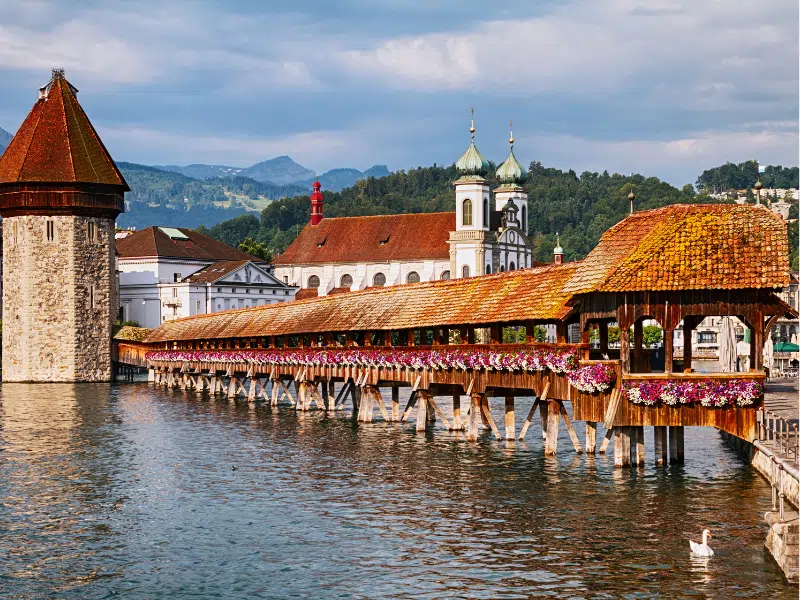
Lucerne sits where the river Reuss leaves Lake Lucerne, with Mount Pilatus on one side and the Rigi on the other. Its two covered wooden bridges, its medieval town wall and its painted squares have survived for centuries, and the mountains are only a boat or train ride away. Here are the facts and stories that make the city special.
10 fun facts about Lucerne
- A 14th-century bridge: the Chapel Bridge was built in the 14th century and is one of the oldest covered wooden bridges in Europe. Triangular paintings from the 17th century, showing scenes from Swiss and Lucerne history, hang under its roof.
- Rebuilt in eight months: on 18 August 1993 a fire destroyed much of the Chapel Bridge and about two-thirds of its paintings. The bridge was rebuilt and reopened in April 1994.
- A tower with many jobs: the octagonal Water Tower in the river is older than the bridge itself. Over the centuries it served as a prison, a torture chamber, the city archive and the treasury.
- A dance with death: the second wooden bridge, the Spreuer Bridge, dates from 1408. Its roof panels show a Dance of Death painted by Caspar Meglinger between 1625 and 1635. The name comes from Spreu, chaff, which the mills were allowed to tip into the river only from this bridge.
- The most mournful stone in the world: the Lion Monument, a dying lion carved into a cliff in 1820–1821, honours the Swiss Guards killed at the Tuileries in Paris on 10 August 1792. It was designed by Bertel Thorvaldsen and carved by Lukas Ahorn. Mark Twain called it 'the most mournful and moving piece of stone in the world'.
- A clock that runs early on purpose: the Musegg Wall, about 800 metres long, still has nine towers. The clock on the Zyt Tower is allowed to strike the hour one minute before every other clock in the city.
- An early Baroque landmark: the Jesuit Church on the river, built from 1667 and consecrated in 1677, was among the first large Baroque churches in Switzerland north of the Alps. Its onion-domed towers were only finished in 1893.
- The steepest cogwheel railway: the Pilatus Railway, opened in 1889, climbs gradients of up to 48 percent, which makes it the steepest rack railway in the world.
- Europe's first mountain railway: across the lake, the Vitznau–Rigi line opened in 1871 as the first mountain rack railway in Europe.
- A lake with four names: in German, Lake Lucerne is the Vierwaldstättersee, the lake of the four forest cantons: Lucerne, Uri, Schwyz and Unterwalden. On the Rütli meadow on its shore, according to tradition, the oath that founded Switzerland was sworn in 1291.
The legend of Mount Pilatus
The mountain that rises behind Lucerne owes its name, the legend says, to Pontius Pilate. After his death his body is said to have been thrown into one river and lake after another, each time causing storms, until it was sunk in a small lake high on the mountain. Whenever someone disturbed the water, his restless spirit sent storms and floods over the land below, so for a long time the Lucerne authorities forbade people to go up to the lake. In 1585 a Lucerne priest, Johannes Müller, climbed up with a group of witnesses, threw stones into the water and called on the spirit. Nothing happened, and the spell was broken. Historians suggest a duller origin, the Latin pileatus, meaning capped with clouds. Pilatus also had dragons in its old tales, which is why the cable car to the summit is called the Dragon Ride.
Fasnacht, explained
Lucerne's carnival, the Fasnacht, takes over the Old Town in the days before Lent. It begins on the Thursday before Ash Wednesday, Schmutziger Donnerstag, at five in the morning with a huge bang called the Urknall, and thousands of people in masks pour into the dark streets. For six days Guggenmusigen, brass bands that play loud and deliberately wild versions of popular songs, march through the lanes, and parades fill the squares along the river.
What to eat in Lucerne
- Luzerner Chügelipastete: the city's own dish, a large puff-pastry shell filled with veal, mushrooms and a cream sauce, sometimes with raisins.
- Lake fish: perch (Egli) and whitefish (Felchen) from Lake Lucerne, usually served as fillets with lemon and boiled potatoes.
- Älplermagronen: Alpine macaroni baked with potatoes, cheese, cream and fried onions, eaten with apple sauce on the side.
- Kafi Luz: a Lucerne classic of weak coffee, sugar and fruit schnapps, served in a glass. Traditionally it is made so light that you can see through it.
Good to know before you go
- The Musegg Wall and four of its towers can be visited from spring to autumn. The view from the Männli Tower over the roofs and the lake is one of the best in town.
- The cogwheel railway up Pilatus runs only in the warmer months, roughly May to October. The cable cars from Kriens on the other side run for most of the year.
- Lake boats from the pier by the station go to Vitznau, where the Rigi railway starts, so you can combine a cruise and a mountain in one day.
Explore Lucerne with World City Trail
Our Lucerne scavenger hunt turns these sights into a game you play on your phone. The route links 10 stops and takes around three hours, with about 59 minutes of walking, and takes you past the Jesuit Church, across the Spreuer Bridge and up to the Nölliturm on the Musegg Wall, among other sights.
At each stop you solve a puzzle and hear a short story, at your own pace. You can start whenever you like and play in English, German, French, Italian, Spanish, Dutch or Chinese.
Play the Lucerne scavenger hunt →
Facts checked in October 2026.