
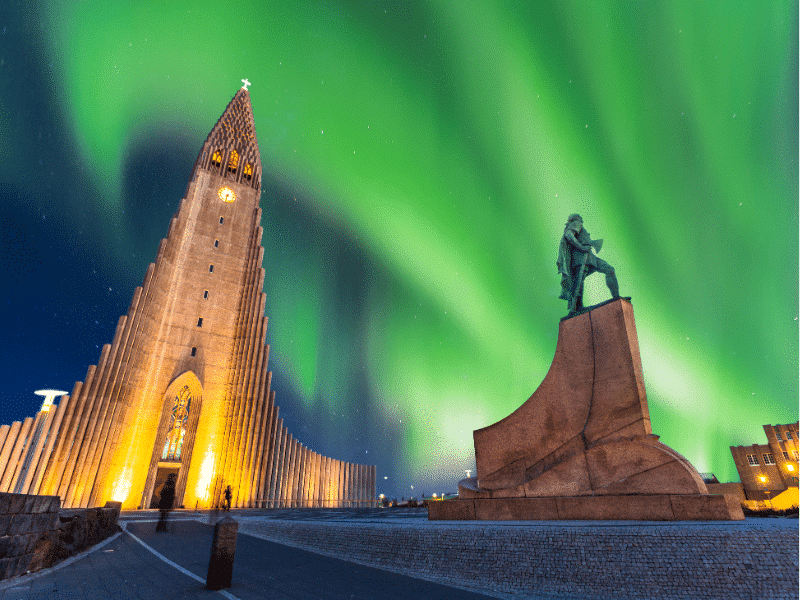
Reykjavík is a small capital with a big landscape around it. Colourful tin-clad houses, a concrete church that looks like a lava flow and a glass concert hall on the harbour sit between mountains and the North Atlantic, and the whole city is heated by water from deep underground. Here are the facts and stories behind it.
10 fun facts about Reykjavík
- The northernmost capital: Reykjavík is the northernmost capital of a sovereign state in the world.
- A city named after steam: Reykjavík means smoky bay. The first settlers named it after the steam rising from the hot springs.
- A church that took 41 years: Hallgrímskirkja was designed in 1937 by the state architect Guðjón Samúelsson. Building began in 1945, and the church was only completed and consecrated in 1986. At 74.5 metres it is one of the tallest buildings in Iceland.
- Named after a poet: the church honours Hallgrímur Pétursson, a 17th-century pastor whose Passion Hymns are among the best-loved works of Icelandic literature.
- A giant organ: the church's organ, built by the German firm Klais, is about 15 metres tall and has 5,275 pipes.
- An American gift for an old parliament: the statue of Leif Erikson in front of Hallgrímskirkja was a gift from the United States in 1930, marking 1,000 years of the Althing, Iceland's parliament, founded in 930.
- Where the Cold War thawed: in October 1986 Ronald Reagan and Mikhail Gorbachev met for a summit at Höfði, a white wooden house on the shore of Reykjavík.
- Heated from below: almost every building in Reykjavík is heated with geothermal hot water. The domed Perlan, on the hill of Öskjuhlíð, was built on top of the city's hot-water storage tanks.
- A concert hall made of light: Harpa, the concert and conference hall on the old harbour, opened in 2011. Its glass facade was designed together with the artist Olafur Eliasson.
- Not a Viking ship: the steel Sun Voyager on the seafront, by Jón Gunnar Árnason, was unveiled in 1990. It is meant as a dream boat and an ode to the sun, not a Viking longship.
The legend of Ingólfur's pillars
According to the medieval Book of Settlements, Ingólfur Arnarson sailed from Norway around 874. As Iceland came into sight, he threw his high-seat pillars, the carved wooden posts of his chieftain's seat, into the sea and vowed to settle wherever the gods let them wash ashore. He spent the first winters on the south coast while his slaves searched the shoreline. After about three years they found the pillars in a steaming bay in the south-west, and Ingólfur built his farm there: Reykjavík. Whether or not the pillars are legend, archaeologists have found a Viking-age longhouse in the city centre, now shown in the Settlement Exhibition, and a statue of Ingólfur looks out over the harbour from the hill of Arnarhóll.
Reykjavík's swimming pools, explained
For many people in Reykjavík, the local swimming pool is the place to meet friends, talk politics and relax in the hot tubs, in every season. The city has several public pools heated by geothermal water. Laugardalslaug is the largest, and Sundhöll, the oldest indoor pool, opened in 1937 and was designed by Guðjón Samúelsson, the architect of Hallgrímskirkja. The one strict rule: shower thoroughly without your swimsuit before you get in.
What to eat in Reykjavík
- Pylsur: Icelandic hot dogs made mostly with lamb. Order one with everything, including raw and crispy onions and remoulade, at the Bæjarins Beztu stand, which has sold them since 1937.
- Kjötsúpa: a hearty lamb soup with root vegetables, ideal after a cold day outdoors.
- Plokkfiskur: a homely mash of cod or haddock, potatoes and onion in a creamy sauce, often eaten with dark rye bread.
- Skyr: thick, high-protein cultured dairy that tastes like a cross between yoghurt and fresh cheese, eaten plain, with berries or in desserts.
- Rúgbrauð: dense, sweet rye bread, sometimes baked slowly in geothermal ground, delicious with butter and smoked trout.
Good to know before you go
- Hallgrímskirkja is free to enter, but the lift up the tower needs a ticket. The view takes in the whole city, the harbour and Mount Esja.
- The northern lights can appear from roughly September to April on clear, dark nights. Get away from the city lights for the best chance.
- Volcanic eruptions on the Reykjanes peninsula have closed the Blue Lagoon several times since 2023, so check its status before you book.
- The Golden Circle, with Þingvellir National Park, the Geysir area and the Gullfoss waterfall, is the classic day trip from the city.
Explore Reykjavík with World City Trail
Our Reykjavík scavenger hunt turns these sights into a game you play on your phone. The route links 10 stops and takes around two hours, with about 41 minutes of walking. Along the way you visit Hallgrímskirkja.
At each stop you solve a puzzle and hear a short story, at your own pace. You can start whenever you like.
Play the Reykjavík scavenger hunt →
Facts checked in October 2026.