
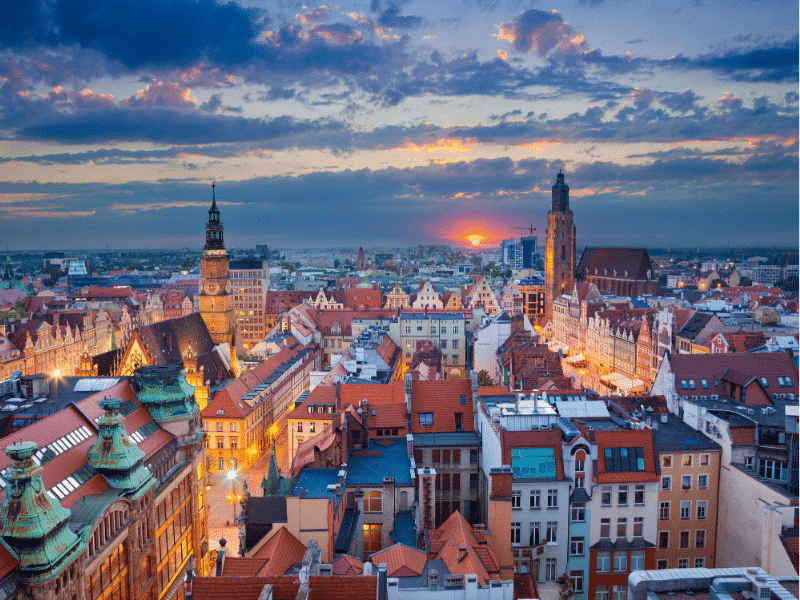
Wrocław has been Bohemian, Austrian, Prussian, German and Polish, and every chapter has left its mark on the city. It spreads across islands in the Oder, it was rebuilt almost from scratch after 1945, and today hundreds of small bronze dwarfs hide on its pavements. Here are the facts and stories that make the city special.
10 fun facts about Wrocław
- A thousand years of records: Wrocław is first mentioned in the year 1000, when a bishopric was founded here at the Congress of Gniezno.
- A city of bridges: the Oder and its branches split Wrocław into islands, linked by more than 100 bridges and footbridges.
- Dwarfs everywhere: hundreds of small bronze dwarfs, krasnale, are scattered around the city. The first official one, Papa Krasnal, was placed on Świdnicka Street in 2001.
- One of Europe's largest market squares: the Rynek is lined with colourful merchants' houses and has the Gothic Old Town Hall in the middle, a building that grew in stages over some 250 years.
- Hansel and Gretel: at a corner of the Market Square, beside St Elizabeth's Church, two tiny houses joined by a Baroque arch are known as Jaś i Małgosia, Hansel and Gretel.
- A concrete record: the Centennial Hall, designed by Max Berg and built in 1911–1913, had the largest reinforced concrete dome in the world when it opened. It has been a UNESCO World Heritage Site since 2006.
- A painting the length of a football pitch: the Racławice Panorama, painted in 1893–1894 by Jan Styka and Wojciech Kossak, is a circular canvas about 114 metres long. It came from Lviv after the Second World War and has been on display in Wrocław since 1985.
- A university founded by an emperor: the University of Wrocław was founded in 1702 by Emperor Leopold I. Its Baroque assembly hall, the Aula Leopoldina, is one of the finest rooms in the city.
- A new start in 1945: as German Breslau, the city was declared a fortress and besieged for months in 1945, and much of it was destroyed. After the war its population was almost entirely replaced, and many of the new residents came from Lwów, today's Lviv.
- Walking into the ground: The Passage, a group of bronze pedestrians by Jerzy Kalina unveiled in 2005, shows people sinking into the pavement on one side of the street and rising again on the other. It commemorates the martial law imposed in Poland on 13 December 1981.
How the dwarfs came to Wrocław
The dwarfs began as a protest. In the 1980s, during communist rule, a movement called the Orange Alternative, led by Waldemar 'Major' Fydrych, painted cheerful dwarfs on the patches of paint the authorities used to cover anti-government slogans. Its street happenings, with crowds in orange dwarf hats, made the regime look ridiculous and were hard to punish without looking more ridiculous still. In 2001 the city honoured the movement with Papa Krasnal on Świdnicka Street, and since then new bronze dwarfs have kept appearing outside shops, banks and museums. Spotting them has become a game in its own right.
Ostrów Tumski, explained
Ostrów Tumski, Cathedral Island, is where Wrocław began. It is no longer a true island, since one branch of the river was filled in during the 19th century, but it still feels apart from the rest of the city. The twin towers of the Cathedral of St John the Baptist rise above quiet streets of churches and clergy houses, and lovers fix padlocks to the green Tumski Bridge. Every evening at dusk a lamplighter in a cape walks the streets and lights the gas lamps by hand.
What to eat in Wrocław
- Rolada śląska: Silesian beef roulade with bacon and pickled cucumber, served with kluski śląskie, soft potato dumplings with a dent in the middle, and red cabbage.
- Pierogi: dumplings filled with potato and cheese, meat, cabbage and mushrooms, or fruit in summer. The city has whole restaurants devoted to them.
- Żurek: sour rye soup with sausage and egg, a Polish classic that is especially good on a cold day.
- Local beer: brewpubs in and around the Market Square brew their own beer, continuing a long brewing tradition in the city.
Good to know before you go
- You don't need a map to find the dwarfs, but if you want to collect them, ask at the tourist information office on the Market Square for a dwarf map.
- The Racławice Panorama is shown at set times to small groups, so book a slot in advance in summer.
- For a view over the Old Town, climb to the Penitents' Bridge between the two towers of St Mary Magdalene's Church. Legend says a girl who refused every suitor was condemned to sweep it forever.
- The Multimedia Fountain next to the Centennial Hall puts on water, light and music shows in the warmer months.
Explore Wrocław with World City Trail
Our Wrocław scavenger hunt turns these sights into a game you play on your phone. The route links 10 stops and takes around three hours, with about 58 minutes of walking, and leads you to The Passage sculptures and Copernicus Park, among other sights.
At each stop you solve a puzzle and hear a short story, at your own pace. You can start whenever you like and play in English, German, French, Italian, Spanish, Dutch or Polish.
Play the Wrocław scavenger hunt →
Facts checked in October 2026.