
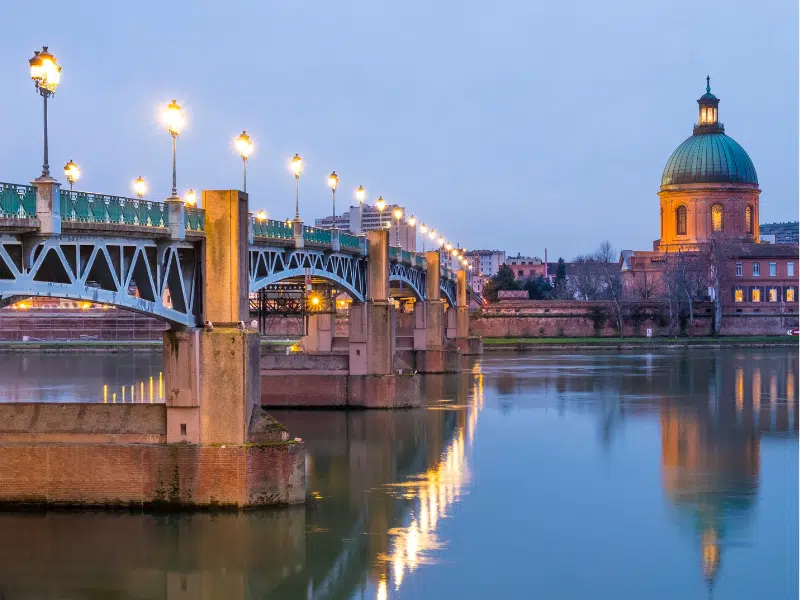
Almost all of historic Toulouse is built of flat red-orange brick, which is why the French call it La Ville Rose, the Pink City. It is also the city where Concorde first flew and where Airbus has its headquarters. Here are the facts and stories that make it special.
10 fun facts about Toulouse
- Why the city is pink: there were no good stone quarries near Toulouse, but plenty of clay along the Garonne. For centuries the city was built in brick, and in the evening light its façades shift from pink to deep orange.
- A giant Romanesque church: the Basilica of Saint-Sernin is one of the largest Romanesque churches in Europe. Pope Urban II consecrated its altar on 24 May 1096, while the building was still unfinished.
- On the road to Santiago: Saint-Sernin was a major stop for pilgrims walking to Santiago de Compostela, and since 1998 it has been a UNESCO World Heritage Site as part of the Routes of Santiago de Compostela in France.
- A city hall named after its rulers: the Capitole takes its name from the capitouls, the consuls who governed Toulouse in the Middle Ages. In the paving of the Place du Capitole lies a large Occitan cross with the 12 signs of the zodiac, by the artist Raymond Moretti.
- Where Concorde took off: Concorde made its first flight from Toulouse on 2 March 1969. Airbus is based in Blagnac, and the Aeroscopia museum there displays a Concorde.
- A canal to the Mediterranean: the Canal du Midi, built between 1666 and 1681 by Pierre-Paul Riquet, links Toulouse with the Mediterranean. Riquet died in 1680, months before it opened. It has been a UNESCO World Heritage Site since 1996.
- The Dominicans were born here: Saint Dominic founded the Order of Preachers in Toulouse in 1215. Their church, Les Jacobins, is famous for its 'palm tree' vault, and the relics of Saint Thomas Aquinas have rested there since 1369.
- One of Europe's oldest universities: the University of Toulouse was founded in 1229.
- The new bridge that is the oldest: despite its name, the Pont Neuf is the oldest bridge in Toulouse still standing. Work began in 1544 and was only finished in 1632.
- A flower as an emblem: the violet is Toulouse's symbol. You will find it as candied flowers, sweets and liqueur all over the centre, and the city celebrates it with a violet festival every February.
The legend of Saint Saturnin and the bull
Saint-Sernin is named after Saturnin, the first bishop of Toulouse, around the year 250. According to tradition, he refused to honour the pagan gods, so he was tied to a bull and dragged through the streets until the rope broke. Where his body was left, a small chapel was later built: today's church of Notre-Dame du Taur, 'taur' meaning bull in Occitan. The street running from the Capitole to the basilica is still called Rue du Taur. Saturnin's remains were later moved to a larger church over his tomb, and that site became the Basilica of Saint-Sernin.
Toulouse's blue gold
In the 15th and 16th centuries Toulouse grew rich on pastel, or woad, a plant that gave Europe its blue dye. The leaves were crushed and formed into balls called coques or cocagnes, and the area between Toulouse, Albi and Carcassonne became known as the Pays de Cocagne, the land of plenty. The finest, the Hôtel d'Assézat, was begun in 1555 for the merchant Pierre d'Assézat and now houses the Fondation Bemberg art collection. The boom ended when cheaper indigo arrived from overseas.
What to eat in Toulouse
- Cassoulet: white beans slow-cooked with duck confit, pork and Toulouse sausage. Toulouse, Castelnaudary and Carcassonne each claim the true recipe.
- Saucisse de Toulouse: a coarse pork sausage, usually sold as a long coil and grilled.
- Violettes: candied violets and violet sweets, sold in pretty tins.
- Fénétra: a local cake with almonds, apricot and lemon peel, linked to an old Toulouse festival.
- Chocolatine: what Toulouse and the southwest call a pain au chocolat. Ask for it by this name at the bakery.
Good to know before you go
- Saint-Sernin is free to enter, but the ambulatory and crypt have separate, more limited access.
- In the evening, the riverside steps at Quai de la Daurade are the place to watch the sun set over the Garonne and the Pont Neuf.
- Walk or cycle a stretch of the Canal du Midi towpath straight from the city centre.
- Albi, with its huge brick cathedral, and the walled city of Carcassonne both make good day trips by train.
Explore Toulouse with World City Trail
Our Toulouse scavenger hunt turns these sights into a game you play on your phone. The route links 10 stops and takes around three hours, with about 45 minutes of walking: the Basilica of Saint-Sernin, the Musée Saint-Raymond and more of the old centre's main sights.
At each stop you solve a puzzle and hear a short story, at your own pace. You can start whenever you like.
Play the Toulouse scavenger hunt →
Facts checked in October 2026.