
Barcelona has been a Roman colony, a medieval trading power and the showcase of Catalan Modernisme, and all three layers are within walking distance of each other. Here are the facts and stories that make the city special.
10 fun facts about Barcelona
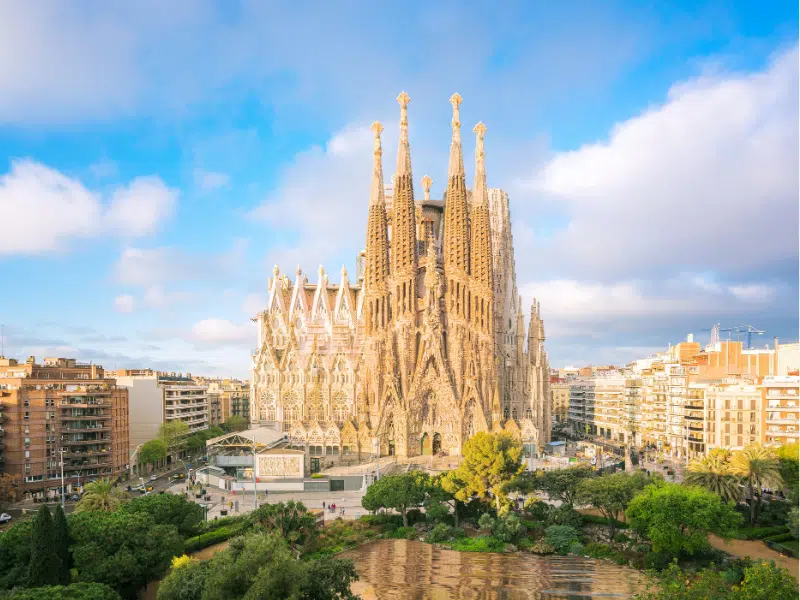
- The world's tallest church: in February 2026 the cross was lifted onto the Tower of Jesus Christ, bringing the Sagrada Família to 172.5 metres. Work began in 1882, Gaudí took over in 1883, and the basilica is still not finished.
- A centenary in 2026: Antoni Gaudí died in June 1926, a few days after being hit by a tram. Because of his shabby clothes, he was at first taken for a beggar. He is buried in the crypt of the Sagrada Família.
- Seven works, one listing: Park Güell, Palau Güell, Casa Milà, Casa Vicens, Casa Batlló, the Nativity façade and crypt of the Sagrada Família, and the crypt at Colònia Güell together form a single UNESCO World Heritage Site.
- A concert hall full of daylight: the Palau de la Música Catalana, built between 1905 and 1908 by Lluís Domènech i Montaner, is crowned by a huge stained-glass skylight that floods the hall with natural light. It became a World Heritage Site in 1997.
- Thirteen geese in the cathedral: the cloister of Barcelona Cathedral is home to 13 white geese, one for each year of the life of Saint Eulàlia, the city's co-patron, who according to tradition was martyred at the age of 13.
- A façade younger than it looks: the cathedral was built mainly between the 13th and 15th centuries, but its Gothic-style main façade was only completed in the late 19th century, and the central spire in 1913.
- Drink and you'll return: legend says that anyone who drinks from the Font de Canaletes, at the top of La Rambla, will come back to Barcelona.
- A Miró underfoot: halfway down La Rambla, at the Pla de l'Os, walkers tread on a colourful pavement mosaic by Joan Miró, created in the 1970s to welcome visitors arriving from the port.
- Beaches shaped for the Olympics: before the 1992 Olympic Games, much of the seafront was taken up by industry and railway lines. The city opened it up and reshaped the beaches that now line the coast.
- A grid with cut corners: the Eixample district was laid out from 1860 to a plan by Ildefons Cerdà, with the corners of its blocks cut off at an angle to let in light and air and give traffic room to turn.
Sant Jordi, the dragon and the rose
Catalonia's patron saint is Sant Jordi, Saint George. In the Catalan version of the legend, a dragon terrorised a town and demanded victims chosen by lot, until the lot fell on the king's daughter. Jordi rode in, killed the dragon with his lance, and from its blood grew a rose bush; he picked a rose and gave it to the princess. On 23 April, Sant Jordi's Day, the city fills with stalls and people give each other roses and books, a tradition UNESCO echoed when it made the date World Book Day.
The Gothic Quarter, explained
The Barri Gòtic grew up on top of Roman Barcino, founded in the late 1st century BC, and four columns of its Temple of Augustus still stand inside a building on Carrer del Paradís. In the early 20th century, ahead of the 1929 International Exhibition, parts of the quarter were rebuilt in a romantic Gothic style: the much-photographed bridge over Carrer del Bisbe, for example, dates from 1928.
What to eat in Barcelona
- Pa amb tomàquet: bread rubbed with ripe tomato, olive oil and salt, served with almost everything.
- Bomba: a fried ball of mashed potato filled with meat and topped with spicy sauce and allioli. La Cova Fumada in Barceloneta claims to have invented it.
- Crema catalana: a custard with a crust of caramelised sugar, traditionally eaten on Saint Joseph's Day, 19 March.
- Calçots: long grilled spring onions dipped in romesco sauce, eaten at outdoor calçotades in winter and early spring.
- Vermut: a glass of vermouth before Sunday lunch, with olives, crisps and tinned seafood, is a much-loved Barcelona ritual.
Good to know before you go
- Book Sagrada Família tickets online well in advance: timed slots often sell out, especially for the towers.
- Park Güell's Monumental Zone, with the mosaic dragon and terraces, needs a timed ticket, while the rest of the park is free to walk.
- La Rambla is in the final phase of a long redesign due to finish in early 2027, so expect some works. As in any crowded area, keep an eye on your bags.
- Montserrat, the mountain monastery north-west of the city, makes an easy day trip by train and rack railway or cable car.
Explore Barcelona with World City Trail
Our Barcelona scavenger hunt turns these sights into a game you play on your phone. The route links 10 stops and takes around three hours, with about 51 minutes of walking, from Plaça de Catalunya and La Rambla to the Palau de la Música Catalana and Barcelona Cathedral.
At each stop you solve a puzzle and hear a short story, at your own pace. You can start whenever you like.
Play the Barcelona scavenger hunt →
Facts checked in October 2026.