
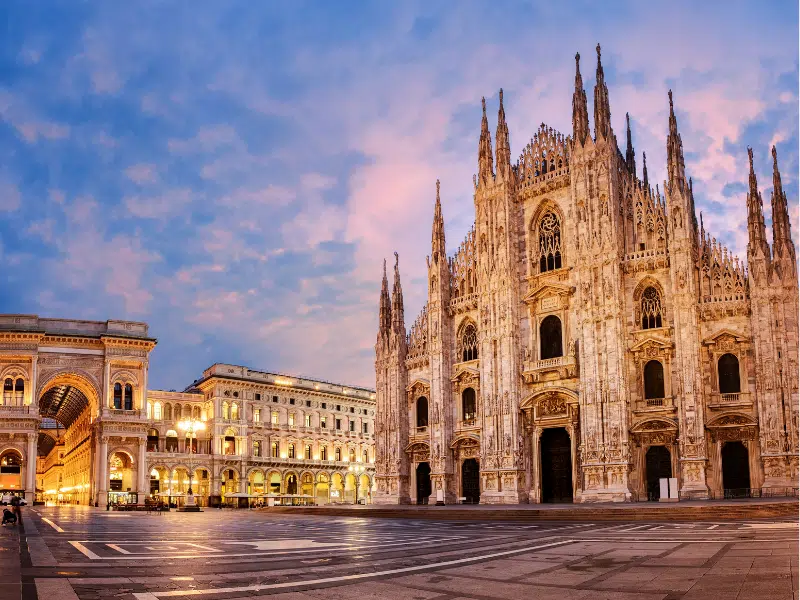
Milan is Italy's capital of fashion, design and finance, but its story goes back more than 2,000 years. Behind its busy streets you find a Gothic cathedral that took centuries to finish, one of the most famous paintings in the world and the opera house where Verdi and Puccini premiered some of their greatest works. Here are the facts and stories that make the city special.
10 fun facts about Milan
- A cathedral centuries in the making: work on the Duomo began in 1386. Napoleon, who was crowned King of Italy inside it in 1805, ordered the facade to be finished, and the last of its bronze doors was only inaugurated in 1965.
- Nothing higher than the Madonnina: the gilded statue of the Virgin Mary by Giuseppe Perego, made in 1774, stands on the Duomo's highest spire, 108.5 metres above the ground. By tradition no building in Milan should rise above her, so when the 127-metre Pirelli Tower went up in the late 1950s, a small copy of the statue was placed on its roof.
- Marble that came by boat: the Duomo is clad in pale, pink-veined marble from the Candoglia quarries near Lake Maggiore, which the Visconti rulers reserved for the cathedral. The blocks reached Milan by water, along the Ticino river and the Naviglio Grande canal.
- Spin on the bull: the floor of the Galleria Vittorio Emanuele II shows the coats of arms of Italian cities, including the bull of Turin. Its private parts have been worn into a hollow, because tradition says that spinning three times on that spot with your heel brings good luck.
- An architect who never saw his work completed: Giuseppe Mengoni designed the Galleria, begun in 1865. On 30 December 1877, a few days before the official opening, he fell from the scaffolding of the entrance arch on Piazza del Duomo and died.
- A painting that survived a bomb: Leonardo da Vinci painted The Last Supper on a wall of the convent of Santa Maria delle Grazie in the 1490s. In August 1943 a bomb destroyed much of the dining hall around it, but the painted wall, shielded with sandbags, stayed standing.
- Michelangelo's last sculpture: Sforzesco Castle, rebuilt by Francesco Sforza from 1450, houses the Rondanini Pietà, which Michelangelo was still working on a few days before his death in 1564.
- An opera season that opens on a saint's day: La Scala opened in 1778 with an opera by Antonio Salieri. Its season traditionally starts on 7 December, the feast of Sant'Ambrogio, Milan's patron saint.
- Once an imperial capital: as Mediolanum, Milan was the capital of the Western Roman Empire from 286 to 402. In 313 the emperors Constantine and Licinius agreed here on the Edict of Milan, which gave Christians freedom of worship.
- An Olympic city: Milan and Cortina d'Ampezzo hosted the 2026 Winter Olympics, which opened with a ceremony at the San Siro stadium on 6 February 2026.
The story of The Last Supper
Around 1495, Duke Ludovico Sforza, known as il Moro, asked Leonardo da Vinci to paint the end wall of the monks' dining hall at Santa Maria delle Grazie. Leonardo chose the dramatic moment when Jesus says that one of the apostles will betray him, and each of the twelve reacts in his own way. Instead of true fresco, which must be painted quickly on wet plaster, he worked slowly with tempera and oil on a dry wall, so that he could rework details. The experiment failed: within a few decades the paint was already flaking. The work survived Napoleonic troops, damp, clumsy retouching and the bombing of 1943, and a restoration that ran from 1978 to 1999 removed centuries of overpainting. Since 1980 the church and the painting have been a UNESCO World Heritage Site.
What to eat in Milan
- Risotto alla milanese: rice cooked slowly with stock, butter and saffron, which gives it its deep yellow colour.
- Cotoletta alla milanese: a thick veal chop on the bone, coated in breadcrumbs and fried in butter.
- Ossobuco: braised slices of veal shin with the marrow in the bone, traditionally served with risotto alla milanese.
- Panettone: the tall, domed Christmas cake with raisins and candied peel. Legend says it was invented at the Sforza court, when a kitchen boy called Toni saved a burnt dessert, hence pan de Toni.
Good to know before you go
- Book The Last Supper well in advance: visits are in small, timed groups, and slots often sell out weeks ahead.
- The Duomo and its rooftop terraces need separate tickets. Go up by stairs or lift to walk among the spires and see the Madonnina up close.
- Lake Como and Bergamo are both an easy train ride from Milan and make good day trips.
Explore Milan with World City Trail
Our Milan scavenger hunt turns these sights into a game you play on your phone. The route links 10 stops and takes around three hours, with about 53 minutes of walking, and leads you past Sforzesco Castle, the Duomo and the Galleria Vittorio Emanuele II.
At each stop you solve a puzzle and hear a short story, at your own pace. You can start whenever you like.
Play the Milan scavenger hunt →
Facts checked in October 2026.