
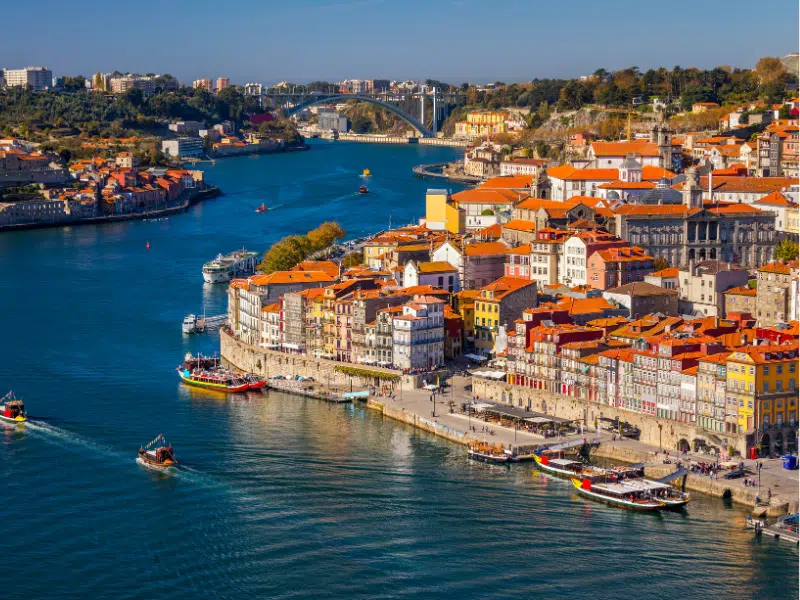
Porto climbs steeply up from the River Douro in tiers of tiled houses, church towers and narrow stairways. It gave its name to both Portugal and port wine, and its people are still called tripeiros, tripe-eaters, after a story from 1415. Here are the facts and stories that make the city special.
10 fun facts about Porto
- The city that named a country: the Roman settlement of Portus Cale at the mouth of the Douro gave its name to the medieval County of Portucale, and from there to Portugal.
- Twenty thousand tiles in one hall: the entrance hall of São Bento station, opened in 1916, is lined with around 20,000 azulejos painted by Jorge Colaço between 1905 and 1916. They show battles and royal events alongside scenes of country life, including the wine harvest on the Douro.
- A station on a convent: São Bento was built on the site of a Benedictine convent that King Manuel I founded in 1518, which is where the station gets its name.
- A tower by an Italian: the Clérigos Tower, about 75 metres high, was built between 1754 and 1763 to designs by the Italian-born Nicolau Nasoni. It has 240 steps, and Nasoni asked to be buried in the church below it.
- One of the first regulated wine regions: the Douro wine region was demarcated in 1756 by order of the Marquis of Pombal, which makes it one of the oldest wine regions in the world with official boundaries and rules.
- Port is aged across the river: most of the big port houses keep their wine in lodges in Vila Nova de Gaia, on the south bank, which is a separate city from Porto.
- A bridge from Eiffel's circle: the double-deck Dom Luís I Bridge opened in 1886. It was designed by Théophile Seyrig, a former business partner of Gustave Eiffel.
- Birthplace of Henry the Navigator: Prince Henry, who sponsored Portugal's early voyages of discovery along the coast of Africa, was born in Porto in 1394.
- The Unvanquished: Porto's nickname, the Invicta, dates from the Liberal Wars, when the city held out through a long siege in 1832 and 1833.
- On the World Heritage List since 1996: the historic centre of Porto, together with the Luís I Bridge and the Serra do Pilar monastery on the Gaia side, was listed by UNESCO in 1996.
Why the people of Porto are called tripeiros
The usual story goes back to 1415, when Portugal was preparing the fleet that would capture Ceuta in North Africa. Prince Henry, born in the city, asked Porto to help supply it, and the townspeople salted and shipped off all their good meat, keeping only the offal for themselves. They learned to cook the tripe with white beans, and tripas à moda do Porto became the city's signature dish, along with the nickname tripeiros. Historians debate the details, but the people of Porto wear the name with pride, and the dish is still on the menu in traditional tascas.
The festival of São João
On the night of 23 to 24 June, Porto celebrates São João, its biggest festival. The whole city heads into the streets, grills are set up for sardines, and people tap each other on the head with soft plastic hammers, a newer addition to a centuries-old festival. Pots of basil with a paper flower and a short verse are given as gifts, and at midnight fireworks go up over the Douro. Expect crowds until sunrise, and book a room well in advance.
What to eat in Porto
- Francesinha: a sandwich of ham, sausage and steak, covered in melted cheese and a spicy tomato-and-beer sauce, usually served with fries.
- Tripas à moda do Porto: tripe stewed with white beans, sausage and spices, the dish behind the city's nickname.
- Bacalhau à Gomes de Sá: salt cod baked with potatoes, onions, olives and egg, a recipe that comes from Porto.
- Caldo verde: a soup of finely shredded kale, potato and a slice of chouriço, eaten all year and above all on São João.
- Port wine: try a white port and tonic as an aperitif, or a tawny or ruby at one of the lodges in Gaia.
Good to know before you go
- Porto is very hilly. Wear good shoes, and use the Guindais funicular or the Gaia cable car to save your legs.
- Walk across the upper deck of the Luís I Bridge to the Jardim do Morro in Gaia for the best sunset view of the city.
- Livraria Lello, the ornate bookshop opened in 1906, needs a ticket and often has long queues, so go early.
- The Douro Valley, where the grapes for port are grown, makes a good full-day trip by train, boat or car.
Explore Porto with World City Trail
Our Porto scavenger hunt turns these sights into a game you play on your phone. The route links 10 stops and takes around two hours, with about 34 minutes of walking, and passes São Bento station and the Clérigos Tower.
At each stop you solve a puzzle and hear a short story, at your own pace. You can start whenever you like and play in English, German, French, Italian, Spanish, Dutch or Portuguese.
Play the Porto scavenger hunt →
Facts checked in October 2026.