
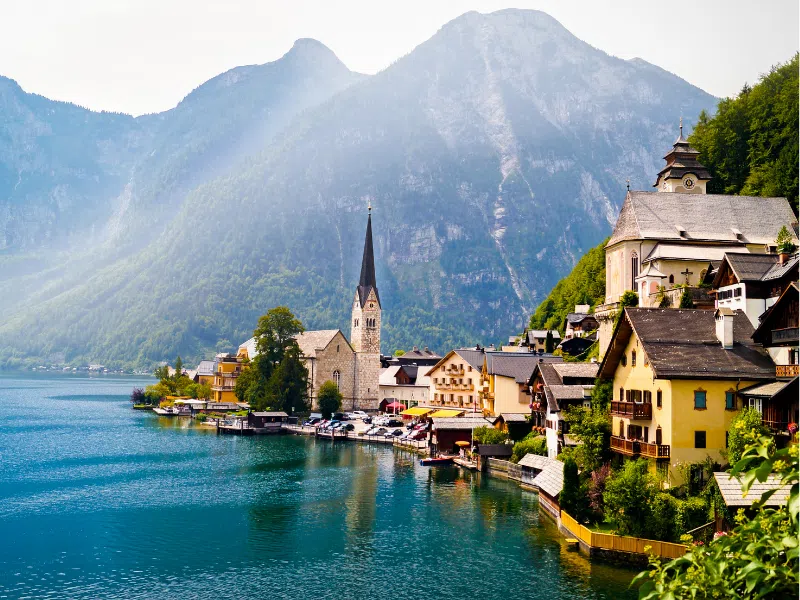
Hallstatt is a village of a few hundred people squeezed between a steep mountain and the Hallstätter See, yet it gave its name to a whole chapter of European prehistory. Salt has been taken from the mountain above it for thousands of years, and that salt paid for almost everything you see: the houses stacked on the slope, the two church towers and the boats on the lake. Here are the facts and stories behind the famous view.
10 fun facts about Hallstatt
- Salt for around 7,000 years: salt production at Hallstatt is estimated to go back more than 7,000 years, and large-scale mining inside the mountain is documented from the 14th century BC at the latest. The mine is still in operation today.
- A prehistoric era named after a village: the Hallstatt culture, the early Iron Age in Central Europe from roughly 800 to 450 BC, takes its name from the town because of the rich finds made in the burial ground above it.
- 980 graves dug by a mine manager: in November 1846, the salt mine official Johann Georg Ramsauer began excavating a prehistoric cemetery in the high valley above Hallstatt. By 1863 he and his team had opened 980 graves and kept written records of each one.
- Europe's oldest wooden staircase: archaeologists from the Natural History Museum Vienna found a wooden staircase deep in the salt mine. Tree-ring dating shows its timber was felled in 1344 BC, making it the oldest known wooden staircase in Europe.
- A room full of painted skulls: the graveyard could never be enlarged, so graves were reopened after 10 to 15 years and the bones moved to the bone house in St Michael's Chapel. It holds about 1,200 skulls, 610 of them painted with names and dates; the last was added in 1995.
- A pipeline from 1607: since 1607, brine has flowed from Hallstatt to the saltworks at Ebensee through a pipeline more than 30 kilometres long. It is regarded as the oldest industrial pipeline in the world, and its route is now a popular hiking trail.
- No road until 1890: for centuries you could reach Hallstatt only by boat or on a bridle path. The lakeside road was built in 1890, and seven houses had to be removed to make room for it. Through traffic has run through a tunnel in the mountain since 1966.
- World Heritage since 1997: the village is the centre of the Hallstatt–Dachstein / Salzkammergut Cultural Landscape, which UNESCO added to the World Heritage List in 1997.
- A copy on the other side of the world: in 2012 a replica of Hallstatt's centre, complete with its market square and church tower, opened in Boluo County in the Chinese province of Guangdong.
- A funicular to the salt mountain: the Salzbergbahn climbs from the lakeside to the high valley of the salt mine, where the Skywalk World Heritage View platform juts out from the cliff high above the rooftops.
The Man in the Salt
In 1734 miners clearing a collapsed gallery in the Kilbwerk section of the mine found a body embedded in rock salt, his clothes and shoes partly preserved. Nobody knew who he was. A monk declared him a Catholic miner who had died about 150 years earlier, and on 3 April 1734 he was buried in the village graveyard. Modern research tells a very different story: the man died around 350 BC, in a natural disaster that buried the valley and stopped mining there for a time. His body cannot be studied today. It may even lie among the bones in Hallstatt's bone house.
What to eat in Hallstatt
- Reinanke: a whitefish from the Hallstätter See, usually served whole, fried or grilled, with potatoes.
- Saibling: Arctic char from the cold, clear lakes of the Salzkammergut, often smoked and eaten with horseradish and bread.
- Kasnocken: small cheese dumplings with crispy fried onions, a classic of the mountain huts around the Dachstein.
- Kaiserschmarrn: a thick pancake torn into pieces, dusted with icing sugar and served with plum compote or apple sauce.
Good to know before you go
- Hallstatt's train station is on the opposite shore of the lake. A small ferry carries passengers across to the village, which is the most scenic way to arrive.
- The village is tiny and gets very busy in the middle of the day in summer. Come early in the morning or stay into the evening to see it quiet.
- The salt mine tours and the funicular run in the warmer part of the year, so check the season before you plan your visit.
- From nearby Obertraun, cable cars climb the Dachstein to the Dachstein ice caves and the 5fingers viewing platform on the Krippenstein.
Explore Hallstatt with World City Trail
Our Hallstatt scavenger hunt turns these sights into a game you play on your phone. The route leads you through the main sights of the village and takes around two hours, with about 21 minutes of walking.
At each stop you solve a puzzle and hear a short story, at your own pace. You can start whenever you like and play in English, German, French, Italian, Spanish or Dutch.
Play the Hallstatt scavenger hunt →
Facts checked in October 2026.