
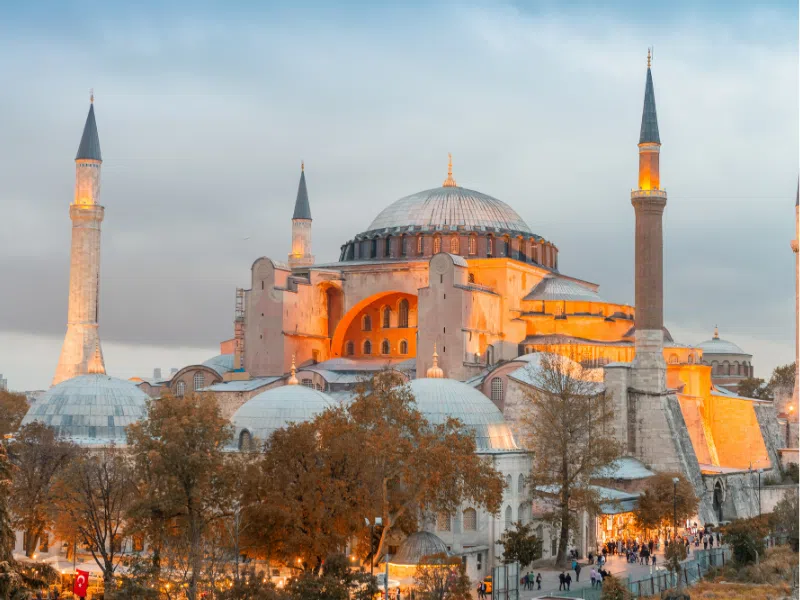
Istanbul spreads across two continents, with the Bosphorus running between its European and Asian sides. For nearly 1,600 years it was an imperial capital, first of the Byzantine and then of the Ottoman Empire, and the layers are everywhere: Roman cisterns under the streets, Byzantine mosaics in former churches and Ottoman domes on the skyline. Here are the facts and stories that make the city special.
10 fun facts about Istanbul
- One city, two continents: the Bosphorus strait divides Istanbul into a European and an Asian side. Commuter ferries cross it all day, and a ride from Eminönü to Kadıköy or Üsküdar is the simplest way to change continents in well under half an hour.
- Three names in one: the city began as the Greek colony of Byzantium, was renamed Constantinople when Emperor Constantine made it his capital in 330, and has officially been called Istanbul since 1930.
- A dome that set records: Hagia Sophia was completed in 537 under Emperor Justinian, after only about five years of building. For nearly a thousand years it was the largest cathedral in the world. It became a mosque in 1453, a museum in 1934 and a mosque again in 2020.
- A palace under the street: the Basilica Cistern was built in 532, also under Justinian, to store water for the Great Palace. Its roof rests on 336 marble columns, and two of them stand on carved Medusa heads, one upside down and one on its side.
- One of the world's oldest covered markets: the core of the Grand Bazaar was built in 1455–56 on the orders of Sultan Mehmed II, soon after he took the city. Today it has 61 covered streets and around 4,000 shops.
- Six minarets, one misunderstanding: the Sultan Ahmed Mosque, known as the Blue Mosque for the blue İznik tiles inside, was built between 1609 and 1616. A popular legend says the sultan asked for golden minarets, altın in Turkish, and the architect heard altı, six.
- The world's second-oldest underground railway: the Tünel, a short funicular from Karaköy up to Beyoğlu, opened in 1875. Only the London Underground is older.
- Home of the sultans: Topkapı Palace was the main residence of the Ottoman sultans for about 400 years, until they moved to Dolmabahçe Palace on the Bosphorus in 1856. It opened as a museum in 1924.
- Tulips came from here: the tulip reached Western Europe from the Ottoman Empire in the 16th century, and the early 18th century, from 1718 to 1730, is still known as the Tulip Era. Every April, the city plants millions of tulips in its parks.
- A city of cats: Istanbul's street cats are fed and sheltered by shopkeepers and neighbours all over town, and starred in the 2016 documentary Kedi.
1453: the ships that crossed a hill
In the spring of 1453, the 21-year-old Sultan Mehmed II laid siege to Constantinople. The defenders had stretched a heavy chain across the mouth of the Golden Horn to keep the Ottoman fleet out of the harbour. Mehmed's answer was to have dozens of ships hauled out of the Bosphorus, dragged overland on greased wooden rollers over the hills behind Galata, and launched again inside the Golden Horn. Now the defenders had to guard the harbour walls as well, and their thin lines were stretched further still. On 29 May 1453 the city fell. The last Byzantine emperor, Constantine XI, died in the fighting, and Mehmed, known ever since as the Conqueror, made the city the capital of his empire.
What to eat in Istanbul
- Simit: a ring of bread crusted with sesame seeds, sold from red street carts and eaten with tea for breakfast.
- Balık ekmek: grilled fish in bread, the classic snack by the water at Eminönü, next to the Galata Bridge.
- Turkish breakfast: a spread of cheeses, olives, tomatoes, honey, kaymak cream and eggs.
- Baklava: layers of thin pastry with pistachios or walnuts, soaked in syrup. Pistachio baklava from Gaziantep is the benchmark.
- Turkish coffee and tea: coffee, on UNESCO's intangible heritage list since 2013, comes thick with grounds left in the cup. Tea, served in small tulip-shaped glasses, is what people drink all day.
Good to know before you go
- Mosques close to visitors for a short time during each of the five daily prayers, and for longer around Friday noon prayers. Cover shoulders and knees, women cover their hair, and shoes come off at the door.
- The Grand Bazaar is closed on Sundays and on public holidays.
- Foreign visitors now enter Hagia Sophia on a separate ticketed route to the upper galleries. Arrangements have changed several times, so check before you go.
- An Istanbulkart travel card works on trams, metro, buses and ferries. For a day trip, ferries also run to the largely car-free Princes' Islands in the Sea of Marmara.
Explore Istanbul with World City Trail
Our Istanbul scavenger hunt turns these sights into a game you play on your phone. The route takes around three hours, with about 60 minutes of walking, and leads you through the main sights of the old city.
At each stop you solve a puzzle and hear a short story, at your own pace. You can start whenever you like.
Play the Istanbul scavenger hunt →
Facts checked in October 2026.