
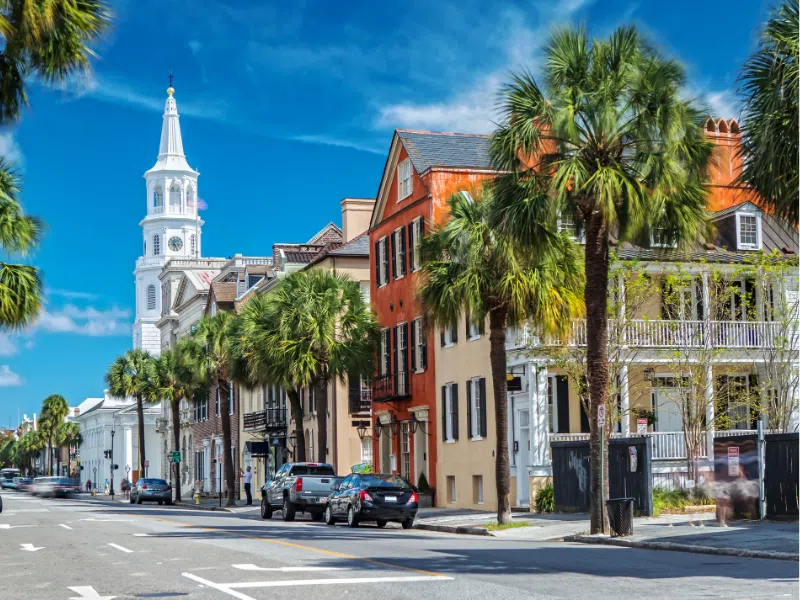
Charleston packs more than three centuries of American history onto a small peninsula between two rivers. Pastel houses, church steeples and gas lamps line streets that saw the first shots of the Civil War, and the city's food and crafts carry a strong West African heritage. Here are the facts and stories that make the city special.
10 fun facts about Charleston
- Named after a king: English colonists founded Charles Town in 1670, in honour of King Charles II, and moved it to its present site on the peninsula in 1680.
- The Holy City: Charleston's nickname comes from the many church steeples on its skyline and from the colony's early tolerance of different faiths.
- Rainbow Row: the 13 houses of Rainbow Row on East Bay Street were not always colourful. The pastel look began in 1931, when Dorothy Porcher Legge painted her house pink and her neighbours followed.
- Houses that stand sideways: the classic Charleston single house is only one room wide, with its narrow end to the street and long side porches, called piazzas, built to catch the sea breeze.
- Bolts from an earthquake: in 1886 an earthquake estimated at around magnitude 7 damaged much of the city. Many houses were braced with iron rods, and the round or star-shaped plates of these earthquake bolts are still visible on their walls.
- A museum older than the nation: The Charleston Museum was founded in 1773 and is widely regarded as the first museum in the United States.
- An early stage: the original Dock Street Theatre opened in 1736 and is often called the first building in America built for theatre. Today's theatre sits inside an early 19th-century hotel and reopened in 1937.
- A submarine first: on 17 February 1864 the Confederate submarine H.L. Hunley sank the USS Housatonic off Charleston, the first submarine to sink an enemy warship. It sank too, and was raised in 2000.
- A dance named after the city: the Charleston, the dance that defined the 1920s, took its name from the 1923 song The Charleston by James P. Johnson.
- Baskets with African roots: Gullah Geechee artisans still weave sweetgrass baskets by hand, a craft brought by enslaved West Africans. You can see them made at the City Market and along Highway 17.
The first shots of the Civil War
In December 1860, South Carolina became the first state to leave the Union. Major Robert Anderson moved his small US Army garrison into Fort Sumter, an unfinished island fort at the mouth of Charleston Harbor. Before dawn on 12 April 1861, Confederate batteries around the harbour opened fire, and Charlestonians watched from rooftops and from the Battery. After about 34 hours of bombardment Anderson surrendered. No one was killed during the shelling itself, yet the attack started a war that would last four years. Fort Sumter is now a national park, reached only by boat.
Gullah Geechee culture, explained
The Gullah Geechee are descendants of enslaved Africans who worked the rice and cotton plantations of the coastal Carolinas and Georgia. Living on isolated Sea Islands, they kept much of their West and Central African heritage, including a creole language, crafts and cooking. Charleston was one of the main ports through which enslaved Africans entered North America, and the International African American Museum, opened in 2023 at Gadsden's Wharf, tells that story where many of them arrived.
What to eat in Charleston
- Shrimp and grits: local shrimp over creamy stone-ground grits, once a fishermen's breakfast and now on almost every menu.
- She-crab soup: a rich, creamy crab soup with crab roe, often finished with a splash of sherry at the table.
- Lowcountry boil: shrimp, sausage, corn and potatoes boiled together and tipped out onto a newspaper-covered table. It is also called Frogmore stew.
- Hoppin' John: black-eyed peas cooked with rice, traditionally eaten on New Year's Day for good luck.
- Benne wafers: thin, crisp cookies made with sesame seeds, which enslaved Africans brought to the Lowcountry.
Good to know before you go
- Fort Sumter can only be reached by the official ferries from Liberty Square downtown or from Patriots Point in Mount Pleasant. Book ahead in busy seasons.
- Summers are hot and humid, and hurricane season runs from June to November. Spring, when the azaleas bloom, and autumn are the most pleasant times to walk.
- Walk along the Battery and through Waterfront Park, with its pineapple fountain, at the end of the day, when the light on the harbour is at its best.
- The historic plantations along the Ashley River make a good half-day trip. Several now give much more attention to the lives of the enslaved people who worked them.
Explore Charleston with World City Trail
Our Charleston scavenger hunt turns these sights into a game you play on your phone. The route links 10 stops and takes around three hours, with about 43 minutes of walking, and passes sights such as The Charleston Museum.
At each stop you solve a puzzle and hear a short story, at your own pace. You can start whenever you like and play in English, German, French, Spanish or Portuguese.
Play the Charleston scavenger hunt →
Facts checked in October 2026.