
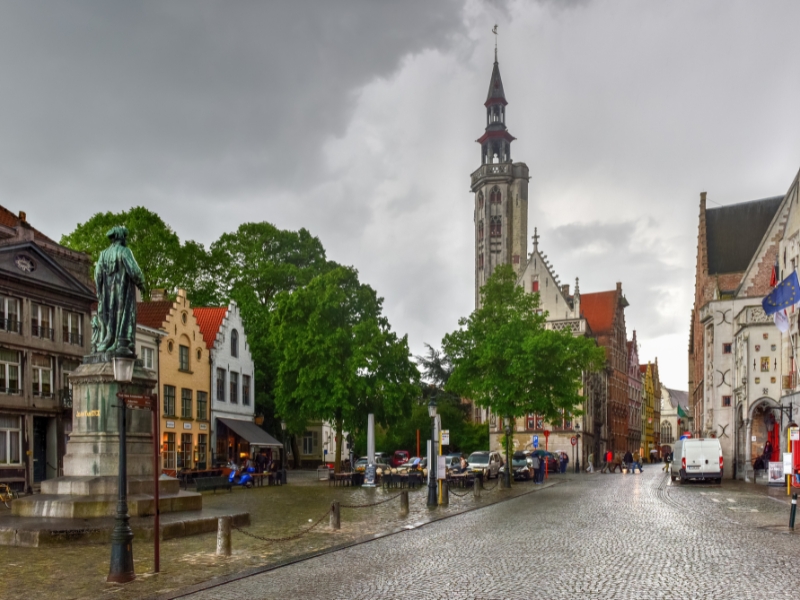
Jan van Eyckplein is a small square at the end of the Spiegelrei canal, a short walk north of the Markt in Bruges. In the Middle Ages this was where ships tied up and goods were taxed, the busiest commercial corner of one of Europe's great trading cities. Today it is quiet, framed by two late-Gothic trade buildings and watched over by a bronze statue of the painter Jan van Eyck.
Jan van Eyckplein at a glance
- Where: where the Spiegelrei canal meets Academiestraat and Spanjaardstraat, a few minutes' walk north of the Markt.
- Created: the open square took shape in the late 18th century, when part of the canal was covered over; the statue of Jan van Eyck was unveiled in 1878.
- What it is today: a quiet square and canal basin with the Poortersloge and the old Tolhuis, the former customs house.
- Time needed: 15 to 20 minutes, a little more if an exhibition is open in the Poortersloge.
The harbour of a merchant city
In the 14th and 15th centuries Bruges was one of the leading trading centres of northern Europe, and this spot at the end of the Spiegelrei was its inner harbour. Boats came in along the canals, cargo was unloaded on the quays, and duty was collected at the Tolhuis. Merchant communities from abroad set up their own houses in the streets nearby, which is why the neighbourhood still has names like Spanjaardstraat, the street of the Spaniards.
The Poortersloge, built between 1395 and 1417, was the club of the city's merchants and patricians; from its slender tower they could watch for their ships. From 1720 to 1890 it housed classrooms of the Bruges Academy of fine arts, which explains the square's old name, Academieplaats. In 1878 the city honoured Jan van Eyck, who lived and worked in Bruges in the 15th century, with a statue in the middle of the square, and it has carried his name ever since.
What to look for
- The statue of Jan van Eyck: about 3.75 metres tall, by the local sculptor Hendrik Pickery, showing the painter of the Ghent Altarpiece.
- The Poortersloge: the late-Gothic merchants' lodge with its slim tower, now used for contemporary art exhibitions.
- The Bear of the Loggia: a small sculpture of a bear in a niche on the Poortersloge, a reminder of the White Bear society that met there and organised tournaments.
- The Tolhuis: the old customs house, with a stone façade rebuilt in 1477 and the coat of arms of Pieter of Luxembourg above its Gothic porch.
- The Pijndershuisje: the narrow house next to the Tolhuis, which belonged to the guild of porters who carried goods off the boats.
Why Jan van Eyck?
Jan van Eyck is the best known of the painters later called the Flemish Primitives. He settled in Bruges around 1430, worked for Duke Philip the Good of Burgundy, and died in the city in 1441. Two of his most famous works, the Madonna with Canon Joris van der Paele and the portrait of his wife Margaret, hang in the Groeninge Museum, so you can see his originals only a short walk from his statue.
Tips for your visit
- Come in the morning: the square catches soft light on the Poortersloge, and the canal is still calm before the tour boats start.
- For the classic photo, stand on the Spiegelrei quay and frame the Poortersloge tower behind the water.
- Walk on along the Spiegelrei and Langerei: these are among the quietest canals in the centre and show a residential side of Bruges.
Nearby
- Markt and the Belfry: the main square and its medieval tower, a few minutes' walk south.
- Burg: the square with the Gothic City Hall and the Basilica of the Holy Blood, close to the Markt.
- St Walburga's Church: a 17th-century Baroque church built by the Jesuits, a short walk east.
- Groeninge Museum: where the paintings of Jan van Eyck himself are on display.
See Bruges with World City Trail
Our Bruges scavenger hunt turns the old town into a game you play on your phone. The route links 10 stops and takes around two hours, with about 24 minutes of walking. Jan van Eyckplein is one of the stops, along with the Belfry and Burg square.
If you prefer a different format, Bruges also has a self-guided walking tour and an outdoor escape game.
Play the Bruges scavenger hunt →
Take the self-guided walking tour of Bruges →
Play the outdoor escape game in Bruges →
Facts checked in October 2026.