
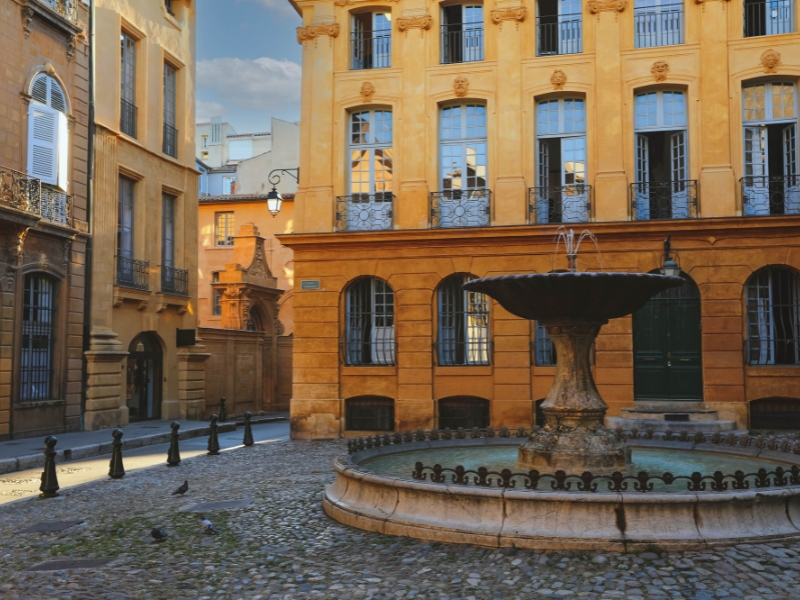
Place d'Albertas is a small, perfectly regular square on the Rue Espariat in the old centre of Aix-en-Provence, with a round fountain in the middle and matching 18th-century façades on three sides. It was not built for the town but for one family: the d'Albertas, who in the 1730s and 1740s bought and demolished the houses opposite their mansion so they could look out on a square modelled on the royal squares of Paris.
Place d'Albertas at a glance
- Where: on the Rue Espariat in the old centre, a few minutes' walk north of the Cours Mirabeau, opposite the Hôtel d'Albertas.
- Built: 1735–1746; Henri Rainaud d'Albertas cleared the site from 1735, and his son Jean-Baptiste completed the square between 1742 and 1746.
- By: the architect Georges Vallon, son of Laurent Vallon, who had designed the façade and entrance of the Hôtel d'Albertas in 1724.
- What it is today: a quiet pedestrian square, protected as a historic monument, used for photos, film shoots and the occasional summer concert.
- Time needed: 10 minutes, a little longer if you sit on the edge of the fountain.
A square built for a view
The d'Albertas were one of the leading families of 18th-century Aix, a city of parliamentarians and nobles who competed to build the finest hôtels particuliers (town mansions). In 1724 Henri Rainaud d'Albertas commissioned the architect Laurent Vallon to design a new front and entrance for his mansion on the Rue Espariat. But the street was narrow and the houses opposite blocked the view. Between 1735 and 1741 Henri bought those houses and had them pulled down, with the idea of creating a square in the spirit of the Parisian places royales, such as the Place Vendôme.
His son Jean-Baptiste d'Albertas carried the project through, entrusting it to Georges Vallon, Laurent's son. Between 1742 and 1746 Vallon built a U-shaped ensemble of uniform façades facing the family mansion across the street, turning the open space into a stage set seen from the d'Albertas windows. The buildings were let as apartments to well-off families. The fountain in the centre was not part of the original design; it was added much later, after the square had stood empty and cobbled for more than a century.
What to look for
- The uniform façades: three sides designed as one composition, with pilasters and wrought-iron balconies, the closest Aix comes to a Parisian royal square.
- The Hôtel d'Albertas across the Rue Espariat: turn your back to the fountain to see the mansion the whole square was built to face.
- The fountain in the middle, with its round basin and jets of water, a later addition that is now inseparable from the picture.
- The pale golden stone, typical of 18th-century Aix, which looks its best in the low light of late afternoon.
A murder and a film set
Jean-Baptiste d'Albertas, who completed the square, came to a violent end: in 1790, during a party at the family estate in Gémenos, near Marseille, he was stabbed by a man named Anicet Martel, who was later publicly executed in Aix. Two centuries on, the square's stage-set look has made it a favourite with film-makers. It appears in the comedy La moutarde me monte au nez, in Retour chez ma mère and in Cézanne et moi, the film about Paul Cézanne and Émile Zola, both of whom grew up in Aix.
Tips for your visit
- Come in the morning, when the square is often almost empty, or in the late afternoon for the warmest light on the façades.
- For the classic photo, stand in the opening on the Rue Espariat side and frame the fountain against the curve of the buildings.
- People live in the apartments around the square: keep your voice down, especially in the evening.
- In summer, listen out for music: small classical and jazz concerts are sometimes held here.
Nearby
- Cours Mirabeau: the broad plane-tree avenue with its fountains and cafés, a few minutes' walk away.
- Place de l'Hôtel de Ville: the square in front of the town hall, overlooked by the clock tower with its astronomical clock and figures of the seasons.
- Cathedral of Saint-Sauveur: the cathedral at the north end of the old town, which mixes Romanesque, Gothic and later styles.
- Musée Granet: the city's main art museum in the Mazarin quarter, with works by Cézanne among its collections.
See Aix-en-Provence with World City Trail
Our Aix-en-Provence scavenger hunt turns the old town into a game you play on your phone. The route takes around 2 hours, with about 43 minutes of walking, through the lanes, squares and fountains of the old centre.
If you prefer a different format, there is also a self-guided walking tour and an outdoor escape game in Aix-en-Provence.
Play the Aix-en-Provence scavenger hunt →
Take the self-guided walking tour of Aix-en-Provence →
Play the outdoor escape game in Aix-en-Provence →
Facts checked in October 2026.