
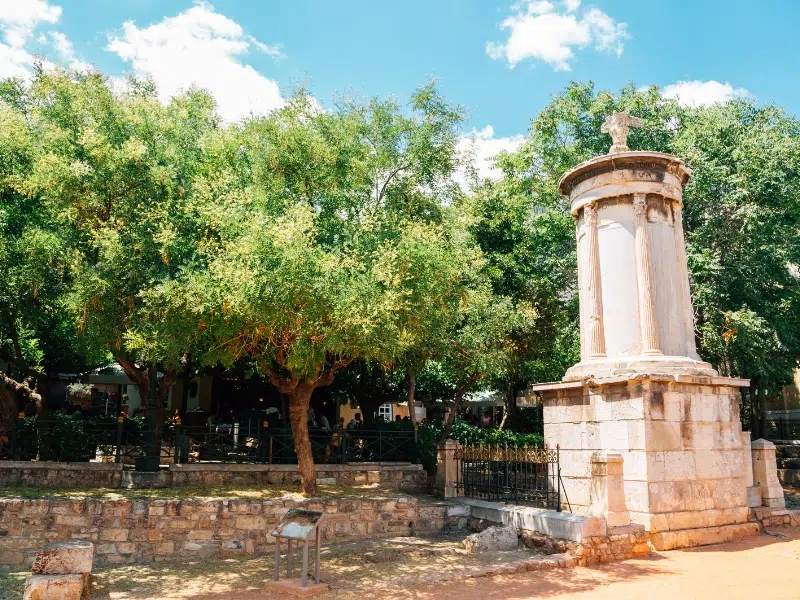
The Choragic Monument of Lysicrates is a small round marble temple on a tall base, standing in a little square in Plaka below the Acropolis. It was built in 335/334 BC by a wealthy Athenian, Lysicrates, to show off the bronze tripod his chorus had won at a music festival, and it is the oldest known building to use Corinthian columns on its outside. Over the centuries it has been a monastery library, a lodging for Lord Byron and a model for monuments from Edinburgh to New York.
The Monument of Lysicrates at a glance
- Where: Lysikratous Square on Tripodon Street in Plaka, a few minutes' walk east of the Acropolis Museum.
- Built: 335/334 BC, the year of Lysicrates' victory.
- By: commissioned by Lysicrates, son of Lysitheides, of the deme of Kikynna; the architect is not known.
- What it is today: an open-air ancient monument in a small fenced square, visible at any time from the street.
- Time needed: 10 to 15 minutes.
A trophy stand for a choir
In ancient Athens, rich citizens acted as choregoi: they paid for a chorus to compete at festivals in honour of Dionysus. The winning sponsor received a bronze tripod, and it was the custom to put it on public display on a monument along the Street of the Tripods, which led to the Theatre of Dionysus. Lysicrates' boys' chorus won the dithyramb contest at the City Dionysia in 335/334 BC, and his monument is the only one along the street that survives almost whole. The inscription on it still names the sponsor, the winning tribe Akamantis, the pipe-player Theon, the trainer Lysiades and the archon Euainetos, which dates it exactly.
In 1658 French Capuchin friars founded a monastery around the monument and later bought it; it ended up as part of their library, and people knew it as the 'Lantern of Demosthenes' or 'Lantern of Diogenes'. Lord Byron stayed at the monastery on his second visit to Greece, and in 1818 one of the friars is said to have planted the first tomatoes in Greece in its garden. The monastery burned during the War of Independence in 1821, and in 1876–1887 French architects cleared and restored the monument.
What to look for
- The Corinthian capitals: the six engaged columns have acanthus-leaf capitals, the first known use of the Corinthian order on the outside of a building.
- The frieze: a band of relief around the top shows Dionysus turning Tyrrhenian pirates into dolphins, a scene from the Homeric Hymn to Dionysus.
- The small tripods: just below the frieze, between the capitals, look for a second band carved with tripods.
- The crowning ornament: the roof is a single marble block topped by a carved floral finial that once supported the bronze tripod.
- The inscription: on the architrave facing the street, the Greek text that names Lysicrates and the members of the winning team.
A monument copied around the world
Two English architects, James Stuart and Nicholas Revett, published accurate drawings of the monument in 1762, and it quickly became a favourite model of the Greek Revival. Versions of it crown the Dugald Stewart Monument and Burns Monument in Edinburgh, the Merchants' Exchange in Philadelphia and the Tennessee State Capitol in Nashville, and it inspired the Soldiers' and Sailors' Monument in New York. Lord Elgin is said to have tried to acquire it, without success, which is why it is still standing in Athens.
Tips for your visit
- Come in the late afternoon or evening, when the square is shaded, the cafés fill up and the marble glows in the low light.
- Walk round the railing: the frieze tells its story all the way around, and different scenes face different streets.
- Combine it with a stroll along Tripodon Street, which follows the line of the ancient Street of the Tripods.
Nearby
- Acropolis Museum: the modern museum at the foot of the Acropolis, with the Parthenon frieze and the Caryatids, a few minutes' walk away.
- Arch of Hadrian: the Roman gateway on Amalias Avenue, marking the border between the old city and the new district built by the emperor.
- Anafiotika: a small quarter of whitewashed island-style houses clinging to the slope of the Acropolis above Plaka.
See Athens with World City Trail
Our Athens scavenger hunt turns the old centre into a game you play on your phone. The route links 10 stops and takes around 2 hours, with about 50 minutes of walking, and it leads around the Acropolis and the Acropolis Museum. You can play in English, German, French, Italian, Spanish, Dutch and Greek.
If you prefer a different format, Athens also has a self-guided walking tour and an outdoor escape game.
Play the Athens scavenger hunt →
Take the self-guided walking tour of Athens →
Play the outdoor escape game in Athens →
Facts checked in October 2026.