
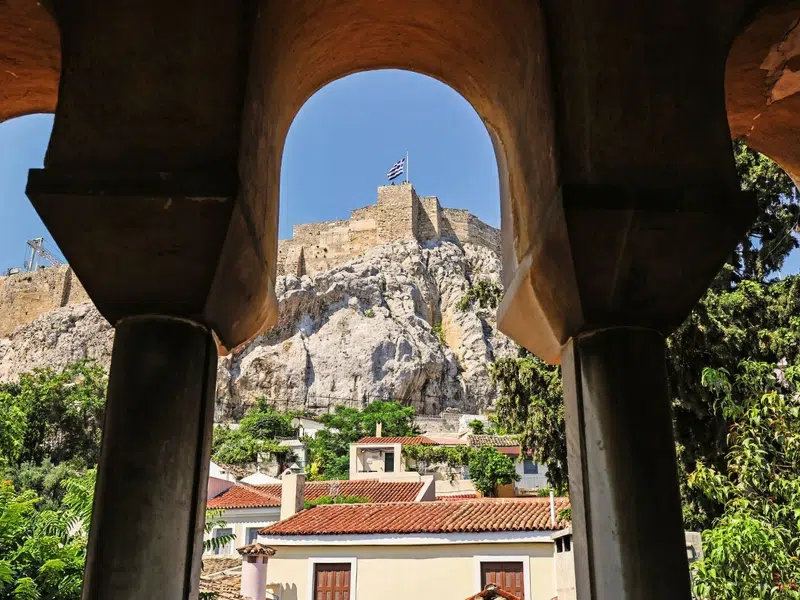
Agios Nikolaos Rangavas is a small Byzantine church in Plaka, on the northern slope of the Acropolis in Athens, built in the 11th century. It is named after the Rangavas family of Byzantine nobles, and an inscription naming a Leon Rangavas was found on one of its dome columns. By tradition, its bell was one of the first to ring out the liberation of Athens from Ottoman rule.
Agios Nikolaos Rangavas at a glance
- Where: Prytaneiou Street in Plaka, where the lanes of Anafiotika begin to climb towards the Acropolis.
- Built: in the 11th century, with later additions in the 17th, 19th and 20th centuries.
- What it is today: a working Orthodox parish church dedicated to St Nicholas, whose feast falls on 6 December, and one of the most important Byzantine monuments in Athens.
- Time needed: 10–15 minutes for the outside, longer if the church is open.
A noble family's church below the Acropolis
The original building is a cross-in-square church with a dome, the standard plan of Middle Byzantine Athens. Tradition links it to the family of the Byzantine emperor Michael I Rangabe, who ruled in 811–813. During restoration work in 1979–1980 an inscription naming Leon Rangavas was found on a column of the dome, and it is considered the best clue to who founded the church. It probably began as the private church of the family's house and later became a parish church.
The church has been damaged and rebuilt many times. A cannonball hit it during the Venetian siege of the Acropolis in 1687, and its east end was rebuilt in the late 17th century. The chapel of Agia Paraskevi was added in 1838, a western hall followed, and the bell tower was built after 1917. The 1979–1980 restoration rebuilt most of the dome and uncovered the original masonry. Lightning damaged the dome again in 2016, and it was repaired in 2019. In December 2025 the Ministry of Culture announced a new project to strengthen the building and conserve its wall paintings, so you may find scaffolding.
What to look for
- The cloisonné masonry: each block of stone framed by thin bricks, the typical building style of Byzantine Athens. The north side shows it best.
- The octagonal dome of the 'Athenian' type, with eight narrow single-light windows and slim marble colonettes at its corners.
- The bell tower at the west end, a 20th-century addition that carries on the story of the liberation bell.
- The chapel of Agia Paraskevi, built onto the old church in 1838, which shows how the building grew with the new Greek state.
- Inside, the wall paintings are not Byzantine: the originals are lost, and what survives is Western in style, from the reign of King Otto in the mid-19th century.
The bell of liberation
Under Ottoman rule church bells in Athens were largely silent. Local tradition says that the bell of Agios Nikolaos Rangavas rang to celebrate when the Ottoman garrison left the Acropolis in the 1830s, and that it rang again on 12 October 1944, when Athens was freed from German occupation. Treat the details as a proud local story rather than a documented record: the present bell tower is much younger, so any bell rung in the 1830s must have hung somewhere else.
Tips for your visit
- The church is often closed outside service times, so plan to see the outside; the masonry and dome are the real highlights anyway.
- If you go in, dress modestly, with shoulders and knees covered, and do not take photos during services.
- Come in the early morning or late afternoon: Plaka's lanes are quieter, and the low light brings out the brick patterns of the walls.
- Continue uphill through Anafiotika to the paths on the northern slope of the Acropolis.
Nearby
- Anafiotika: the little whitewashed quarter built in the 19th century by builders from the island of Anafi, a couple of minutes' climb away.
- Museum of Paul and Alexandra Kanellopoulos: a private collection of Greek art from prehistory to Byzantium in a mansion at the foot of the Acropolis, a few minutes' walk away.
- Roman Agora and Tower of the Winds: the Roman market and its octagonal marble clock tower, a short walk down through Plaka.
- Choragic Monument of Lysicrates: a small round monument from the 4th century BC, put up to celebrate a theatre prize, a short walk east.
See Athens with World City Trail
Our Athens scavenger hunt turns the streets below the Acropolis into a game you play on your phone. The route links 10 stops and takes around 2 hours, with about 50 minutes of walking, around the Acropolis and the Acropolis Museum. You can play in English, German, French, Italian, Spanish, Dutch and Greek.
If you prefer a different format, there is also a self-guided walking tour and an outdoor escape game in Athens.
Play the Athens scavenger hunt →
Take the self-guided walking tour of Athens →
Play the outdoor escape game in Athens →
Facts checked in October 2026.