
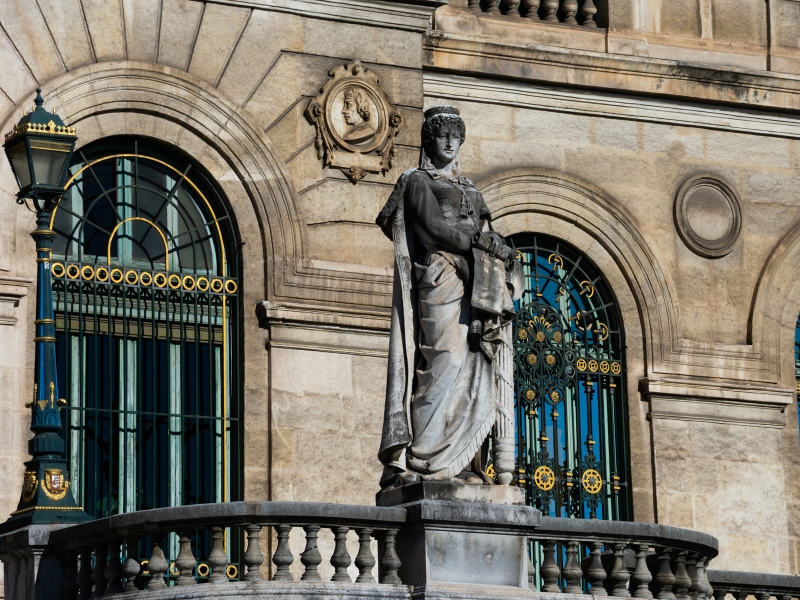
Bilbao City Hall is the grand seat of the city council on the right bank of the Nervión estuary, at the end of the City Hall Bridge. It opened in 1892, designed by the municipal architect Joaquín Rucoba in an eclectic style inspired by the public buildings of France's Third Republic. Its most famous room, the Arab Hall, is decorated in a Neo-Mudéjar style that recalls the Alhambra in Granada.
Bilbao City Hall at a glance
- Where: on the right bank of the estuary, at the Uribarri end of the Puente del Ayuntamiento, next to Plaza Ernesto Erkoreka.
- Built: 1883–1892; inaugurated on 17 April 1892.
- By: Joaquín Rucoba, Bilbao's municipal architect, who also designed the Teatro Arriaga.
- What it is today: the working seat of Bilbao City Council; most visitors see the façade and the riverside setting from outside.
- Time needed: 15 minutes for the façade, the bridge and the sculpture beside it.
From flooded town halls to a riverside palace
The current building is the fourth town hall in Bilbao's history. The first, built in 1535 opposite the church of San Antón in the old town, was destroyed by floods in 1553; its replacement on the same site was swept away by another flood in 1593, and a third was eventually built in the 17th century. By the late 19th century industrialisation had transformed Bilbao, and the council needed a building that matched the booming city and stood outside the cramped Casco Viejo.
The site chosen was that of the Convent of San Agustín, left in ruins after the First Carlist War. Work began in 1883 and took nine years. The inauguration on Sunday 17 April 1892 was marked by a banquet; the councillors first held a final meeting in the old town hall and then walked together to the new building. Between 2008 and 2011 a modern municipal building, the San Agustín offices, was added behind it to house many city departments.
What to look for
- The central axis of the façade, with the main balcony, three arches on eight columns, and a bell tower on top.
- Five relief portraits of figures from Bilbao's history, including the city's founder Diego López V de Haro and Admiral Juan Martínez de Recalde.
- The four statues flanking the building, two mace-bearers and two heralds, and the figures of Law and Justice on the main staircase.
- The fifth step of the staircase, which tradition says marks Bilbao's official height above sea level.
- The sculpture by Jorge Oteiza in Plaza Ernesto Erkoreka next to the building, a work by one of the great Basque sculptors of the 20th century.
The Arab Hall
Inside, the city hall has three main rooms: the reception hall, the council chamber and the entrance hall with its staircase. The reception hall, known as the Arab Hall, was decorated in a Neo-Arabic or Neo-Mudéjar style, with patterns that recall the Alhambra, while the other two rooms are Neo-Renaissance. Artists from Bilbao, the rest of Spain and abroad worked on the interiors; the furniture came from Bordeaux and some of the lamps from Paris. The Arab Hall is used for official receptions and civil weddings.
Tips for your visit
- The best view of the whole façade is from the Campo Volantín promenade or from the far end of the City Hall Bridge.
- Come in the late afternoon, when the low sun lights up the front of the building and the river.
- The building is a working city hall; ask the city about any open days or guided visits if you want to see the Arab Hall.
Nearby
- Zubizuri: Santiago Calatrava's white footbridge over the estuary, a short walk downstream along Campo Volantín.
- Teatro Arriaga: Bilbao's opera house, also by Rucoba, across the river at the edge of the old town.
- Casco Viejo: the medieval Seven Streets, the church of San Antón and the Ribera market, a few minutes' walk upstream.
- Guggenheim Museum: Frank Gehry's titanium museum, reached by a pleasant walk along the river.
See Bilbao with World City Trail
Our Bilbao scavenger hunt turns the city into a game you play on your phone. The route links 10 stops and takes around three hours, with about 52 minutes of walking. It includes places such as Doña Casilda Iturrizar Park, the Guggenheim Museum and the Zubizuri bridge. You can play in English, German, French, Italian, Spanish or Dutch.
If you prefer a different format, Bilbao also has a self-guided walking tour and an outdoor escape game.
Play the Bilbao scavenger hunt →
Take the self-guided walking tour of Bilbao →
Play the outdoor escape game in Bilbao →
Facts checked in October 2026.