
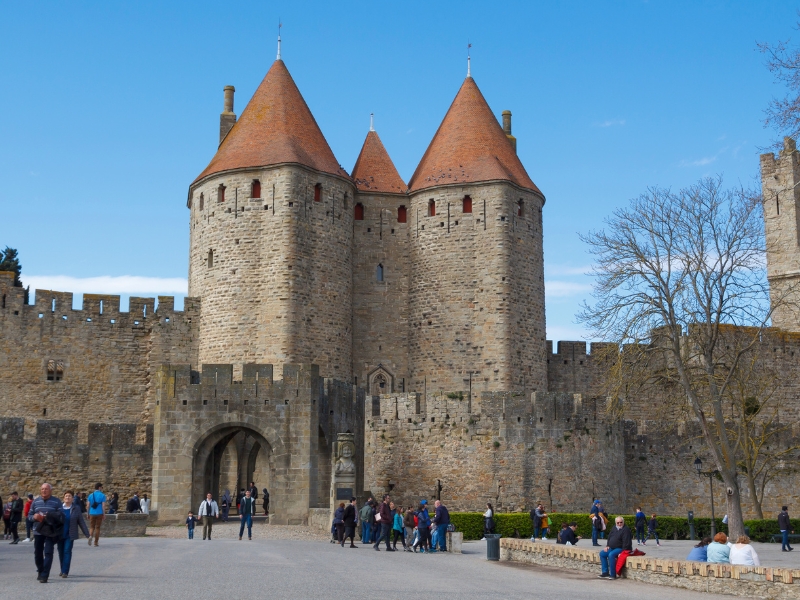
The Porte Narbonnaise is the main gate of the Cité, the walled medieval town on the hill above Carcassonne. It faces east, towards the road to Narbonne, which gave it its name, and it is the gate most visitors walk through first. Two massive towers, a dry moat and a double line of walls show how hard the French crown made it for any army to get in.
The Porte Narbonnaise at a glance
- Where: on the east side of the Cité de Carcassonne, at the end of the approach from the car parks and the lower town.
- Built: around 1280, under King Philip III of France, when the crown strengthened the fortress after taking it over in the 13th century; heavily restored in the 19th century.
- What it is today: the main pedestrian entrance to the Cité, part of the fortified city listed by UNESCO as a World Heritage Site in 1997.
- Time needed: 15 to 20 minutes to look at the gate and the moat, longer if you walk the lices between the two walls.
From royal frontier gate to restored entrance
Carcassonne was a stronghold of the Trencavel viscounts until the Albigensian Crusade, when crusaders took it in 1209. In 1247 the city submitted to the kingdom of France, and under the 1258 Treaty of Corbeil it became a border fortress facing the Crown of Aragon. Louis IX and his son Philip III built the outer ring of walls, and the Porte Narbonnaise was designed as the strongest point of the system: the place where an attacker would most likely try, and where he would meet the most obstacles.
After the Treaty of the Pyrenees moved the border south in 1659, the fortress lost its purpose and fell into neglect. In the 19th century the architect Eugène Viollet-le-Duc led a long restoration of the Cité, beginning in 1853; the towers of the Porte Narbonnaise were among the first parts he worked on. Much of what you see, especially the pointed slate roofs, reflects his ideas of how a medieval fortress should look, which has been debated ever since.
What to look for
- The two towers: tall, rounded on the outside and flat on the side facing the town, with slits for crossbows in the lower rooms. A large guard room links them above the archway.
- The approach: you cross a bridge over the dry moat to the outer gate, then pass through the outer wall before reaching the main gate itself. Each step was meant to slow an enemy down.
- The defences of the archway: grooves for portcullises and openings above the passage, from which defenders could drop missiles on anyone forced into the gateway.
- The statue of the Virgin in a niche above the entrance, which greets everyone who walks in.
- The bust of Dame Carcas on a column outside the gate, a 19th-century sculpture linked to the town's most famous legend.
The legend of Dame Carcas
According to a legend, Charlemagne besieged the city for years while it was held by a Saracen princess called Carcas. When food ran out, she fed the last grain to a pig and threw it over the walls. Seeing such a well-fed animal, the besiegers concluded that the city could hold out for ever and lifted the siege, and bells rang out: "Carcas sona", Carcas rings. It is a good story but not history; historians treat it as a later invention, and the town's name is much older.
Tips for your visit
- Come early in the morning or in the early evening: during the day in summer the gate is the busiest bottleneck of the Cité.
- For the best photo of both towers, step back to the bridge over the moat; the gate is also striking when floodlit after dark.
- Before going in, turn left or right into the lices, the open strip between the outer and inner walls, to see the ramparts from below.
- The cobbles inside are uneven and the slope up from the lower town is steep, so wear good shoes.
Nearby
- Château Comtal: the castle inside the Cité, from which you can walk part of the ramparts; it is only a few minutes' walk from the gate.
- Basilica of Saint-Nazaire: Romanesque nave and Gothic choir with fine stained glass, at the far end of the Cité.
- Porte d'Aude: the western gate, reached by a steep path from the river, with good views of the lower town.
- Pont Vieux: the medieval bridge over the Aude, the classic viewpoint for the whole silhouette of the Cité.
See Carcassonne with World City Trail
Our Carcassonne scavenger hunt turns the old town into a game you play on your phone. The route links 10 stops and takes around two hours, with about 46 minutes of walking. It includes places such as the Cité and its ramparts and the Basilica of Saint-Nazaire.
If you prefer a different format, Carcassonne also has a self-guided walking tour and an outdoor escape game.
Play the Carcassonne scavenger hunt →
Take the self-guided walking tour of Carcassonne →
Play the outdoor escape game in Carcassonne →
Facts checked in October 2026.