
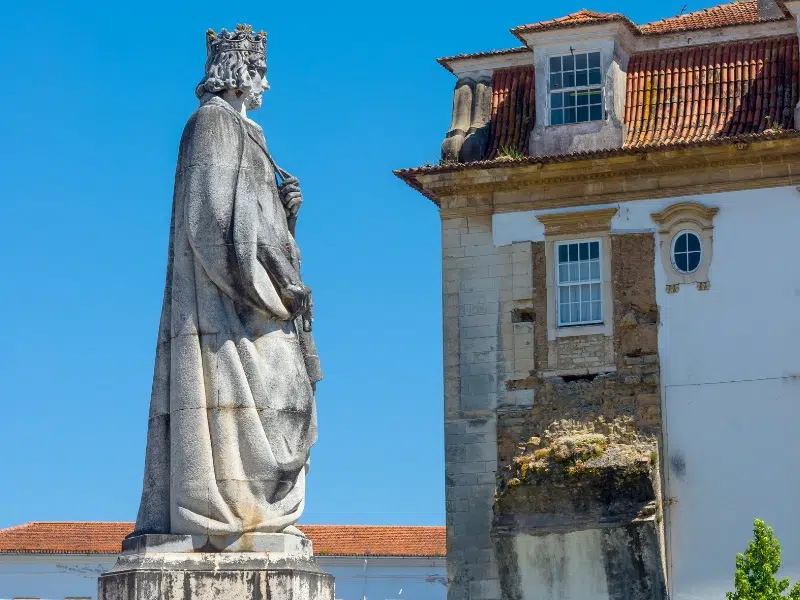
Praça Dom Dinis is the square at the top of Coimbra's hill, where the Monumental Stairs arrive in the university quarter. A bronze statue of King Dinis, who founded Portugal's first university in 1290, stands among the faculty buildings of the 1940s–1960s. Few people crossing it know that this is where Coimbra's castle stood until the 18th century.
Praça Dom Dinis at a glance
- Where: at the top of the Alta (upper town), on the edge of the University of Coimbra campus, at the head of the Monumental Stairs.
- Created: in its present form during the building of the University City between 1942 and 1969; the statue was unveiled in 1943.
- By: the statue is by the Portuguese sculptor Francisco Franco (1885–1955), not to be confused with the Spanish dictator.
- What it is today: a busy student square and the gateway to the university, part of the UNESCO World Heritage Site “University of Coimbra – Alta and Sofia” since 2013.
- Time needed: 15–20 minutes, longer if you walk down the stairs and back.
From castle hill to University City
The highest point of Coimbra was fortified for centuries. The castle was probably built in the 11th century under Sesnando, the first governor after the Christian conquest, and later had a keep with a cistern and a five-sided tower, the Tower of Hercules, built by King Sancho I. In 1773 demolition began to make room for an astronomical observatory for the university. That project was abandoned because of the steep slope, but the castle was never rebuilt, and its site became the open ground you stand on now.
The square took its present look under the Estado Novo dictatorship. From 1942 the government rebuilt the upper town as a monumental University City, with new buildings for the faculties of mathematics, letters, medicine, physics and chemistry, the general library and the university archives. Much of the old residential and commercial quarter was demolished, along with the last arch of the aqueduct. The work took 27 years and was finished in 1969, the same year the Monumental Stairs became one of the sites of large student protests against the regime.
What to look for
- The statue of King Dinis: the bronze king who gave the square its name. He founded the university, the Estudo Geral, in Lisbon in 1290; it moved to Coimbra in 1308 and settled here for good in 1537.
- The Monumental Stairs: 125 steps leading down from the square towards the student canteens. They replaced an older, smaller tree-lined staircase.
- The Estado Novo architecture: tall, severe stone façades with large statues and reliefs, designed to look powerful. Compare them with the older university buildings around the Porta Férrea.
- The Colégio de São Jerónimo: one of the few older buildings that survived the demolitions, a 16th-century college beside the stairs.
- The remains of the aqueduct: part of the 16th-century São Sebastião aqueduct still stands near the stairs, a reminder of the city before the rebuilding.
The king behind the statue
Dinis ruled Portugal from 1279 to 1325 and is remembered as a poet king and a builder. Besides founding the university, he made Portuguese the language of the royal court and of official documents, and he is known for promoting agriculture and planting the pine forest of Leiria. Students crossing his square on the way to class pass a king who believed the country needed its own place of learning, though the university only settled in Coimbra for good more than two centuries after his death.
Tips for your visit
- Come during term time on a weekday morning to see the square full of students, sometimes wearing the traditional black academic cape.
- If you arrive from the lower town, climb the Monumental Stairs instead of the side streets: it is the most dramatic way into the university quarter.
- Wear good shoes: the Alta is steep and the cobbles can be slippery after rain.
Nearby
- Porta Férrea: the 17th-century gate into the Paço das Escolas, the old royal palace that became the centre of the university, a few minutes' walk away.
- Biblioteca Joanina: the baroque university library inside the Paço das Escolas, one of the best reasons to visit Coimbra; tickets are timed, so book ahead.
- Sé Nova: the New Cathedral, a former Jesuit church a short walk down the hill.
- Machado de Castro National Museum: built over the Roman cryptoporticus of Aeminium, with excellent sculpture and views over the city.
See Coimbra with World City Trail
Our Coimbra scavenger hunt turns the old town into a game you play on your phone. The route links 10 stops and takes around 2 hours, with about 37 minutes of walking. It includes the Santa Cruz Church and Praça do Comércio in the lower town. You can play in English, German, French, Italian, Spanish, Dutch or Portuguese.
If you prefer a different format, there is also a self-guided walking tour and an outdoor escape game in Coimbra.
Play the Coimbra scavenger hunt →
Take the self-guided walking tour of Coimbra →
Play the outdoor escape game in Coimbra →
Facts checked in October 2026.