
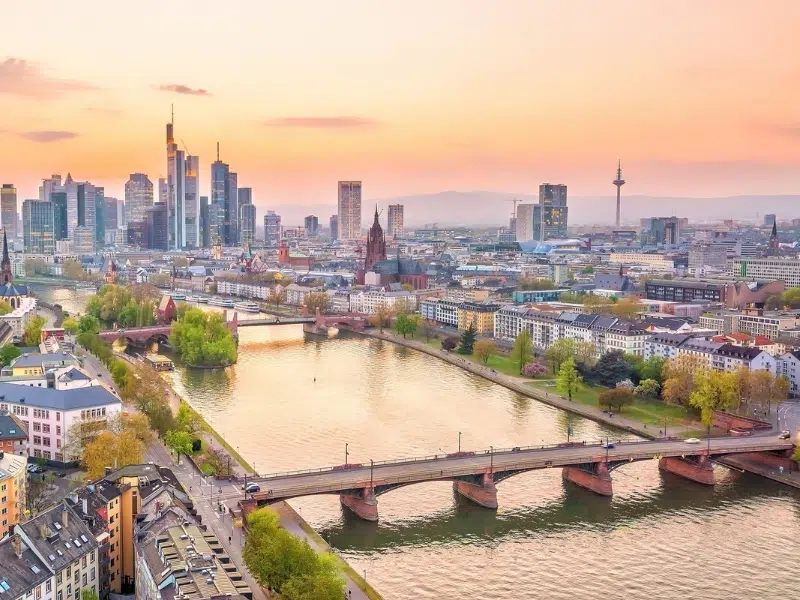
The Alte Brücke (Old Bridge) is Frankfurt's oldest river crossing, linking the old town with Sachsenhausen across the Main. For centuries it was the only bridge in the city, and on a pole above its middle still stands a small golden rooster, the Brickegickel, tied to one of Frankfurt's best-known legends.
The Alte Brücke at a glance
- Where: between the Fahrgasse in the old town and the Brückenstraße in Sachsenhausen, a few minutes' walk south-east of the cathedral.
- Built: first recorded in 1222; the present bridge is the 1926 structure, rebuilt after 1945 and reopened in its current form in 1965.
- What it is today: a road and pedestrian bridge about 237 metres long, with wide walkways, the Maininsel island and the Portikus art hall halfway across.
- Time needed: 15 minutes to walk across and back; longer if you stop for the view or an exhibition.
Eight centuries on the Main
A crossing existed here by the late 12th century, and a cathedral document of 1222 is the first record of the bridge. In the Middle Ages it was the city's lifeline: in 1235 King Henry (VII) set aside coin revenue and timber from the royal forest of Dreieich for its upkeep. Floods and ice tore parts of it away in 1306 and 1342, and in the early 15th century ten of its thirteen arches and both towers were rebuilt, probably under the master builder Madern Gerthener. A large mill was built against the bridge in 1411, and mills stood here in some form until 1914.
By the 20th century the narrow medieval bridge could no longer cope. It was closed in 1914 and replaced by a new bridge with eight arches, opened on 15 August 1926 after a long pause during the First World War. On 26 March 1945 the retreating Wehrmacht blew up two central arches. A provisional steel section reopened in 1947, and in 1965 the bridge was rebuilt again. A refurbishment in 2014 added sandstone parapets, new lighting and space for cyclists and pedestrians.
What to look for
- The Brickegickel: the golden rooster on a tall pole near the middle of the bridge. The current bronze rooster, covered in gold, dates from 1994.
- The statue of Charlemagne: a copy of the red sandstone figure that stood on the bridge from 1843, placed here in 2016. The original is in the Historical Museum.
- The Portikus: a small art hall with a steep roof on the Maininsel, designed by Christoph Mäckler and opened in 2006, which you reach from the bridge.
- The view upstream and downstream: the skyline of the banking district to the west, the cathedral tower behind you and the Sachsenhausen embankment ahead.
- The sandstone parapets from the 2014 renovation, which echo the colour of the old town's buildings.
The legend of the golden rooster
The Brothers Grimm recorded the tale. The master builder could not finish the bridge on time and made a pact with the devil: the devil would complete it, and in return take the first soul to cross. When the bridge was done, the builder sent a rooster across first. Furious, the devil tore the bird apart and hurled it through the bridge, leaving two holes that could never be closed. The rooster on the pole is said to remember the trick; in reality a crucifix with a golden rooster on top was set up in 1401 to mark the deepest point of the river.
Tips for your visit
- Cross at sunset for the best light on the skyline to the west, then walk back along the riverbank.
- The bridge carries traffic: stay on the walkways and watch for cyclists on the shared paths.
- Look up near the middle of the bridge for the rooster: it sits high on its pole and is easy to miss.
- Combine the bridge with the Römerberg and the cathedral on the north bank, and Sachsenhausen's apple wine taverns on the south side.
Nearby
- Frankfurt Cathedral: the red sandstone church where emperors were crowned, a few minutes' walk north.
- Römerberg: the old town square with the town hall and its rebuilt half-timbered houses.
- Eiserner Steg: the iron footbridge just downstream, with views back to the Alte Brücke.
- Museumsufer: the line of museums along the Sachsenhausen bank, including the Städel art museum.
See Frankfurt with World City Trail
Our Frankfurt scavenger hunt turns the old town into a game you play on your phone. The route links 10 stops and takes around two hours, with about 24 minutes of walking, and it includes places such as the Römerberg.
If you prefer a different format, Frankfurt also has a self-guided walking tour and an outdoor escape game.
Play the Frankfurt scavenger hunt →
Take the self-guided walking tour of Frankfurt →
Play the outdoor escape game in Frankfurt →
Facts checked in October 2026.