
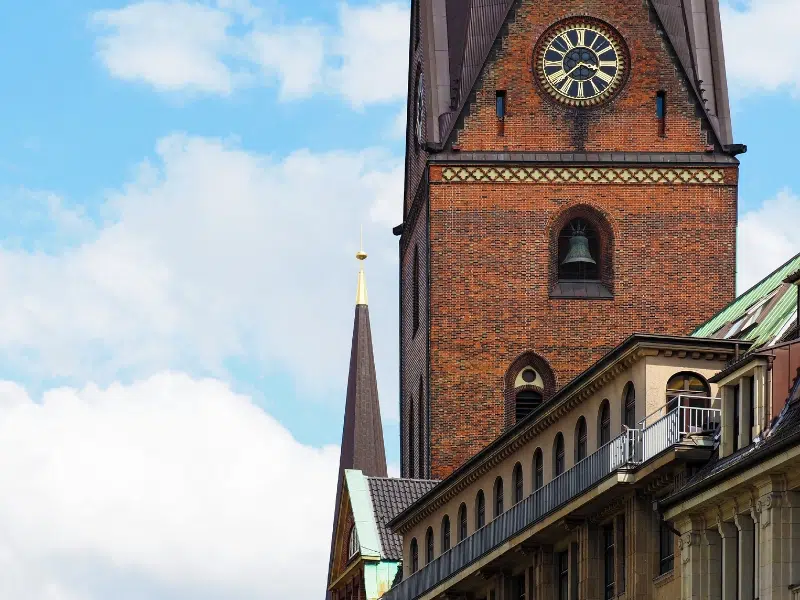
St Peter's Church, the Hauptkirche St. Petri, is the oldest of Hamburg's five main Lutheran churches and stands a couple of minutes from the Town Hall, on the low hill where Hamburg's first settlement grew up. The building you see is mostly a reconstruction after the Great Fire of 1842, but on its west door you can still grab a bronze lion's head made when the medieval tower was begun in 1342.
St Peter's Church at a glance
- Where: between Mönckebergstraße and Speersort in the Altstadt, a short walk east of the Rathausmarkt.
- Built: first recorded in 1195 as the market church; the Gothic hall church was begun around 1310, and the present neo-Gothic building was consecrated in 1849, seven years after the Great Fire. The 132-metre tower was completed in 1878.
- By: the rebuilding after 1842 was designed by Alexis de Chateauneuf and Hermann Peter Fersenfeldt; the copper spire follows plans by Johann Hermann Maack.
- What it is today: a working Lutheran parish church, with services, concerts and a tower you can climb.
- Time needed: 20–30 minutes for the church, about an hour if you also climb the tower.
From market church to fire and rebuilding
A wooden chapel probably stood here by the early 11th century, and in 1195 the church appears in records as the ecclesia forensis, the market church. From about 1310 the citizens, growing rich on trade, rebuilt it as a three-aisled brick Gothic hall church. Its tower was begun in 1342, and between 1513 and 1516 it received a new copper spire 127.5 metres high, for a short time the tallest in the city. After the neighbouring cathedral was demolished in 1804–07, St. Petri became the city's oldest surviving church. During the French occupation it was among the churches Napoleonic troops used as a stable.
On 7 May 1842 the Great Fire destroyed almost the whole medieval building; only parts of the north wall, the lower floors of the tower and some of the apse survived. Most of the artworks, including the lion-head door handle, were rescued. The church was rebuilt on the same site and to the same basic plan, reopening in 1849. In the 20th century the old town turned into a business district and the parish lost most of its residents, but the church came through the bombing raids of 1943 almost undamaged.
What to look for
- The bronze lion-head door handle on the left wing of the west portal, dating from 1342 and often called Hamburg's oldest surviving work of art.
- The statue of St Ansgar, the 'Apostle of the North', on a column in the choir, carved by the Lübeck master Bernt Notke around 1480–83.
- A Gothic wall painting of Ansgar from about 1460 in the north part of the church.
- The painting 'Christmas 1813 in St. Petri' on a column in the south aisle, recalling the citizens who were locked in the church by French soldiers.
- Outside, at the north-east end of the choir, Fritz Fleer's bronze statue of Dietrich Bonhoeffer, unveiled in 1979, showing the theologian in prison clothes with his hands bound.
Climbing the tower
The tower is one of Hamburg's lesser-known viewpoints. A staircase of 544 steps leads up to about 123 metres, where small round windows like portholes look out over the Town Hall, the Binnenalster and the harbour cranes. It is a real climb with no lift, but you are rewarded with a view that the crowds at the Elbphilharmonie or St Michael's never see.
Tips for your visit
- Try the lion's head yourself: it is a working door handle, not a museum piece behind glass.
- Climb the tower on a clear day; the porthole windows are small, so haze ruins the view more than elsewhere.
- Respect services and concerts; check the church's own website before you go if you want to visit at a particular time.
- Combine it with the Town Hall and the Domplatz, all within a few minutes' walk.
Nearby
- Hamburg Town Hall: the neo-Renaissance Rathaus with its courtyard fountain, a couple of minutes west.
- Domplatz: the open square where Hamburg's medieval cathedral and the early Hammaburg once stood, just south of the church.
- St. Jacobi: another of the five main churches, a few minutes east, known for its Arp Schnitger organ.
- Mönckebergstraße: the main shopping street, running past the north side of the church towards the central station.
See Hamburg with World City Trail
Our Hamburg scavenger hunt turns the old town into a game you play on your phone. The route links 10 stops and takes around 3 hours, with about 64 minutes of walking. It includes the Town Hall, the Elbphilharmonie and St Michael's Church. You can play in English, German, French, Italian, Spanish, Dutch and Polish.
If you prefer a different format, Hamburg also has a self-guided walking tour and an outdoor escape game.
Play the Hamburg scavenger hunt →
Take the self-guided walking tour of Hamburg →
Play the outdoor escape game in Hamburg →
Facts checked in October 2026.