
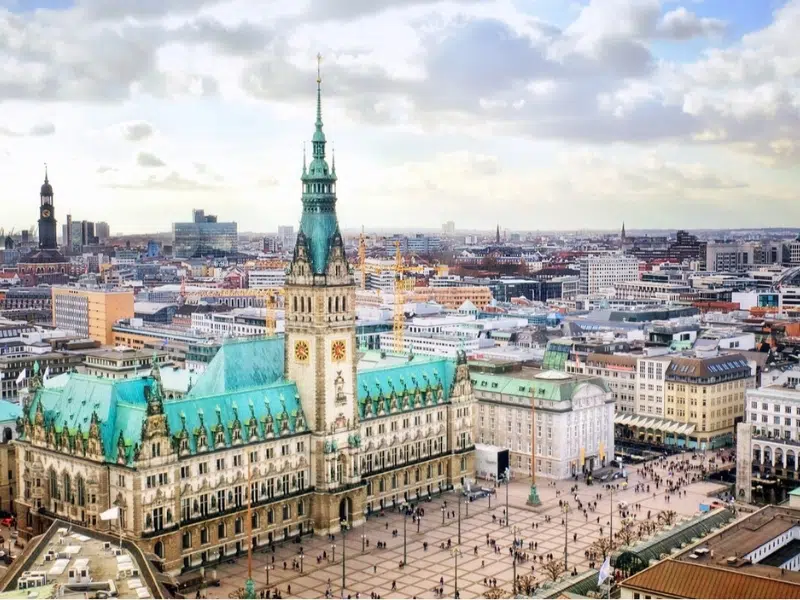
Hamburg Town Hall (Rathaus) is the sandstone palace on the Rathausmarkt where the city-state's parliament and its government both meet. It was built between 1886 and 1897, more than four decades after the old town hall was lost in the Great Fire of 1842. Behind the facade are 647 rooms, and the whole building stands on more than 4,000 oak piles driven into Hamburg's marshy ground.
Hamburg Town Hall at a glance
- Where: on the Rathausmarkt in the Altstadt, beside the Alsterarkaden and a few minutes from the Binnenalster.
- Built: 1886–1897; the first stone was laid on 6 May 1886 and the building was inaugurated on 26 October 1897.
- By: a group of seven Hamburg architects led by Martin Haller.
- What it is today: the seat of the Hamburg Parliament (Bürgerschaft) and the Senate, the city-state's government. The entrance hall and the inner courtyard are open to the public; the state rooms can be seen on guided tours.
- Time needed: 15–20 minutes for the facade, the hall and the courtyard; about an hour with a guided tour.
From the Great Fire to a new town hall
Hamburg's medieval town hall stood by the Trostbrücke from around 1290. In May 1842 the Great Fire swept through the old town, and the town hall was blown up in an attempt to stop the flames. It did not work. After the fire the city was replanned, and the Rathausmarkt and the arcades along the Alster were laid out, inspired by Venice. Finding a design for a new town hall, though, took decades, and the government worked in temporary quarters in the meantime.
In 1886 the first stone was finally laid for a design by a team of architects under Martin Haller, in a richly decorated Neo-Renaissance style. The central tower rises 112 metres above the square. A few years before the building was finished, in 1892, a cholera epidemic spread through the city's drinking water and killed more than 8,600 people. The fountain in the inner courtyard was built in its memory.
What to look for
- The 20 statues of emperors of the Holy Roman Empire between the windows of the main facade, from Charlemagne to Francis II.
- The Latin motto above the main entrance: 'Libertatem quam peperere maiores digne studeat servare posteritas' – roughly, may posterity strive to preserve with dignity the freedom their ancestors won.
- The entrance hall (Rathausdiele), with 16 sandstone columns decorated with 68 portraits of notable Hamburg citizens. It often hosts free exhibitions.
- The Hygieia Fountain in the inner courtyard: a bronze figure of the Greek goddess of health, a memorial to the cholera epidemic of 1892.
- On a tour: the Great Festival Hall, 46 metres long, with five large history paintings and three chandeliers that each weigh 1.5 tonnes.
The phoenix over the fireplace
One of the state rooms is called the Phoenix Hall, after the phoenix rising from the flames over its fireplace. It stands for Hamburg's recovery after the fire of 1842, the disaster that destroyed the old town hall in the first place. The building also hosts one of the city's oldest traditions: the Matthiae-Mahl, a formal banquet held by the Senate every year in the Great Festival Hall, a custom that goes back to the 14th century.
Tips for your visit
- Guided tours run in German, English and French and last about an hour. They are not held during official events, so check the schedule before you go.
- Walk through the main entrance and the hall to the inner courtyard: it is quieter than the square and the best place to see the Hygieia Fountain.
- For a photo of the whole facade and the tower, stand on the far side of the Rathausmarkt, or look across the Alster canal from the Alsterarkaden.
- Come back after dark, when the facade is lit up. In December the Rathausmarkt hosts one of the city's Christmas markets.
Nearby
- Alsterarkaden: the white arcades along the canal next to the town hall, with shops and cafés, laid out after the 1842 fire.
- Binnenalster and Jungfernstieg: the inner Alster lake and its promenade, a few minutes' walk north, with the Alster fountain and boat trips.
- St. Nikolai Memorial: the ruined tower of a church destroyed in the bombing of 1943, now a memorial to the victims of war, with a lift up the tower.
- St Michael's Church: Hamburg's best-known church, with a viewing platform in its tower, a longer walk west through the city centre.
See Hamburg with World City Trail
Our Hamburg scavenger hunt turns the city centre into a game you play on your phone. The route links 10 stops and takes around 3 hours, with about 64 minutes of walking. The Town Hall is one of the stops, along with the Elbphilharmonie and St Michael's Church. You can play in English, German, French, Italian, Spanish, Dutch or Polish.
If you prefer a different format, there is also a self-guided walking tour and an outdoor escape game in Hamburg.
Play the Hamburg scavenger hunt →
Take the self-guided walking tour of Hamburg →
Play the outdoor escape game in Hamburg →
Facts checked in October 2026.