
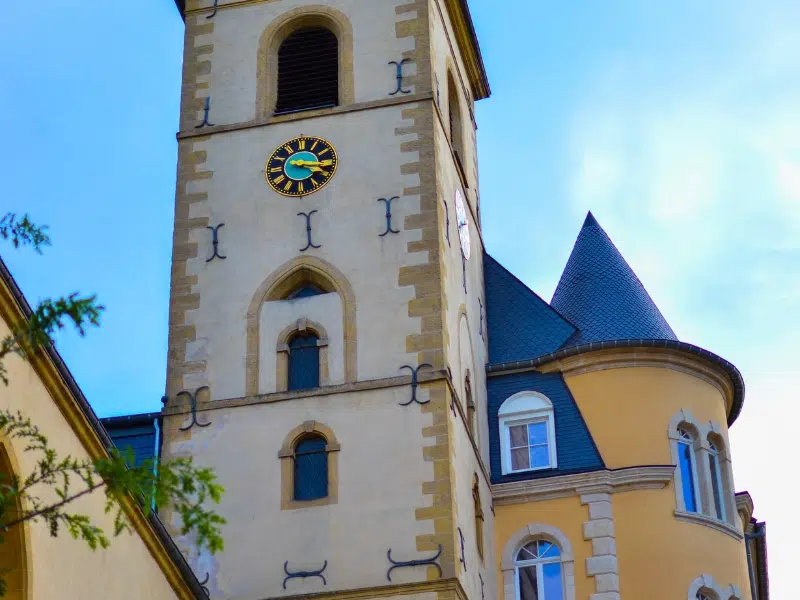
Saint Michael's Church (Église Saint-Michel, Méchelskierch in Luxembourgish) stands on the Fish Market, the oldest corner of Luxembourg City's old town. It is the oldest religious site in the city: a chapel for the Counts of Luxembourg stood here as early as 987. The building you see today was rebuilt again and again after fires and sieges, and its present look dates mostly from 1688.
Saint Michael's Church at a glance
- Where: on the Fish Market (Marché-aux-Poissons), at the corner of rue Sigefroi, in the Ville Haute a few steps above the Bock promontory.
- Built: on the site of a castle chapel from 987; the present late Gothic church was rebuilt after a fire in 1509 and given its present Baroque look in 1687–1688.
- What it is today: a working Catholic parish church and, since July 2024, the church of the Luxembourg lieutenancy of the Order of the Holy Sepulchre of Jerusalem.
- Time needed: 15–20 minutes inside, a little longer if you also explore the Fish Market around it.
From castle chapel to parish church
The story starts with Count Siegfried, who acquired the Bock rock in 963 and founded the castle that grew into Luxembourg City. By 987 a chapel for the counts stood on this spot, with several altars, one of them dedicated to Saint Michael. The name of the archangel became the name of the church, and by the early 14th century it served a parish. A fire in 1509 burned through the neighbourhood, and the church was rebuilt in the late Gothic style by 1519.
Luxembourg was one of the most fought-over fortresses in Europe, and the church paid for it. Dominican friars took it over in the 1630s and extended it, but fire destroyed their tower in 1679, and French troops wrecked the choir during Louis XIV's siege of 1683–1684. The French rebuilt it in 1687–1688, which is when the church took the shape you see today. During the French Revolution the friars were expelled and the furnishings were sold or destroyed in 1798; the parish got its church back in 1803. Restorations followed in the 1960s, the 1980s and in 2003–2004.
What to look for
- The Baroque north portal, carved by the Luxembourg sculptor Nicolas Koenen after the rebuilding under Louis XIV.
- The mix of styles: a sturdy square tower, a late Gothic nave with ribbed vaults, and Baroque details from the 1680s.
- The Baroque high altar, which stands out against the plain Gothic vaulting of the nave.
- The stained-glass windows from 1962, by Luxembourg artists and the French glassmaker Gabriel Loire, showing saints, old craft brotherhoods and scenes from the Gospels.
- The organ case at the back of the nave: the organ goes back to an instrument made in 1662 for the old Franciscan church on today's Place Guillaume II and was moved here in 1805.
The church that escaped the Revolution
A local tradition says that Saint Michael's was the only church in the city spared by French revolutionary troops, supposedly because a decoration on the tower reminded them of a revolutionary cap. It is a story rather than a recorded fact: the church was in fact used as a store and a school and lost its furnishings. What is documented is a living tradition outside its doors. An annual Mass for the potters' brotherhood on Easter Monday, followed by a sale of their wares, grew into the Éimaischen, the Easter Monday market on the Fish Market where clay bird whistles called Péckvillercher are still sold.
Tips for your visit
- The church is an active parish: visit outside Mass times, keep your voice down and dress respectfully.
- Come on Easter Monday to see the Éimaischen market fill the square outside, but expect crowds.
- For the best view of the tower, step back to the far side of the Fish Market, where the old houses frame the church.
Nearby
- National Museum of Archaeology, History and Art (MNHA): right on the Fish Market, with Luxembourg's history from prehistory to modern art.
- Bock Casemates: the tunnels cut into the rock where Count Siegfried's castle once stood, a few minutes' walk down rue Sigefroi.
- Chemin de la Corniche: the walkway on the old ramparts, with views down into the Grund and the Alzette valley.
- Grand Ducal Palace: the official town residence of the Grand Duke, a few minutes' walk away on rue du Marché-aux-Herbes.
See Luxembourg with World City Trail
Our Luxembourg scavenger hunt turns the old town into a game you play on your phone. The route links 10 stops and takes around 2 hours, with about 30 minutes of walking. It takes you to places such as the Place d'Armes, the Place Guillaume II and the monument to Dicks and Lentz, the fathers of Luxembourgish literature.
If you prefer a different format, there is also a self-guided walking tour and an outdoor escape game in Luxembourg.
Play the Luxembourg scavenger hunt →
Take the self-guided walking tour of Luxembourg →
Play the outdoor escape game in Luxembourg →
Facts checked in October 2026.