
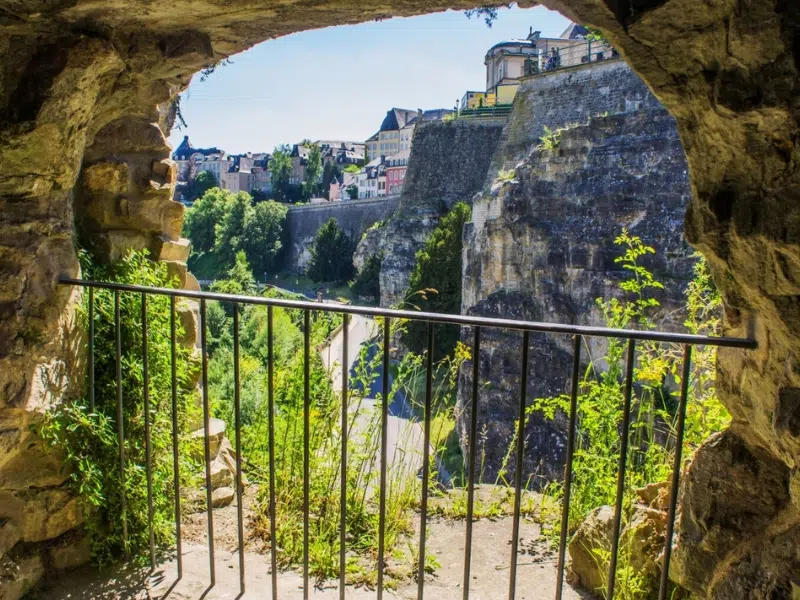
The Bock Casemates are tunnels and gun chambers cut into the Bock, the rocky promontory above the Alzette valley where Luxembourg City began. Spanish engineers started digging them in 1644, and when the fortress was dismantled after 1867, the tunnels survived because destroying them would have put the town above at risk. Today you can walk through part of them, with cannon openings looking out over the Grund and Pfaffenthal.
The Bock Casemates at a glance
- Where: Montée de Clausen, on the Bock promontory at the eastern edge of the Old Town, beside the Castle Bridge and close to St Michael's Church.
- Built: from 1644 under Spanish rule, extended by Vauban in the 1680s and by the Austrians in the mid-18th century.
- What it is today: a visitable section of the old underground defences, part of the UNESCO World Heritage Site of Luxembourg's old quarters and fortifications since 1994.
- Time needed: 45 minutes to an hour inside, plus time for the views outside.
From Siegfried's castle to the Gibraltar of the North
Luxembourg's story starts on this rock. In 963 Count Siegfried acquired the Bock and built a castle on it, and a town grew up beside it. Over the centuries Burgundians, Spaniards, French, Austrians and Prussians held the site and kept strengthening it, until Luxembourg was one of the strongest fortresses in Europe, nicknamed the Gibraltar of the North. The Spanish began the casemates in 1644, using the cellars of the medieval castle as a starting point. After the French took the city in 1684, Vauban extended the defences, and the Austrians continued the work in the mid-18th century. The tunnels could hold about 1,200 soldiers and their horses, with workshops, kitchens, bakeries and slaughterhouses, and a well supplied water during sieges.
The 1867 Treaty of London made Luxembourg neutral and required the fortress to be dismantled. The walls above ground came down, but the underground galleries could not be destroyed without endangering the town, and a large part of the network survives. During the Second World War the casemates sheltered more than 30,000 people during air raids. In 1964 a theatre company founded by the actor Tun Deutsch even staged avant-garde plays down here, including works by Samuel Beckett.
What to look for
- The archaeological crypt at the entrance: the antechamber to the casemates, which introduces the castle that once stood on the rock.
- The gun openings: the Bock tunnels have many loopholes, so they are lighter than the Pétrusse Casemates, and each opening frames a view of the Grund or Pfaffenthal far below.
- The rock-cut passages and stairs: the galleries run on several levels, carved straight into the sandstone.
- The well that supplied the garrison with fresh water when the fortress was under siege.
- The Castle Bridge outside: the two-level bridge that links the Bock to the Old Town, built by the Austrians in the 1730s.
The legend of Melusina
According to legend, Count Siegfried married Melusina, a beautiful woman who made him promise never to look at her on one day of the week. When he broke his promise, he saw that she was half fish, and she vanished into the rock of the Bock. The story says she is still inside, knitting one stitch a year; if she ever finishes, Luxembourg will disappear with her. It is only a legend, but it is one of the best-known stories in Luxembourg's folklore, and it is told about this very rock.
Tips for your visit
- Bring a layer: the tunnels stay cool even in summer. Wear sturdy shoes for the uneven floors and steep stairs.
- With its narrow passages and many steps, the site is not suitable for wheelchairs or pushchairs.
- The casemates are open seasonally and opening times change, so check before you go.
- Afterwards, walk along the Chemin de la Corniche to see the Bock and its openings from the outside.
Nearby
- Chemin de la Corniche: the rampart walk along the edge of the Old Town above the Grund, often called the most beautiful balcony in Europe.
- St Michael's Church: a small church just above the casemates, on one of the oldest places of worship in the city.
- The Grund: the riverside quarter at the foot of the rock, with Neimënster Abbey, reached on foot by steps or by the public lift from the Plateau du Saint-Esprit.
- Pétrusse Casemates: the second set of visitable casemates, on the other side of the Old Town near the Monument of Remembrance (the Gëlle Fra).
See Luxembourg with World City Trail
Our Luxembourg scavenger hunt turns the Old Town into a game you play on your phone. The route links 10 stops and takes around 2 hours, with about 30 minutes of walking. It includes places such as the Place d'Armes, the Place Guillaume II and the monument to the poets Dicks and Lentz.
If you prefer a different format, there is also a self-guided walking tour and an outdoor escape game in Luxembourg.
Play the Luxembourg scavenger hunt →
Take the self-guided walking tour of Luxembourg →
Play the outdoor escape game in Luxembourg →
Facts checked in October 2026.