
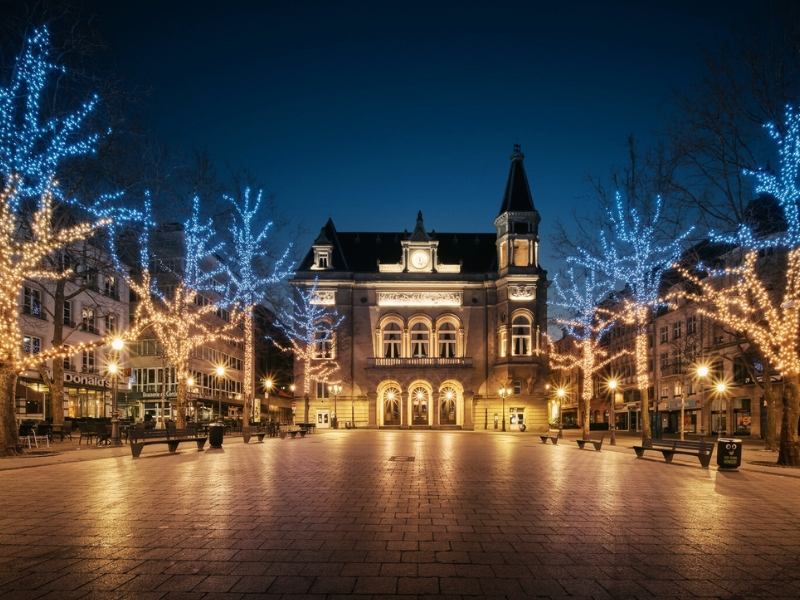
Place d'Armes is the tree-lined square in the upper town of Luxembourg City, ringed by café terraces and known to locals simply as the Plëss. It began as the parade ground of one of Europe's great fortresses, and its name still recalls the garrison that drilled here.
Place d'Armes at a glance
- Where: in the Ville Haute, the old upper town, in the middle of the pedestrian zone, a few steps from Place Guillaume II and the Grand Ducal Palace.
- Created: laid out in its present form in 1671, on the site of a larger square planned after a disastrous fire in 1554.
- By: the Spanish military engineer Jean Charles de Landas, Count of Louvigny, who completed the square in 1671.
- What it is today: the city's favourite meeting place, with a bandstand for open-air concerts, café terraces under lime trees and the Cercle Cité cultural centre at its eastern end.
- Time needed: 15–20 minutes to look around, or as long as you like over a coffee.
From fortress parade ground to the city's living room
In 1554 gunpowder stored in the church of the Franciscan friary exploded, and the fires that followed destroyed much of the upper town. The rebuilding plans that followed proposed a large new square here, a Forum Novum of about 96 by 64 metres. In 1671 the Spanish engineer Jean Charles de Landas, Count of Louvigny, created a slightly smaller square on the same site. Because the garrison of the fortress used it for drills and parades, it became the Place d'Armes. Under Louis XIV, after the French took the city, it was paved with flagstones and planted with lime trees.
The square took on its present look in the early 20th century. The Cercle Municipal, now called the Cercle Cité, was built at the eastern end as a municipal building with reception rooms; the main structure was finished in 1906 and the interior in 1909. It was restored between 2006 and 2011 and is now used for exhibitions, concerts and events. On 10 September 1944, during the liberation of Luxembourg, the crowds gathered here to welcome the American troops of the 5th Armored Division, a moment remembered by a plaque on the building.
What to look for
- The frieze on the Cercle Cité by Pierre Federspiel, showing Countess Ermesinde granting the city its charter of freedoms in 1244.
- The liberation plaque on the same building, recalling the arrival of the US 5th Armored Division on 10 September 1944.
- The monument to Dicks and Michel Lentz in the corner known as Square Jan Palach: a pillar topped by the Luxembourg lion, with a blacksmith standing for the steel industry.
- The motto on the monument, 'Mir wëlle bleiwe wat mir sinn' ('We want to remain what we are'), a line by Michel Lentz that became the national motto.
- The bandstand in the middle of the square and the double row of lime trees, a reminder of the trees first planted here in the time of Louis XIV.
Two poets on a pillar
Michel Lentz (1820–1893) wrote the words of Luxembourg's national anthem, 'Ons Heemecht', while Edmond de la Fontaine, known by his pen name Dicks (1823–1891), was a pioneer of theatre in the Luxembourgish language. Their joint monument by Pierre Federspiel is a tribute to the writers who made Luxembourgish a written, literary language. The national motto on it comes from a song Lentz wrote, and you will see it again on buildings around the country.
Tips for your visit
- Come on a summer evening, when bands play open-air concerts on the bandstand and the terraces fill up.
- In December the square becomes part of the city's Christmas market, so expect stalls and crowds.
- Use the square as your base: the Grand Ducal Palace, the cathedral and the views over the old fortifications are all within a short walk.
Nearby
- Place Guillaume II: the larger square next door, known locally as the Knuedler, with an equestrian statue of King William II and the city hall.
- Grand Ducal Palace: the official town residence of the Grand Duke, with a richly carved Renaissance façade, a few minutes' walk away.
- Notre-Dame Cathedral: Luxembourg's cathedral, begun in the early 17th century as a Jesuit church, with a crypt holding the tombs of the grand ducal family.
- Chemin de la Corniche: the rampart walk often called the most beautiful balcony in Europe, with views down into the Grund and over the Bock rock.
See Luxembourg with World City Trail
Our Luxembourg scavenger hunt turns the old town into a game you play on your phone. The route links 10 stops and takes around 2 hours, with about 30 minutes of walking. Place d'Armes is one of the stops, along with the Monument to Dicks and Lentz and Place Guillaume II.
If you prefer a different format, there is also a self-guided walking tour and an outdoor escape game in Luxembourg.
Play the Luxembourg scavenger hunt →
Take the self-guided walking tour of Luxembourg →
Play the outdoor escape game in Luxembourg →
Facts checked in October 2026.