
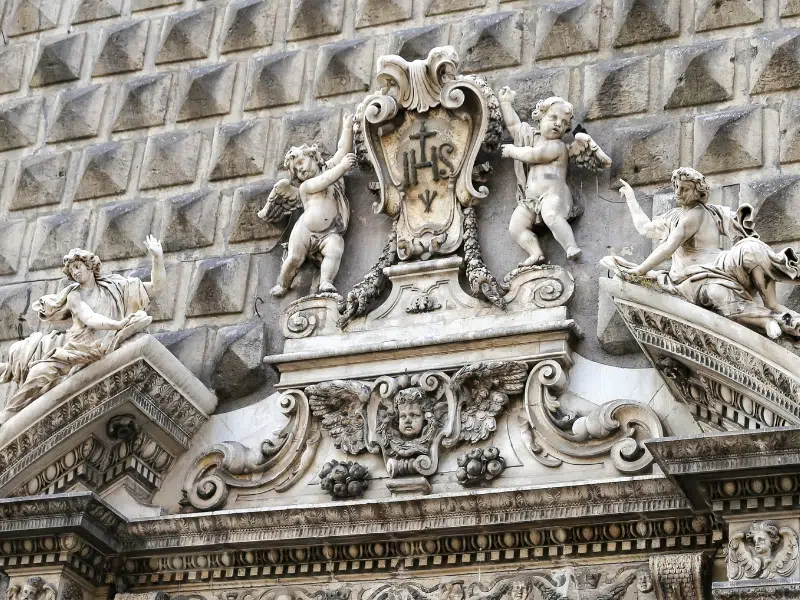
The Gesù Nuovo is the large Jesuit church on Piazza del Gesù Nuovo, at the western end of Spaccanapoli in the historic centre of Naples. Its grey stone front, covered in rows of pyramid-shaped points, looks more like a fortress than a church, and for good reason: it is the facade of a 15th-century palace. Behind it the Jesuits built one of the richest Baroque interiors in the city.
The Gesù Nuovo at a glance
- Where: Piazza del Gesù Nuovo, opposite the Basilica of Santa Chiara, at the start of Spaccanapoli.
- Built: as a palace in 1470; converted into a church between 1584 and 1601.
- By: the palace by Novello da San Lucano; the church by the Jesuit architects Giuseppe Valeriano and Pietro Provedi.
- What it is today: a working church, one of the largest in Naples, and the resting place of Saint Giuseppe Moscati.
- Time needed: 30 to 45 minutes inside, a few more to study the facade.
From a prince's palace to a Jesuit church
The building began as the palace of Roberto Sanseverino, Prince of Salerno, completed in 1470. His family was one of the most powerful in the kingdom, and also one of the most rebellious. His son Antonello joined the Barons' Conspiracy against the Aragonese king in 1485 and lost the palace for a time. A later prince, Ferrante Sanseverino, hosted Emperor Charles V here in 1536, but when he backed the people of Naples against an attempt to introduce the Spanish Inquisition in 1547, the Spanish confiscated his property and he went into exile in 1552.
The Jesuits bought the palace in 1584. Their architects gutted it completely, keeping only the stone facade and the Renaissance marble portal. The church opened for worship in 1597 and was consecrated in 1601. It was dedicated to the Immaculate Virgin, but everyone called it the Gesù Nuovo, the New Jesus, to tell it apart from the order's older church, now the Gesù Vecchio. Its first dome, frescoed by Giovanni Lanfranco, came down in the earthquake of 1688, and the dome has been rebuilt more than once since. The Jesuits were expelled from the kingdom in 1767, and the church passed to the Franciscans for a time before the order returned.
What to look for
- The diamond-point facade: rows of grey piperno stone, each block cut into a projecting pyramid, the only part of the Sanseverino palace that survives.
- The marks on the stones: look closely and you will see small symbols carved into many blocks. The art historian Vincenzo De Pasquale has argued they are Aramaic letters that can be read as a musical score; it remains a theory, not an accepted fact.
- The main portal: the palace's Renaissance marble doorway, enlarged in 1695 with columns, a broken pediment, angels and the emblem of the Jesuits.
- Solimena's fresco: turn around once inside. Above the entrance is Francesco Solimena's huge Expulsion of Heliodorus from the Temple, painted in 1725.
- Saint Giuseppe Moscati: in the Chapel of the Visitation, a bronze urn holds the remains of the doctor who treated the poor of Naples for free and was made a saint in 1987. A bronze statue of him stands nearby, and some rooms of the church are dedicated to his life.
Curses, a composer and a bomb
The facade has gathered its own legends. One says the masons set the pointed stones the wrong way round and so turned their power against the Sanseverino family, whose fortunes collapsed soon after; take it as a story, not history. The church also holds a darker figure: Carlo Gesualdo, Prince of Venosa, the composer remembered for murdering his wife and her lover, is buried in front of the Chapel of Saint Ignatius. And in 1943 a bomb fell through the roof over Moscati's chapel without exploding. Its casing is still on display in the church.
Tips for your visit
- Look at the facade first from the middle of the square, near the spire, to see the whole wall of points in raking light; morning and late afternoon bring out the texture best.
- Then walk up to the stones at eye level beside the doors: that is where the carved marks are easiest to spot.
- This is an active church with many local visitors at Moscati's chapel, so dress modestly, keep your voice down and avoid walking around during Mass.
- Combine it with Santa Chiara across the square, then follow Spaccanapoli east into the old centre.
Nearby
- Basilica of Santa Chiara: the Gothic church opposite, rebuilt after the Second World War, with a cloister decorated in 18th-century majolica tiles.
- Guglia dell'Immacolata: the tall Baroque spire in the middle of the square, finished in 1750 after decades of work.
- Sansevero Chapel: home of the Veiled Christ, the marble statue of Christ under a seemingly transparent shroud, a short walk east along Spaccanapoli.
- San Domenico Maggiore: a large Gothic church on its own square, a few minutes further along the same street.
See Naples with World City Trail
Our Naples scavenger hunt turns the old town into a game you play on your phone. The route links 10 stops and takes around 2 hours, with about 46 minutes of walking, and includes places such as the Sansevero Chapel with the Veiled Christ and the National Archaeological Museum.
If you prefer a different format, there is also a self-guided walking tour and an outdoor escape game in Naples.
Play the Naples scavenger hunt →
Take the self-guided walking tour of Naples →
Play the outdoor escape game in Naples →
Facts checked in October 2026.