
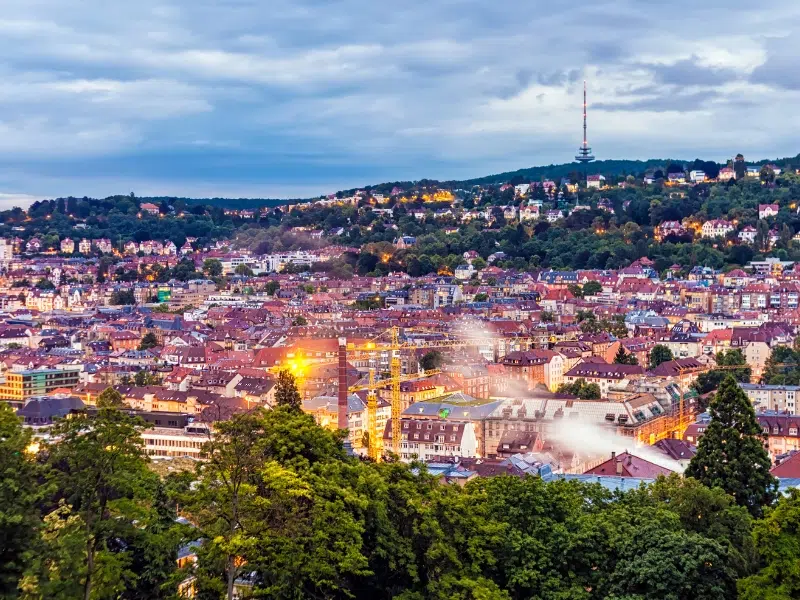
Stuttgart lies in a bowl of hills, with vineyards climbing almost to the city centre and mineral springs bubbling up beneath it. It is where the motorcar took shape and where the first concrete TV tower rose. Here are the facts and stories behind the city.
10 fun facts about Stuttgart
- A city named after a stud farm: Stuttgart grew from a Stutengarten, a stud farm for mares founded around 950 by Duke Liudolf of Swabia. That is why a black horse rears on the city's coat of arms, and the same horse sits at the centre of the Porsche crest.
- The first motorcycle: in 1885 Gottlieb Daimler and Wilhelm Maybach built the Reitwagen in Cannstatt, a wooden two-wheeler with a petrol engine that is considered the first motorcycle.
- A start-up from 1886: Robert Bosch opened his small workshop for precision mechanics and electrical engineering in Stuttgart in 1886. It grew into one of the world's largest automotive suppliers.
- The mother of all TV towers: the Fernsehturm, opened in 1956 and designed by the engineer Fritz Leonhardt, was the world's first TV tower made of reinforced concrete. With its antenna it is about 217 metres tall.
- Water in abundance: about 44 million litres of mineral water flow from Stuttgart's springs every day. Within Europe, only Budapest has more.
- Vines in the city: Stuttgart is one of the few big German cities with vineyards inside its limits. The local red grape is Trollinger.
- A harvest festival with a royal founder: King Wilhelm I of Württemberg founded the Cannstatter Volksfest in 1818, after years of famine. Every autumn a tall column decorated with fruit and vegetables, the Fruchtsäule, stands at its centre.
- A showcase of modern living: the Weissenhof Estate was built for a 1927 housing exhibition led by Ludwig Mies van der Rohe. Its two houses by Le Corbusier have been part of a UNESCO World Heritage Site since 2016.
- A philosopher's birthplace: Georg Wilhelm Friedrich Hegel was born in Stuttgart in 1770. The house where he was born is now a museum about his life and work.
- A city of steps: because the centre sits in a valley basin, Stuttgart has hundreds of public staircases, called Stäffele in Swabian, that link the hillside streets with the centre.
Daimler's secret greenhouse
In the early 1880s Gottlieb Daimler bought a villa in Cannstatt, enlarged the greenhouse in its garden with a brick extension and turned it into a workshop. There he and Wilhelm Maybach worked in secret on a small, fast-running petrol engine. The gardener grew suspicious of the hammering and metallic noises at all hours and told the police that he thought the two men were making counterfeit coins. When officers searched the greenhouse one night, they found only tools and engine parts and left the inventors to carry on. By 1883 Daimler and Maybach had their high-speed engine. The greenhouse still stands in the Kurpark of Bad Cannstatt as the Gottlieb Daimler Memorial.
Schlossplatz, explained
Schlossplatz is Stuttgart's grand central square. On one side stands the Neues Schloss, the Baroque palace of the dukes and later kings of Württemberg, badly damaged in the Second World War and rebuilt to house state ministries. Across the street, the Altes Schloss, a Renaissance castle with an arcaded courtyard, holds the Landesmuseum Württemberg. In the middle of the square rises the Jubilee Column, built for King Wilhelm I's 25 years on the throne, and along the north side runs the colonnaded Königsbau.
What to eat in Stuttgart
- Maultaschen: large pasta pockets filled with meat, spinach and herbs, served in broth or fried with onions. Legend says monks invented them to hide meat from God during Lent, which is why they are nicknamed Herrgottsbscheisserle.
- Käsespätzle: soft egg noodles layered with melted mountain cheese and crispy onions, Swabia's answer to macaroni cheese.
- Linsen mit Spätzle und Saitenwürstle: lentils with spätzle and a pair of thin sausages, the classic Swabian home-style plate.
- Zwiebelrostbraten: a roast beef steak with a heap of crispy fried onions and gravy, usually served with spätzle.
- Trollinger in a Besen: in season, winegrowers open simple pop-up taverns called Besenwirtschaften, marked by a broom hung over the door. Order a glass of Trollinger with a hearty snack.
Good to know before you go
- The area around the main station is a large building site for the Stuttgart 21 rail project, whose opening has been postponed several times.
- The Fernsehturm's viewing platforms look out over the vineyards and the Swabian Jura on clear days.
- Car fans should plan time for the Mercedes-Benz Museum near Bad Cannstatt and the Porsche Museum in Zuffenhausen, both easy to reach by S-Bahn.
- Ludwigsburg Residential Palace, one of the largest Baroque palaces in Germany, is a short S-Bahn ride north and makes an easy half-day trip.
Explore Stuttgart with World City Trail
Our Stuttgart scavenger hunt turns these sights into a game you play on your phone. The route leads through the main sights of the city centre and takes around three hours, with about 43 minutes of walking.
At each stop you solve a puzzle and hear a short story, at your own pace. You can start whenever you like and play in English, German, French, Italian, Spanish or Dutch.
Play the Stuttgart scavenger hunt →
Facts checked in October 2026.