
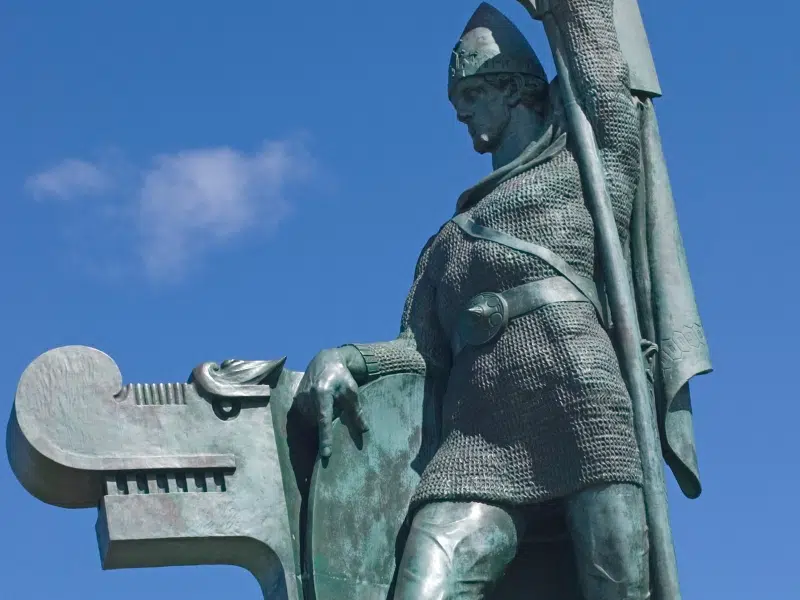
On top of Arnarhóll, the grassy hill above Reykjavík's harbour, stands a bronze Viking in armour: Ingólfur Arnarson, traditionally counted as the first permanent Norse settler of Iceland. According to the medieval Book of Settlements, he made his home in this bay in 874 and gave Reykjavík its name. The statue by Einar Jónsson has looked out from the hill since 1924.
The Ingólfur Arnarson statue at a glance
- Where: on the summit of Arnarhóll, between Lækjargata and the harbour, opposite the Harpa concert hall.
- Created: designed by Einar Jónsson in the early 20th century, cast in bronze and unveiled on 24 February 1924.
- By: Einar Jónsson, Iceland's first great modern sculptor; the Reykjavík craftsmen's association raised the money and set it up.
- What it is today: a national monument owned by the Icelandic state, and the hill around it is a city park and gathering place.
- Time needed: 10 to 15 minutes, more if you stay for the view.
From a Norwegian feud to a smoky bay
Ingólfur came from western Norway. The Book of Settlements, written two or three centuries after the events, says he left after a blood feud and sailed for the newly discovered island with his foster brother Hjörleifur. As land came into sight he threw his high-seat pillars, the carved posts of a chieftain's seat, overboard and vowed to settle wherever the gods brought them ashore. His slaves searched the coast for three years before finding them in a small bay. He called it Reykjavík, smoky bay, probably after the steam rising from hot springs.
His settlement is traditionally dated to 874, and his land stretched across much of the southwest. Modern archaeology suggests people may have arrived a little earlier, and the medieval writer Ari Þorgilsson mentions Irish monks living in Iceland before the Norse, although no trace of them has been found. Ingólfur's son Þorsteinn is said to have founded the first local assembly in Iceland, a forerunner of the Althing. In 1924, fifty years after Iceland's millennium celebrations of the settlement, the craftsmen of Reykjavík gave the capital its founder in bronze.
What to look for
- The armoured figure: Ingólfur stands in a Viking-age helmet and mail, holding a drawn halberd, calm rather than warlike.
- The dragon-headed post: beside him rises part of a high-seat pillar ending in a carved dragon's head, a reference to the pillars that, in the saga, chose the site of Reykjavík.
- The tall plain pedestal: Einar Jónsson planned reliefs for all four sides, with themes from Norse myth, but they were never made.
- The hill itself: Arnarhóll, Eagle Hill, is traditionally linked to the place where the high-seat pillars were found.
- The view: from the summit you look over Harpa and the harbour to Faxaflói bay and, on clear days, Mount Esja.
How true is the story?
Treat the details of the saga as tradition rather than fact. The Book of Settlements was written long after the events, and stories like the drifting high-seat pillars are common in Norse literature. What archaeology does confirm is a Viking-age settlement right in the centre of Reykjavík: a few minutes from the statue, the Settlement Exhibition on Aðalstræti shows the remains of a 10th-century longhouse and a fragment of wall built just before a volcanic ash layer dated to around 871.
Tips for your visit
- Climb the hill on a clear day, ideally in the evening, when the light over the bay and the mountains is softest.
- The grassy slopes are a popular place to sit in summer, and big outdoor events such as the National Day celebrations on 17 June take place here.
- Photograph the statue from below against the sky, then turn around for the view of Harpa and the sea.
- Pair it with the Settlement Exhibition to see the archaeological side of Ingólfur's story.
Nearby
- Harpa: the glass-fronted concert hall on the harbour, just below the hill, free to walk into.
- Government House: the white 18th-century building at the foot of Arnarhóll, now the Prime Minister's office.
- Settlement Exhibition: Viking-age remains under the old town on Aðalstræti, a short walk west.
- Laugavegur: Reykjavík's main shopping street starts a few minutes away and leads up towards Hallgrímskirkja.
See Reykjavík with World City Trail
Our Reykjavík scavenger hunt turns the city centre into a game you play on your phone. The route links 10 stops and takes around 2 hours, with about 41 minutes of walking, and includes places such as Hallgrímskirkja.
If you prefer a different format, there is also a self-guided walking tour and an outdoor escape game in Reykjavík.
Play the Reykjavík scavenger hunt →
Take the self-guided walking tour of Reykjavík →
Play the outdoor escape game in Reykjavík →
Facts checked in October 2026.