
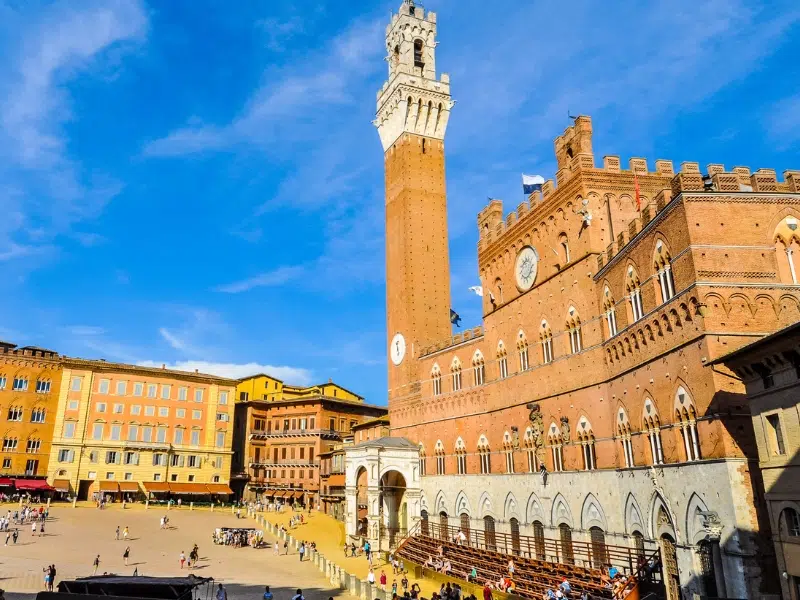
Piazza del Campo is Siena's main square, a sloping fan of red brick spread out in front of the town hall, the Palazzo Pubblico. Its paving was finished in 1349 and is divided into nine wedges in honour of the Nine, the merchant government that ruled the city at the time. Twice every summer, on 2 July and 16 August, its outer ring becomes the track for the Palio horse race.
Piazza del Campo at a glance
- Where: in the middle of Siena's historic centre, in the hollow where the town's three hillside districts meet. You reach it through narrow lanes and archways from the surrounding streets.
- Created: an open market and meeting ground before the 13th century; fully paved in 1349.
- What it is today: Siena's main square and the setting of the Palio, part of the Historic Centre of Siena, a UNESCO World Heritage Site since 1995.
- Time needed: 30 minutes for the square itself, two to three hours if you also visit the town hall museum and the tower.
From open field to the city's stage
The Campo began as just that, a field: low, open ground where Siena's three hill communities met, used for markets, assemblies and games. From the late 13th century until 1355 the city was governed by the Nine (the Noveschi), a council of merchants and bankers, and they turned the field into the civic centre. The Palazzo Pubblico rose along the lower edge, and the square was paved in red brick laid in a herringbone pattern, split by eight lines of pale travertine into nine segments, one for each member of the government.
The Torre del Mangia was added between 1338 and 1348; at 102 metres it is one of the tallest medieval towers in Italy. In 1348 the Black Death killed a large part of the population, and the survivors built the Cappella di Piazza, the open chapel at the foot of the tower, as a thank-offering for the end of the plague. Around 1342 water had reached the square through the bottini, Siena's underground channels, and in 1419 Jacopo della Quercia finished a new marble fountain for it, the Fonte Gaia.
What to look for
- The nine segments: stand at the top of the square and follow the white travertine lines down the slope. They meet like the ribs of a scallop shell in front of the town hall.
- The drain at the bottom: where the lines meet, a stone-framed drain called the Gavinone collects the rain that runs down the square, which drops about four and a half metres from top to bottom.
- Fonte Gaia: the marble fountain at the top of the square. What you see is a 19th-century copy by Tito Sarrocchi; Jacopo della Quercia's weathered original panels are kept in Santa Maria della Scala. The name means 'joyful fountain', after the celebrations when water first arrived.
- The Palazzo Pubblico: the curved brick and stone front with Gothic triple windows, battlements and a large disc bearing the monogram of Christ (IHS), linked to the preacher Bernardino of Siena.
- The Cappella di Piazza: the marble loggia at the foot of the tower, the plague chapel of 1348.
- The Torre del Mangia: named after its first bell-ringer, Giovanni di Balduccio, nicknamed 'Mangiaguadagni' ('profit-eater'). It was built so that its top would reach the same height as the cathedral bell tower, which stands on higher ground.
The Palio: a horse race around the square
On 2 July and 16 August a layer of earth is laid around the outer ring of the Campo, and ten of Siena's seventeen contrade (city districts) race horses ridden bareback three times round the square. The race itself is over in less than two minutes, after days of trial runs, processions and parades in historical costume. The prize is the palio, a painted silk banner, and the crowd fills the centre of the square standing.
Tips for your visit
- Do what the Sienese do and sit on the brick paving: the slope makes the square a natural amphitheatre. Early morning is quiet, and in the evening the low sun lights up the palace front.
- For the classic view down onto the shell, climb the Torre del Mangia or the Facciatone, the unfinished wall of the planned cathedral extension. Both have narrow stairs; check before you go.
- In the days around the Palio the square is fenced off, covered with earth and very crowded. Plan accordingly if you visit in late June, early July or mid-August.
- There is no shade in the square. In summer come before mid-morning or after late afternoon.
Nearby
- Palazzo Pubblico and Museo Civico: inside the town hall, Ambrogio Lorenzetti's frescoes of Good and Bad Government, painted in 1338–1339.
- Siena Cathedral: the black-and-white striped Duomo with its inlaid marble floor, a few minutes' walk uphill.
- Santa Maria della Scala: the former hospital opposite the cathedral, now a museum that holds the original panels of the Fonte Gaia.
- Piazza del Mercato: Siena's old market square, just behind the Palazzo Pubblico, with a view over the valley.
See Siena with World City Trail
Our Siena scavenger hunt turns the historic centre into a game you play on your phone. The route links 10 stops and takes around 2 hours, with about 24 minutes of walking. The route includes Siena Cathedral, Santa Maria della Scala and the Pinacoteca Nazionale.
If you prefer a different format, there is also a self-guided walking tour and an outdoor escape game in Siena.
Play the Siena scavenger hunt →
Take the self-guided walking tour of Siena →
Play the outdoor escape game in Siena →
Facts checked in October 2026.