
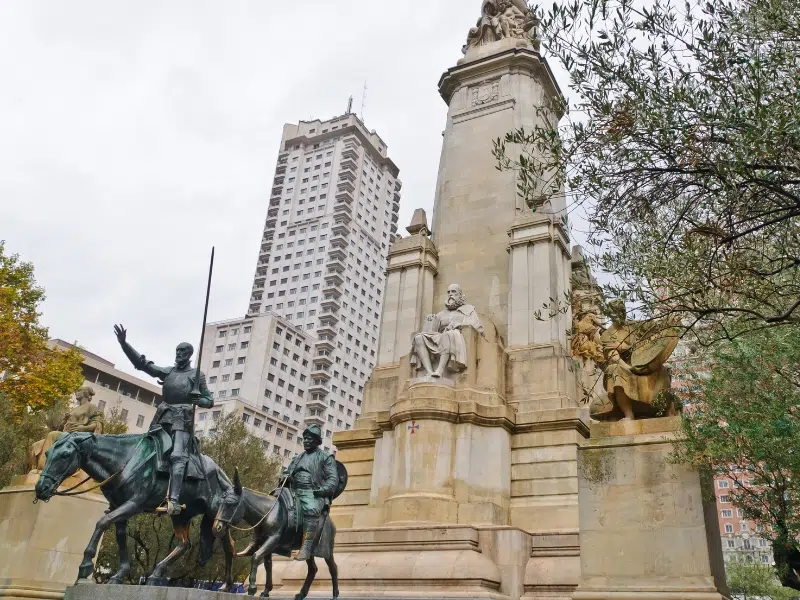
Plaza de Cervantes (Cervantes plaza in Basque) is a small square on the seafront of San Sebastián, where La Concha promenade begins beside the Alderdi Eder gardens and the City Hall. Its centrepiece is a bronze group of Don Quixote on his horse and Sancho Panza on his donkey. It is the work of Lorenzo Coullaut Valera, the sculptor who made the same pair for the great Cervantes monument on Madrid's Plaza de España.
Plaza de Cervantes at a glance
- Where: at the eastern end of La Concha promenade, next to the Alderdi Eder gardens and the City Hall, between the Old Town and La Concha beach.
- Created: the statue group was designed in the 1920s for the Madrid monument; this version has stood in San Sebastián since the 1970s.
- By: the sculptor Lorenzo Coullaut Valera (1876–1932).
- What it is today: a small open square with the statue, benches and a view across the bay, and the usual starting point for a walk along La Concha.
- Time needed: 10–15 minutes, or as long as you want to sit and look at the bay.
From fortress town to seaside resort
Until the 1860s San Sebastián was a walled fortress town squeezed between Mount Urgull and the sea. After the walls came down in 1863, the city spread south and along the bay, and the open ground in front of the old walls, once used by the army, became the Alderdi Eder gardens. In 1887 the Gran Casino opened on the edge of the gardens, around the time the Spanish royal court began spending its summers in the city. For decades this stretch of seafront, with its casino, promenade and white railings, was the showpiece of one of Europe's most fashionable resorts. Gambling was banned in Spain in 1924, and in 1947 the casino building became the City Hall.
The square takes its name from Miguel de Cervantes, author of Don Quixote, published in two parts in 1605 and 1615. In 1915 Lorenzo Coullaut Valera and the architect Rafael Martínez Zapatero won the competition for a national monument to Cervantes in Madrid, which opened on the Plaza de España in 1929 with a bronze Don Quixote and Sancho Panza in front of a stone tower. San Sebastián has its own bronze version of that famous pair, which brings the knight and his squire from the plains of La Mancha to the edge of the Bay of Biscay.
What to look for
- The two riders: the tall, bony knight on his thin horse Rocinante, and the short, round Sancho Panza on his donkey. The contrast between them is the whole joke of the novel, and the sculptor made the most of it.
- The City Hall behind the square: the former Gran Casino, a white belle-époque building with towers at its corners, still looks more like a grand hotel than a town hall.
- The view of Mount Urgull: turn towards the sea and look left to the hill above the Old Town, crowned by a large statue of the Sacred Heart.
- La Concha railing: the white wrought-iron railing that runs along the whole promenade starts here. It is one of the symbols of the city, and its pattern turns up on souvenirs everywhere.
- Santa Clara island: the small wooded island in the middle of the bay, with Mount Igueldo behind it on the far side.
Tips for your visit
- Come in the early morning, when the light is soft on the statue and the bay is calm, or at sunset, when the sun goes down behind Mount Igueldo.
- Start here and walk the full length of La Concha promenade towards Ondarreta; it is one of the finest seafront walks in Spain and takes about half an hour at an easy pace.
- At high tide in stormy weather, waves can break over the promenade at this end of the bay; keep a distance from the edge.
Nearby
- In summer the promenade fills up from late morning; come before ten for a photo of the statue without crowds around it.
- Alderdi Eder gardens: the seafront gardens with tamarisk trees and an old-fashioned carousel, the most photographed park in the city.
- Parte Vieja (Old Town): the grid of narrow streets full of pintxo bars, with the Plaza de la Constitución and the Basilica of Santa María, a few minutes' walk away.
- The port and the Aquarium: the fishing harbour at the foot of Mount Urgull, with the Aquarium and the Naval Museum, a short walk along the waterfront.
See San Sebastián with World City Trail
Our San Sebastián scavenger hunt turns the city centre into a game you play on your phone. The route links 10 stops and takes around 3 hours, with about 38 minutes of walking. It includes places such as the City Hall, the María Cristina Bridge and the Good Shepherd Cathedral. You can play in English, German, French, Italian or Spanish.
If you prefer a different format, there is also a self-guided walking tour and an outdoor escape game in San Sebastián.
Play the San Sebastián scavenger hunt →
Take the self-guided walking tour of San Sebastián →
Play the outdoor escape game in San Sebastián →
Facts checked in October 2026.