
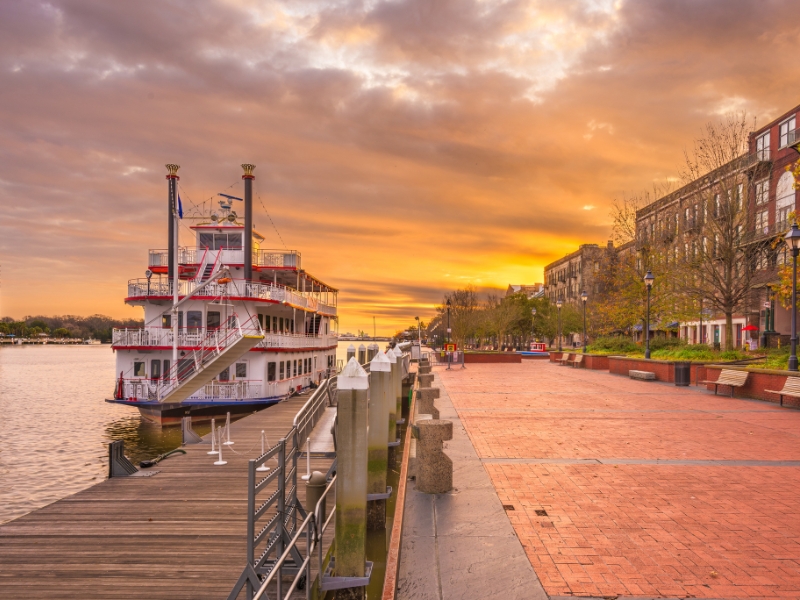
East River Street is the eastern half of Savannah's riverfront, the cobbled street that runs below the bluff from City Hall towards Morrell Park. Its brick buildings were cotton warehouses in the 19th century, built into the bluff so that their upper floors open onto Bay Street above. Today they hold shops, restaurants and hotels, while container ships glide past only a few metres from the quay.
East River Street at a glance
- Where: along the Savannah River, below Bay Street and Factors Walk, from Bull Street (where Savannah's street names switch from West to East) to Morrell Park near East Broad Street.
- Built: the surviving warehouses mostly date from the 1840s to the 1880s; the riverside promenade was laid out in 1975–1979.
- What it is today: a pedestrian-friendly waterfront with shops, bars, restaurants, hotels, an open-air market at the east end, and two well-known monuments in Morrell Park.
- Time needed: 30 minutes for a straight walk; 1–2 hours if you browse, eat and watch the ships.
- Good to know: the street and ramps are paved with uneven cobblestones, and the old stairs down from Bay Street are very steep.
From cotton port to promenade
In the 19th century Savannah exported rice and cotton grown by enslaved people on plantations in Georgia and South Carolina, and after the railway reached the city in 1834 cotton from the interior poured onto these quays. Cotton factors, the brokers who sold the crop, worked in the upper storeys facing Bay Street, while bales were handled at river level below. Several buildings from that time survive downriver from City Hall, among them the Cluskey Embankment Stores of 1840 and the warehouse ranges begun by John Stoddard in 1858.
The port economy along the old riverfront faded in the 20th century, and by the early 1970s only a handful of shops, one bar and one restaurant were left. Between 1975 and 1979, under Mayor John P. Rousakis, the city used about 7.3 million dollars in federal grants to turn the derelict waterfront into a promenade with walkways, planters and low walls. Businesses returned in the early 1980s, and the riverfront plaza near City Hall now carries the mayor's name.
What to look for
- The Waving Girl: a bronze statue by Felix de Weldon, the sculptor of the Iwo Jima Memorial, unveiled in 1972 in Morrell Park. It shows Florence Martus, who waved at every passing ship for 44 years until 1931, with her collie at her side.
- The Olympic Yachting Cauldron: a sculpture of fluted columns and sails by the blacksmith Ivan Bailey, dedicated on 8 August 1996, when Savannah hosted the sailing events of the Atlanta Olympics.
- The ramps and cobbles: tradition says many of the stones arrived as ballast in ships that came to load cotton. Look at the mix of shapes and colours under your feet.
- The warehouse walls: iron bridges and stairs link the upper floors to Factors Walk, and the different building heights show how the bluff drops to the river.
- The ships: huge container vessels heading to and from the Port of Savannah pass close to the quay, a sight that surprises many first-time visitors.
The Waving Girl's story
Florence Martus lived with her brother, a lighthouse keeper, on Elba Island downriver from the city. From the late 1880s she greeted every ship entering or leaving the port, waving a cloth by day and, it is said, a lantern by night, and sailors waved back. Popular stories claim she was waiting for a lost sweetheart; there is no evidence for this, and it is best treated as a legend. When her brother retired in 1931 they moved to the mainland, and she died in 1943. In 2019 the city council voted to move her statue to the west end of River Street, but the plan was put on hold after protests, and she still looks out over the river from Morrell Park.
Tips for your visit
- Wear flat shoes with grip: the cobbles are uneven and slippery after rain, and the old stairs are steep.
- Come in the late afternoon to watch the ships in good light, then stay for dinner as the lights come on along the river.
- Combine the walk with the free-standing monuments in Morrell Park and the Old Harbor Light just above it, then climb up to Bay Street and walk back along Factors Walk.
Nearby
- Emmet Park and the Old Harbor Light: a cast-iron beacon from 1858, about 77 feet above the river, which guided ships past hulls the British had sunk in 1779.
- Factors Walk and the Cotton Exchange: the iron walkways and the 1886 brick exchange building on Bay Street, where cotton prices were once set.
- Savannah City Hall: the domed building of 1906 at the top of the bluff, marking the line between West and East River Street.
- City Market: a few blocks inland to the west, with restaurants, galleries and art studios.
See Savannah with World City Trail
Our Savannah scavenger hunt turns the historic district into a game you play on your phone. The route links 10 stops and takes around 3 hours, with about 56 minutes of walking. It includes the Forsyth Park fountain, Monterey Square and the Cathedral Basilica of St John the Baptist. You can play in English, German, French, Spanish and Portuguese.
If you prefer a different format, there is also a self-guided walking tour and an outdoor escape game in Savannah.
Play the Savannah scavenger hunt →
Take the self-guided walking tour of Savannah →
Play the outdoor escape game in Savannah →
Facts checked in October 2026.