
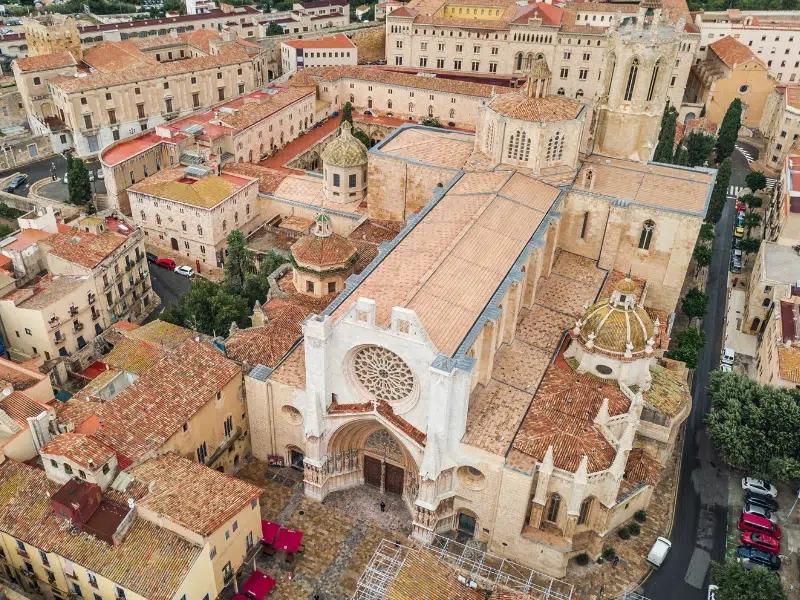
Tarragona Cathedral stands at the top of the Part Alta, the old upper town, on the spot where the Romans worshipped the emperor Augustus. Begun in 1171 and consecrated in 1331 while still unfinished, it mixes Romanesque and Gothic, and its cloister hides one of the most entertaining carvings in Spain: a capital where cats hold a funeral for a rat.
Tarragona Cathedral at a glance
- Where: at the top of Carrer Major and a broad flight of steps, in the Part Alta of Tarragona.
- Built: begun in 1171 and consecrated in 1331, still unfinished; the Gothic bell tower, about 70 metres tall, was completed in later centuries.
- What it is today: the Metropolitan Cathedral of Santa Tecla, seat of the Archbishop of Tarragona, with the Diocesan Museum inside the complex.
- Time needed: about 1 hour for the church, the cloister and the museum.
From imperial temple to Romanesque-Gothic cathedral
Roman Tarraco was the capital of a vast province, and its upper terrace held the cult of the emperor, with a temple to Augustus in the place now occupied by the cathedral. After the Romans came a Visigothic cathedral and, during the Islamic period, a mosque. When Christian rule returned in the 12th century, the archbishops began a new cathedral in 1171. Work went slowly: the apse and the cloister are Romanesque, the nave and the main façade are Gothic, and the church was consecrated in 1331 before it was finished.
The façade was never completed. Its central portal was built by Master Bartomeu from 1277 to around 1291, with the Virgin and Child on the central pillar, the Last Judgement above the door and a large rose window about 11 metres across. The figures of apostles and prophets were added later by the workshop of Jaume Cascalls. Inside, the high altarpiece of Saint Tecla, carved in alabaster by Pere Joan between 1426 and 1434, tells the story of the city's patron saint.
What to look for
- The main portal: the Virgin and Child on the trumeau, the scenes from Genesis on its base and the Last Judgement in the tympanum.
- The rose window, about 11 metres across, with smaller rose windows over the two Romanesque side doors.
- The high altarpiece of Saint Tecla by Pere Joan, in carved alabaster, with scenes from her life and martyrdom.
- The cloister, about 47 by 46 metres, with nearly 300 carved capitals full of biblical scenes, animals and fables.
- The marble panel with an Arabic inscription dated 960, set into the cloister wall, a relic of the earlier Islamic period.
- The octagonal tower over the crossing and the Gothic bell tower, best seen from the cloister garden.
The rats' procession
The most famous capital in the cloister tells a fable in stone. On one side, a cat lies still as if dead, and a procession of rats carries it to its funeral. On the other side, the cat jumps up and pounces on the rats. It is usually read as a moral tale about trickery and the danger of trusting appearances, and it shows how the carvers used animals and humour to teach people who could not read.
Tips for your visit
- Climb the steps from Carrer Major for the classic view of the façade growing above you; the light on it is warmest in the late afternoon.
- Give the cloister time: walk round slowly and look up at the capitals, as the best details are easy to miss.
- It is an active cathedral: dress respectfully and avoid touring during Mass.
Nearby
- Passeig Arqueològic: a walk along the Roman walls of Tarraco, with huge stone blocks at the base and views over the countryside.
- Roman Circus: the vaults of the chariot-racing circus run under the streets of the Part Alta and can be visited.
- Amphitheatre: the Roman arena by the sea, below the Balcó del Mediterrani viewpoint.
- Rambla Nova: the city's main boulevard, where the Monument als Castellers celebrates Catalonia's human towers.
See Tarragona with World City Trail
Our Tarragona scavenger hunt turns the old town into a game you play on your phone. The route links 10 stops and takes around 2 hours, with about 32 minutes of walking. The cathedral is not one of the stops, but the route includes the Monument als Castellers and the Mercat Central. You can play in English, German, French, Italian, Spanish or Dutch.
If you prefer a different format, there is also a self-guided walking tour and an outdoor escape game in Tarragona.
Play the Tarragona scavenger hunt →
Take the self-guided walking tour of Tarragona →
Play the outdoor escape game in Tarragona →
Facts checked in October 2026.