
This guide covers four places that run like a thread through the centre of Toulouse, from north to south: a brick church tied to the city's first bishop, a fine arts museum in a Gothic convent, the round garden at the end of the old boulevards, and the university, one of the oldest in Europe. All four are stops on our scavenger hunt, so you can link them in one walk through the Pink City, which takes its nickname from the pinkish-red brick used all over the old town.
Notre-Dame du Taur
Notre-Dame du Taur stands on rue du Taur, the street that leads from the Capitole to the Basilica of Saint-Sernin. The present church dates mainly from the 14th century and is a good example of southern French Gothic in brick: a single wide nave and, instead of a tower, a tall flat facade wall pierced with openings for bells, a type known as a clocher-mur. Pilgrims on the Via Tolosana, the route to Santiago de Compostela, passed along this street on their way to Saint-Sernin.
The church's name, taur, means bull. According to tradition, Saint Saturnin (Sernin), the first bishop of Toulouse, was martyred in the 3rd century by being tied to a bull that dragged him through the streets; the church is said to stand where the rope broke and where he was first buried. Saint-Sernin was later built over his tomb a little further up the street.
- The clocher-mur facade, with its stepped top and openings: it became a model for many churches in the region.
- Inside, look for the remains of medieval wall paintings in the nave.
- Stand at the door and look up the street: Saint-Sernin's bell tower appears at the end of rue du Taur.
Musée des Augustins
The Musée des Augustins is the city's fine arts museum, housed in the former convent of the Augustinian friars, built mainly in the 14th and 15th centuries. After the Revolution the convent was turned into a museum, which opened in 1795, making it one of the oldest museums in France. A new wing was added in the 19th century.
It is best known for its Romanesque sculpture: capitals and reliefs saved from the cloisters of Saint-Sernin, La Daurade and Saint-Étienne, when those buildings were demolished or altered. The collections also include Gothic sculpture and paintings from the Middle Ages to the early 20th century. The museum reopened in December 2025 after a long renovation.
- The Gothic cloister with its garden, one of the quietest spots in the city centre.
- The gargoyles lined up along the cloister galleries, taken down from the convent's walls.
- The former church of the convent, where large paintings hang under the brick vault.
Grand Rond
The Grand Rond, officially the Jardin du Grand-Rond, is an oval garden at the meeting point of several of the wide avenues laid out on the edge of the old town in the 18th century. The plan is associated with Louis de Mondran, the city planner who also designed the boulevards around it. Footbridges link it to the Jardin Royal and, across the allées Frédéric-Mistral, to the Jardin des Plantes, so the three form one green chain.
It is a classic French public garden: lawns, tall trees, flowerbeds, a central pool with a fountain and an old music bandstand. On warm evenings it fills up with families, students and people just passing through on the way between the old town and the southern districts. It is also the obvious place for a break halfway through a walk across the city.
- The fountain in the middle of the garden and the paths radiating out from it.
- The bandstand, a reminder of the garden's role as a place for promenades and concerts.
- The footbridge over to the Jardin Royal, the oldest public garden in Toulouse.
University of Toulouse
The University of Toulouse was founded in 1229, when the treaty that ended the Albigensian Crusade required the Count of Toulouse to pay for professors in the city. That makes it one of the oldest universities in Europe. Today its teaching is shared between several universities and schools across the city, grouped under the name Université de Toulouse.
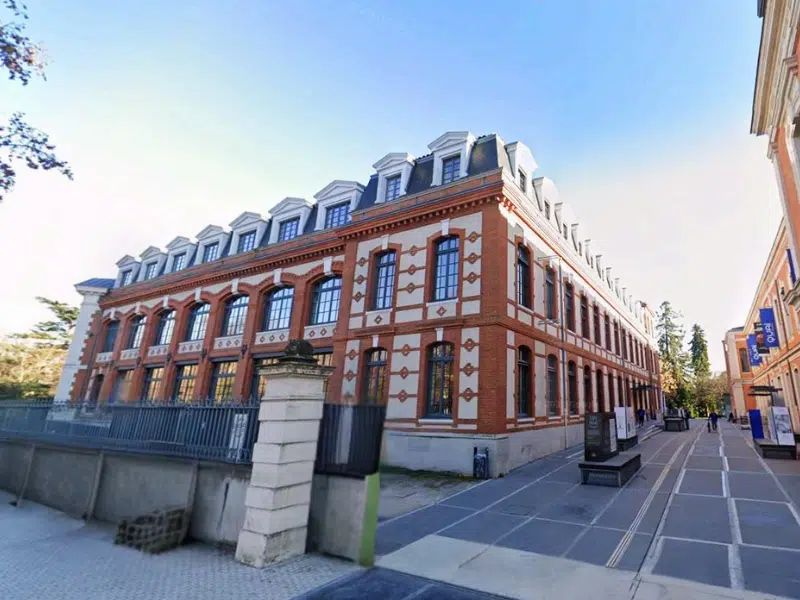
The stop on our route is the large building on the allées Jules-Guesde, near the Grand Rond. It was built between 1887 and 1891 as the faculty of medicine and pharmacy, when the old school of medicine had become too small, and it is a good example of the confident public architecture of the Third Republic.
- The long facade on the allées Jules-Guesde, built in brick and stone like much of Toulouse.
- Cross to the other side of the allées to see the whole length of the building at once.
- Combine it with the Church of Saint-Exupère nearby, the last stop on our route.
How to see them in one walk
Start at the Basilica of Saint-Sernin and walk down rue du Taur to Notre-Dame du Taur. Continue to the Place du Capitole, then head west to the Couvent des Jacobins and the Garonne at the Pont Neuf. Walk back east to the Musée des Augustins and on to the Cathedral of Saint-Étienne. From there follow the allées to the Grand Rond, cross the garden to the university building on the allées Jules-Guesde and finish at the Church of Saint-Exupère. Apart from the detour to the river, the whole route stays inside the old town and its ring of boulevards.
See Toulouse with World City Trail
Our Toulouse scavenger hunt turns the old town into a game you play on your phone. The route links 10 stops, from the Basilica of Saint-Sernin to the Church of Saint-Exupère, and all four places in this guide are among them, together with the Capitole, the Jacobins, the Pont Neuf and the cathedral.
If you prefer a different format, there is also a self-guided walking tour and an outdoor escape game in Toulouse.
Play the Toulouse scavenger hunt →
Take the self-guided walking tour of Toulouse →
Play the outdoor escape game in Toulouse →
Facts checked in October 2026.