
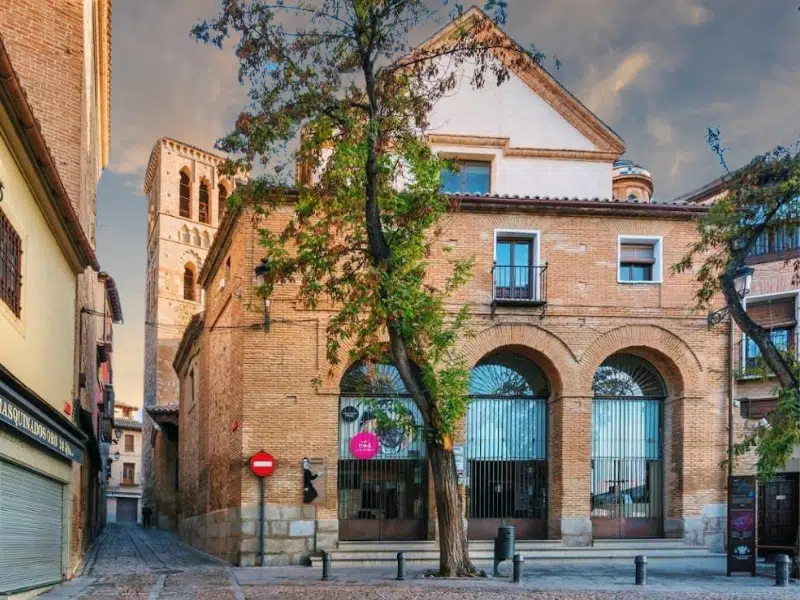
The Church of Santo Tomé is a medieval parish church in the old Jewish quarter of Toledo, built on the site of an 11th-century mosque and topped by a Mudéjar brick tower. People come here for one painting: El Greco's Burial of the Count of Orgaz, painted for this church in the 1580s and still hanging in the chapel it was made for. It shows a 14th-century nobleman being laid in his tomb by two saints who have come down from heaven.
Santo Tomé at a glance
- Where: on Calle Santo Tomé, in the west of the old town, close to the former Jewish quarter and the El Greco Museum.
- Built: on the site of an 11th-century mosque; rebuilt in the early 14th century by Gonzalo Ruiz de Toledo, Lord of Orgaz, who also turned the minaret into the present bell tower.
- What it is today: a parish church open daily to visitors who come to see El Greco's painting, which is viewed from a separate entrance at the back.
- Time needed: 20 to 30 minutes.
From mosque to El Greco's church
After Alfonso VI took Toledo in 1085, many of the city's mosques were turned into churches with few changes, and this was one of them. By the early 14th century it was in poor condition, and Gonzalo Ruiz de Toledo, Lord of Orgaz and a leading figure in the city, paid for its rebuilding. He also left the parish a yearly gift in his will. He died in 1323 and was buried here, in the Chapel of the Conception, as he had asked.
More than two centuries later, the town of Orgaz stopped paying the gift, and the parish priest Andrés Núñez won a lawsuit to restore it. To celebrate, he reshaped the chapel and in 1586 commissioned El Greco, who had settled in Toledo about ten years earlier, to paint the legend of the lord's burial above his tomb. The result, finished around 1588, is considered one of El Greco's greatest works. A Latin inscription below the painting tells the story of the miracle and of the lawsuit.
What to look for
- The two halves of the painting: below, the burial with the nobleman in armour held by Saint Stephen and Saint Augustine; above, the heavens opening to receive his soul.
- The row of Toledo gentlemen in black with white ruffs, painted as portraits of real people of El Greco's time.
- The boy in the lower left corner, usually identified as El Greco's son Jorge Manuel, with a handkerchief in his pocket bearing a date.
- The black marble plaque with gold Latin lettering under the painting, explaining the miracle and the dispute with the town of Orgaz.
- Outside, the Mudéjar tower in brick and stone, with paired windows, blind arches and glazed tiles, built from the old minaret.
Lord or count?
Gonzalo Ruiz de Toledo was never actually a count: in his lifetime he was Lord of Orgaz. The title of Count of Orgaz was created for his descendants in the 16th century, and by El Greco's time the family was known by it, which is why the painting is called the Burial of the Count of Orgaz. The legend itself says that at his funeral in 1323 Saint Stephen and Saint Augustine appeared and laid him in the tomb with their own hands, a reward for his generosity to the church.
Tips for your visit
- Go early in the morning or late in the afternoon: the viewing room is small and fills up with groups at midday.
- The painting is tall; stand back and look at the lower and upper halves separately, then together.
- Photography of the painting is restricted, so plan to look rather than photograph.
- Combine it with the El Greco Museum and the synagogues of the old Jewish quarter, all a few minutes' walk apart.
Nearby
- El Greco Museum: a museum about the painter and his time in Toledo, with several of his works, a few minutes' walk south.
- Synagogue of El Tránsito: a 14th-century synagogue with rich Mudéjar plasterwork, now the Sephardic Museum.
- Synagogue of Santa María la Blanca: white horseshoe arches in one of Europe's oldest surviving synagogue buildings.
- Monastery of San Juan de los Reyes: the Gothic monastery founded by the Catholic Monarchs, with a beautiful cloister.
See Toledo with World City Trail
Our Toledo scavenger hunt turns the old town into a game you play on your phone. The route links 10 stops and takes around two hours, with about 38 minutes of walking. It includes places such as Plaza de Zocodover and Toledo Cathedral. You can play in English, German, French, Italian, Spanish, Dutch and Portuguese.
If you prefer a different format, Toledo also has a self-guided walking tour and an outdoor escape game.
Play the Toledo scavenger hunt →
Take the self-guided walking tour of Toledo →
Play the outdoor escape game in Toledo →
Facts checked in October 2026.