

Table of Contents
The Verona Arena, or Arena di Verona, is one of the most magnificent and best-preserved ancient Roman amphitheaters, standing as a testament to Roman engineering brilliance and cultural legacy. Located in Piazza Bra, the largest square in Verona, Italy, this grand structure is more than just an archaeological site; it is a living monument that continues to host world-class performances and attract millions of visitors each year.
Ancient Origins
Built in the 1st century AD, likely under Emperor Tiberius or possibly Augustus, the Verona Arena was originally constructed to host public spectacles, including gladiatorial combat, wild animal hunts, executions, and theatrical performances. These events were not merely entertainment but also served as instruments of political propaganda, reinforcing the power of the Roman Empire and maintaining social order through mass entertainment.
The Arena was strategically positioned in the heart of Verona, a thriving Roman colony along important trade routes. The choice of location ensured its prominence in public life, making it a focal point for grand events that drew spectators from across the region. The impressive scale and functionality of the amphitheater reflected Rome’s architectural prowess and its ability to create structures that could endure for centuries.
Architectural Brilliance
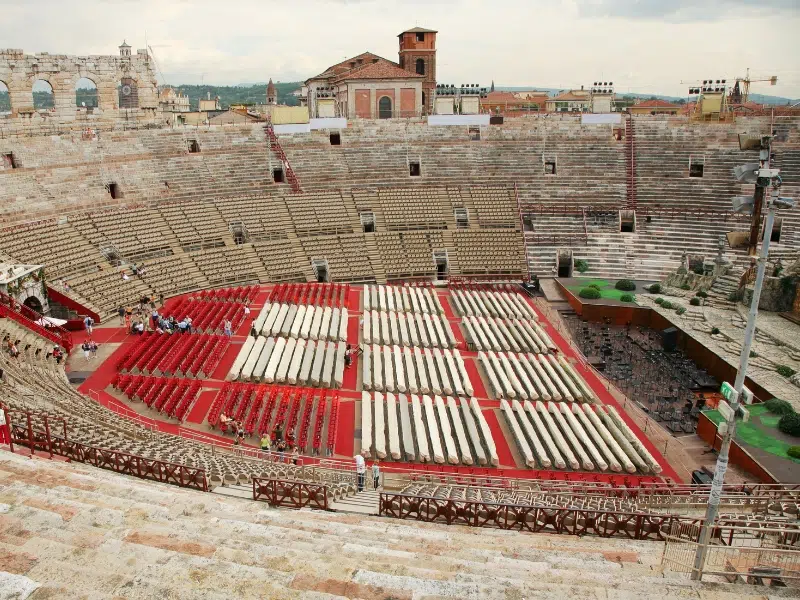
The Verona Arena is an extraordinary feat of Roman engineering, characterized by its elliptical shape, tiered seating, and intricate stone construction. Measuring 139 meters in length, 110 meters in width, and 30 meters in height, it ranks among the largest Roman amphitheaters in the world, second in size only to the Colosseum in Rome.
One of the most striking features of the Arena is its acoustic design. The architects ingeniously constructed the amphitheater in a way that allows sound to carry naturally throughout the venue, eliminating the need for modern amplification during performances. This acoustic excellence remains one of the reasons the Arena is still used for live performances today.
The amphitheater was built using pink and white limestone from Valpolicella, a region near Verona known for its high-quality stone. The original façade consisted of three levels of arches, similar to the Colosseum, but much of the outer ring was lost due to an earthquake in 1117. Despite this damage, the interior remains remarkably well-preserved, with its seating arrangement, underground tunnels, and stage area still intact.
Seating Arrangements
Like other Roman amphitheaters, the Verona Arena’s seating was structured to reflect social hierarchy:
- Front rows (cavea) were reserved for the Roman elite and magistrates.
- Middle-tier seats were occupied by merchants and military officers.
- Upper levels (summa cavea) were designated for the general public, including women and lower-class citizens.
This hierarchical seating arrangement ensured that the most privileged members of society had the best views, while commoners sat further away. Today, the Arena’s seating remains functional and continues to accommodate thousands of spectators during events.
The Arena as an Opera Powerhouse
A defining moment in the Verona Arena’s modern history came in 1913, when it was transformed into a world-renowned opera venue. The Arena di Verona Opera Festival, founded to celebrate the centennial of Giuseppe Verdi’s birth, marked the beginning of a new era for the amphitheater. Since then, the festival has become one of the most prestigious opera events in the world.
Every summer, the Verona Arena hosts large-scale opera productions that attract top-tier artists, musicians, and audiences from around the globe. Unlike traditional opera houses, the Arena’s open-air setting, combined with its ancient acoustics and historical ambiance, creates an unparalleled sensory experience.
A cherished tradition at the festival is the lighting of candles by the audience before the performance, casting a magical glow over the Arena and enhancing the immersive atmosphere. The festival has staged legendary productions, including Verdi’s Aida, Puccini’s Turandot, and Bizet’s Carmen, performed against the backdrop of one of the world’s most extraordinary historical settings.

Verona Arena is part of Verona scavenger hunt and walking tour!
Embark on an unforgettable journey through the enchanting city of Verona with World City Trail. Our interactive walking tour combines the thrill of exploration with the rich history and culture of this beautiful city.
Key Features:
Interactive gameplay: Solve engaging puzzles and challenges as you explore the city.
Hidden gems: Uncover lesser-known spots.
Cultural insights: Learn about the city’s fascinating history.
Flexibility: Explore at your own pace and create your own itinerary.
Family friendly activity and a great way to explore the city!