
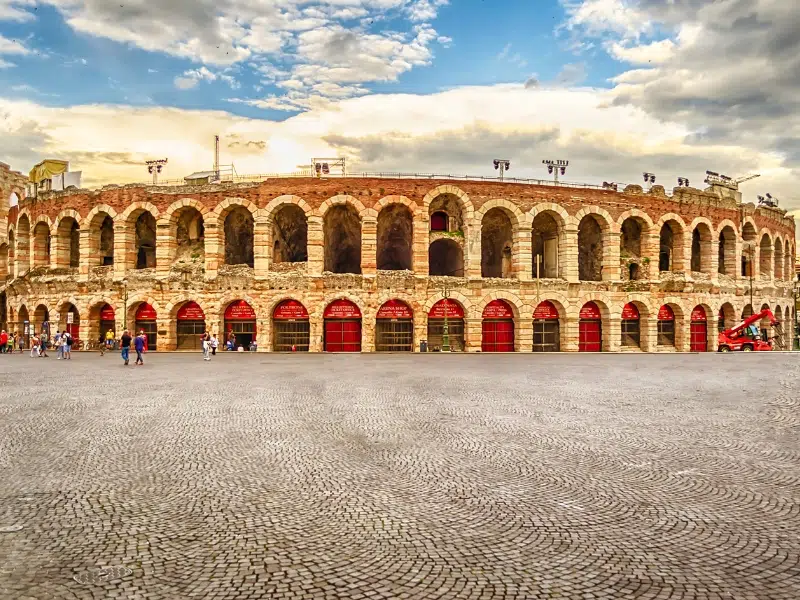
This guide links seven places in Verona's old town, all inside the bend of the Adige or on its banks: the Roman Arena and the Porta Borsari, Juliet's House, the Dominican church of Sant'Anastasia, the cathedral, and two bridges with very different stories, the Ponte della Vittoria and the Ponte Scaligero. Together they cover two thousand years of the city, from Roman Verona to the rebuilding after 1945, and all seven are stops on our Verona scavenger hunt.
The Arena
Verona's amphitheatre was built by the Romans, probably in the 1st century AD, and it is still in use. The arena floor measures about 75 by 44 metres, and in Roman times the stands probably held around 30,000 people. Today, with the stage taking up part of the seating, about 22,000 come to the summer opera nights. The facade and pillars are of limestone from the Valpolicella hills, in pink and white tones.
The building had a busy afterlife. Earthquakes, including the disastrous one of 3 January 1117, damaged it, and almost all of the outer ring is gone. In the Middle Ages judicial combats were fought inside, where hired champions decided uncertain trials by force, and in 1382 the wedding of Antonio della Scala was celebrated here with 25 days of jousts and shows. Opera came in 1856 with a season that included Rossini's The Barber of Seville, and the Arena di Verona festival opened in 1913 with Verdi's Aida.
- The Ala, the only surviving stretch of the outer ring: four arches standing above the rest. A medieval legend said it was the work of the devil, left unfinished.
- The arcades at ground level on Piazza Bra, which you can walk around for a sense of the full oval.
The Porta Borsari
A short walk from the Arena, the Porta Borsari was the main entrance to Roman Verona. The gate dates from the 1st century AD, probably on top of an older one, and the Via Postumia passed through it to become the main east-west street of the Roman town; today that street is Corso Porta Borsari. Its first name was Porta Iovia, after a small temple of Jupiter nearby. The present name comes from the bursarii, the soldiers who collected the tolls here. An inscription from the reign of the emperor Gallienus records a rebuilding in 265 AD.
- The white limestone facade with two arches between Corinthian half-columns, and above them a two-storey wall pierced by twelve arched windows.
Juliet's House
On Via Cappello, close to Piazza delle Erbe, stands a medieval tower house that once held an inn called del Cappello. The hat carved on the keystone of the arch facing the courtyard is a reminder of that inn, and the name Cappello was enough to link the house to the Capulets, Juliet's family in the story Shakespeare made famous. There is no evidence that Juliet was a real person: the house is a tradition, not a historical site.
The city of Verona bought the building in 1905. The famous balcony belongs to the arrangement designed by Antonio Avena and completed in 1939, which shaped the house into what visitors expect. The bronze statue of Juliet in the courtyard, by Nereo Costantini, was placed there on 1 June 1973, a gift from the Lions Club of Verona.
- The hat on the keystone of the courtyard arch, the clue behind the whole Juliet story.
Sant'Anastasia
Sant'Anastasia is a large Gothic church built for the Dominican friars, who received the land in 1260; work on the present building began in 1290 and the church was consecrated in 1471, though smaller works went on for long after. The facade was never finished, with only a few marble panels in place, and the Gothic bell tower rises 72 metres. Inside, above the arch of the Pellegrini Chapel, is Pisanello's fresco of Saint George and the Princess, painted between 1433 and 1438.
- The two holy water stoups by the first columns, each held up by a moustached hunchback (gobbo). One dates from 1491; the other, in red Verona marble, is known as Pasquino.
- The 24 terracotta reliefs by Michele da Firenze in the Pellegrini Chapel, dated 1435.
Verona Cathedral
The cathedral of Santa Maria Matricolare stands at the northern tip of the old town, inside the bend of the river. Earlier churches on the site were destroyed in the earthquake of 1117, and the Romanesque cathedral was consecrated on 13 September 1187. It is the centre of a whole complex: the baptistery of San Giovanni in Fonte, rebuilt in 1123, and the church of Sant'Elena are linked to it by a cloister, and the Chapter Library next door is said to be one of the oldest libraries still in use anywhere.
Inside, the Cartolari-Nichesola chapel holds Titian's Assumption of the Virgin, which came back to Verona after the French took it away in 1797. The bell tower was first designed by Michele Sanmicheli and raised later.
- The main portal by the sculptor Nicholaus, from around 1139: its porch rests on two griffins, and the paladins Roland and Oliver stand on either side.
The Ponte della Vittoria
The Victory Bridge is a 20th-century structure that commemorates Italy's victory in the First World War, especially the battle of Vittorio Veneto and 4 November 1918, and the people of Verona who died in it. It was designed by the architect Ettore Fagiuoli and the engineer Ferruccio Cipriani, who won a competition in 1924; it was built from 1926 and opened on 4 November 1929. Retreating German troops blew it up on the night of 24 April 1945, leaving only one arch. Fagiuoli reworked the design and the bridge reopened to traffic on 29 August 1953.
- The bronze horsemen at both ends: on the right bank by the Veronese sculptor Mario Salazzari, modelled on the Greek Dioscuri, and on the left bank by Angelo Biancini of Bologna, in a sharper, geometric style.
The Ponte Scaligero
The Ponte Scaligero, also called the Castelvecchio Bridge, was built most likely in 1354–1356 by Cangrande II della Scala to link his castle, Castelvecchio, to the other bank of the river. Its main arch, about 48.7 metres wide, is said to have been the widest bridge arch in the world when it was built. The same German retreat that hit the Ponte della Vittoria destroyed it on 24 April 1945, together with the Ponte Pietra. The architect Libero Cecchini rebuilt it between 1949 and 1951.
- The contrast of materials: white marble in the lower part and red brick above, best seen from the riverbank.
How to see them in one walk
Start at the Arena on Piazza Bra and walk north to the Roman gate on Corso Porta Borsari. Continue to Piazza delle Erbe and turn into Via Cappello for Juliet's House. From there walk to Sant'Anastasia and on along the river to the cathedral. Follow the Adige west to the Ponte della Vittoria, then along the embankment to Castelvecchio and finish by crossing the Ponte Scaligero.
See Verona with World City Trail
Our Verona scavenger hunt turns the old town into a game you play on your phone. The route links 10 stops, from the Arena to the Ponte Scaligero, and all seven places in this guide are among them, together with Piazza delle Erbe, Piazza dei Signori and the Ponte Pietra.
There is also a self-guided walking tour and an outdoor escape game in Verona, for people who prefer a different format.
Play the Verona scavenger hunt →
Take the self-guided walking tour of Verona →
Play the outdoor escape game in Verona →
Facts checked in October 2026.