
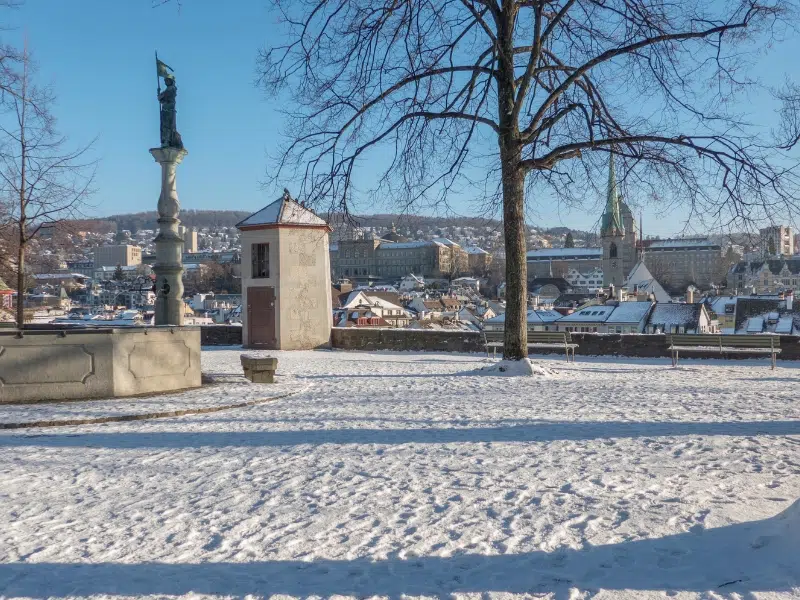
The Lindenhof is a small hill in the middle of Zurich's old town, crowned by a square of lime trees and a terrace that looks straight across the Limmat to the Grossmünster and the university. It is also where the city began: a Celtic settlement, a Roman fort and a Carolingian palace all stood on this spot. Today it is one of the calmest places in the centre, with locals playing giant chess under the trees.
The Lindenhof at a glance
- Where: on the left bank of the Limmat in the old town, between Bahnhofstrasse and the river, reached by lanes such as Pfalzgasse and Fortunagasse.
- Height: about 25 metres above the Limmat, at around 428 metres above sea level.
- What it is today: a public square and viewpoint shaded by lime trees, open at all times.
- Who built here: Celts, then the Romans, who put up a fort in the 4th century, then the Carolingian and Ottonian rulers, who had a palace here.
- Time needed: 15 to 30 minutes, longer if you sit on a bench and watch the chess players.
From Roman fort to public garden
Archaeologists have found traces of a Celtic settlement on the hill, and the Romans later had a customs post below it called Turicum, the origin of the name Zurich. Under Emperor Valentinian I, in the second half of the 4th century, the Roman army built a fortified citadel on the hilltop, with around ten towers, to guard against the Alamanni. In the Carolingian period a royal palace, or Pfalz, rose on the Roman ruins; the lane called Pfalzgasse still recalls it.
By the early 13th century the palace was derelict, and its stones were carried off to build city walls and the first stone houses of wealthy citizens. The open hilltop became a gathering place, and in 1774 a chronicle records the planting of 52 lime trees, the Linden that gave the square its name. In 1851 a Masonic lodge bought a house on the edge of the square, which it still uses today.
What to look for
- The view: from the parapet you look over the Limmat to the Grossmünster's twin towers, the Niederdorf rooftops, and the university and ETH buildings on the hill beyond.
- The Hedwig Fountain: a fountain from 1912 with a helmeted woman in armour by the sculptor Gustav Siber, recalling the legend of 1292.
- The Roman tombstone: on the wall along Pfalzgasse, a copy of a 2nd-century gravestone of a small boy that names the Roman station of Turicum; the original is in the Swiss National Museum.
- The chess boards: large boards laid out on the ground where locals play with knee-high pieces.
The women of 1292
The figure on the fountain tells Zurich's favourite legend. In 1292, the story goes, Duke Albert of Habsburg besieged the city while most of its men were away fighting near Winterthur. The women of Zurich, said to have been led by Hedwig ab Burghalden, put on armour and helmets and marched onto the Lindenhof, where the besiegers took them for a fresh army and withdrew. Historians treat it as a legend rather than documented fact, but it is the reason the armoured woman stands guard on the square.
Tips for your visit
- Come in the late afternoon or at sunset, when the old town across the river glows and the terrace is at its most relaxed.
- Early in the morning you may have the view almost to yourself, a good moment for photos of the Grossmünster.
- Bring a snack: there are no cafés on the square itself, but plenty of benches under the trees.
Nearby
- St Peter's Church: the church with one of the largest clock faces in Europe, just below the hill to the south.
- Schipfe: the old riverside quarter of craftsmen's houses on the Limmat, reached by steps down from the Lindenhof.
- Fraumünster: the church famous for its stained-glass windows by Marc Chagall, a few minutes' walk south.
- Bahnhofstrasse: Zurich's grand shopping street, a block to the west.
See Zurich with World City Trail
Our Zurich scavenger hunt turns the old town into a game you play on your phone. The route links 10 stops and takes around 3 hours, with about 47 minutes of walking. The Lindenhof is one of the stops, along with the Swiss National Museum and Bahnhofplatz. You can play in English, German, French, Italian, Spanish and Dutch.
If you prefer a different format, Zurich also has a self-guided walking tour and an outdoor escape game.
Play the Zurich scavenger hunt →
Take the self-guided walking tour of Zurich →
Play the outdoor escape game in Zurich →
Facts checked in October 2026.