
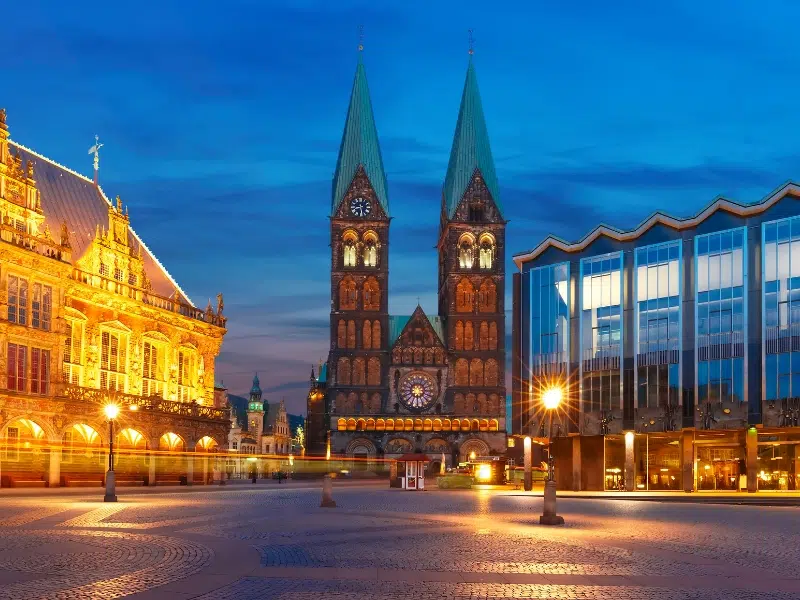
Bremen's Market Square (Marktplatz) is the old centre of the Hanseatic city, framed by the Town Hall, the cathedral, the merchants' guild house and the state parliament. The Town Hall and the stone Roland statue in front of it, both from the early 1400s, are together a UNESCO World Heritage Site.
Bremen Market Square at a glance
- Where: in the old town between the cathedral and Obernstraße, a few minutes' walk from the Weser and the Schlachte promenade.
- Created: the square has been used since the Middle Ages and was levelled and paved in stages from the late 12th century; the Town Hall was built in 1405 to 1410 and the Roland in 1404.
- What it is today: the city's main square and stage for the Christmas market and the Freimarkt fair in late October, with the Town Hall and Roland listed as World Heritage since 2004.
- Time needed: 30 minutes for the square and its statues; longer with a Town Hall tour or a visit to the cathedral.
Merchants, councillors and a free city
The square was once the bank of the Balge, a side arm of the Weser and Bremen's first harbour. As the city grew rich through trade and joined the Hanseatic League, the council built its Gothic Town Hall here, and in 1404 set up the Roland, a symbol of the city's rights and freedom. Between 1608 and 1612 the Town Hall received its richly carved Weser Renaissance façade facing the square.
Around the square stand buildings from several centuries: the Schütting, the merchants' guild house from 1537 and 1538, a row of gabled houses, and the Haus der Bürgerschaft, the glass-and-concrete parliament building completed in 1966, which caused much debate at the time. In 1836 the square was repaved with sandstone, including a Hanseatic cross set into the paving in memory of the Hanseatic Legion of the Wars of Liberation.
What to look for
- The Roland: a stone knight about five and a half metres tall, holding a sword and a shield with an inscription in Low German proclaiming the city's freedom.
- The Weser Renaissance façade of the Town Hall, with its large central gable, sculpted figures and arcades along the ground floor.
- The Town Musicians of Bremen on the west side of the Town Hall: Gerhard Marcks' 1953 bronze of the donkey, dog, cat and rooster from the Grimm fairy tale. Many visitors hold the donkey's front legs, which are polished bright.
- The Hanseatic cross in the paving, inside a circle of darker stones.
- The Spuckstein, a stone with a cross in the pavement between the cathedral and the parliament building (see below).
The spitting stone
The Spuckstein marks the spot where Gesche Gottfried was executed in 1831, the last public execution in Bremen. She had poisoned fifteen people, including her parents, husbands and children, with arsenic. Some locals still spit on the stone as they pass, which is how it got its name. There is also a legend about the Roland: as long as he stands, Bremen will stay free, and a spare statue is supposedly kept in the Ratskeller just in case.
Tips for your visit
- Come early in the morning or in the evening, when the square is quiet and the Town Hall façade is lit.
- Join a guided tour of the Town Hall to see the Upper Hall with its ship models hanging from the ceiling.
- In late October the Freimarkt and in December the Christmas market fill the square, which is festive but crowded.
Nearby
- Bremen Cathedral (St. Petri Dom): with its two towers and the Lead Cellar, where mummified bodies are on display.
- Böttcherstraße: a short brick lane rebuilt in the 1920s and 1930s in an Expressionist style, with a carillon of Meissen porcelain bells.
- Schnoor: Bremen's oldest quarter, a maze of tiny houses, a few minutes' walk south-east.
See Bremen with World City Trail
Our Bremen scavenger hunt turns the old town into a game you play on your phone. The route links 10 stops and takes around two hours, with about 34 minutes of walking. It includes the Schlachte promenade and Böttcherstraße. You can play in English, German, French, Italian, Spanish or Dutch.
If you prefer a different format, Bremen also has a self-guided walking tour and an outdoor escape game.
Play the Bremen scavenger hunt →
Take the self-guided walking tour of Bremen →
Play the outdoor escape game in Bremen →
Facts checked in October 2026.