
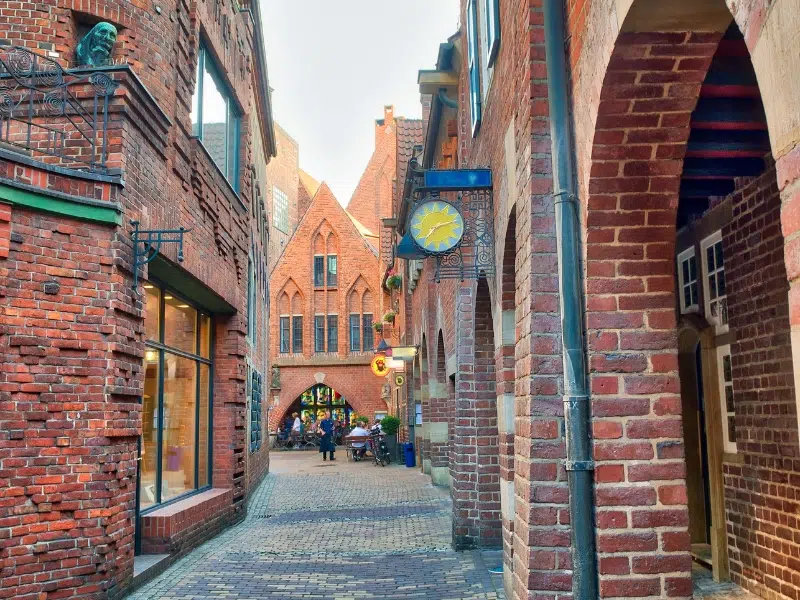
Böttcherstraße is a lane of barely 110 metres between Bremen's Market Square and the Weser, rebuilt in the 1920s by a coffee merchant as a work of art in brick. Its expressionist facades, a golden relief over the entrance and a carillon of porcelain bells make it one of the most unusual streets in Germany.
Böttcherstraße at a glance
- Where: in Bremen's old town, running from the Market Square towards the Martinikirche and the Weser riverbank.
- Built: mostly between 1922 and 1931; badly damaged in 1944 and restored after the war, with a full restoration completed in 1999.
- By: commissioned by the coffee merchant Ludwig Roselius, founder of Kaffee HAG; designed by the architects Eduard Scotland and Alfred Runge and the sculptor Bernhard Hoetger.
- What it is today: a listed ensemble with the Museen Böttcherstraße (the Paula Modersohn-Becker Museum and the Ludwig Roselius Museum), craft workshops, shops, restaurants and a hotel.
- Time needed: 20 minutes to walk it and hear the bells; two hours or more with the museums.
From coopers' lane to coffee king's showcase
In the Middle Ages this was a working street linking the market with the river harbour, home to the coopers (Böttcher) who made barrels; it is recorded as early as 1317 under another name. When the harbour moved in the 19th century, it declined. In 1902 Ludwig Roselius, whose firm later produced decaffeinated Kaffee HAG, bought house No. 6, and after the First World War he bought up the rest of the street and had it rebuilt: first sober brick offices by Scotland and Runge, then Hoetger's wildly sculptural Paula Modersohn-Becker House (1926) and the glass-and-steel Haus Atlantis (1931).
The street has an uncomfortable side. Roselius was drawn to nationalist Nordic myths and wanted the street to express them, and the golden relief at the entrance was put up in 1936 as a tribute to Hitler. Hitler nonetheless mocked this kind of art in a speech that year, and the Nazis listed the street in 1937 as an example of 'degenerate' Weimar art. Bombing in 1944 destroyed much of it, but Kaffee HAG had restored most facades by 1954. Since 2004 the street has belonged to a foundation linked to the Sparkasse Bremen savings bank.
What to look for
- Der Lichtbringer (The Bringer of Light): Hoetger's gilded relief above the entrance from the Market Square, showing the archangel Michael fighting a dragon.
- The Haus des Glockenspiels: 30 bells of Meissen porcelain hung between two gables. While they play, ten carved wooden panels turn in the tower, showing ocean crossers such as Columbus, Lindbergh and Count Zeppelin.
- The Paula Modersohn-Becker House, with curving brick walls and relief-like facades; the museum inside was the first in the world devoted to a woman painter.
- The Handwerkerhof courtyard, where goldsmiths and glassblowers work in view of passers-by.
- Haus Atlantis at the river end, whose concrete and glass front stands out among the brick.
- Small details in the brickwork: twisted patterns, carved heads and inscriptions that change from house to house.
Hearing the carillon
The Glockenspiel was added in 1934 and is the street's crowd-puller. It plays several times a day, more often from spring to the end of the year, and each performance lasts about eight minutes while the panels revolve one by one. Stand in the narrow lane facing the gables a few minutes before it starts; space fills up quickly in summer.
Tips for your visit
- Check the playing times of the Glockenspiel posted on site or online and plan your walk around them.
- Enter from the Market Square side to walk under the golden relief, then follow the lane down to the river.
- The lane is narrow: step aside for delivery carts, and don't block shop entrances while waiting for the bells.
- Combine it with the Schlachte riverside promenade at the other end for a drink by the Weser.
Nearby
- Bremen Market Square: the Town Hall and the Roland statue, together a UNESCO World Heritage Site, right at the start of the lane.
- Schlachte: the old harbour quay along the Weser, now lined with beer gardens and restaurants, a couple of minutes' walk away.
- Martinikirche: a Gothic brick church at the river end of the street.
- The Schnoor: Bremen's oldest quarter of tiny houses and narrow alleys, a short walk east.
See Bremen with World City Trail
Our Bremen scavenger hunt turns the old town into a game you play on your phone. The route links 10 stops and takes around 2 hours, with about 34 minutes of walking. Böttcherstraße is one of the stops, and so is the Schlachte promenade on the Weser. You can play in English, German, French, Italian, Spanish or Dutch.
For people who prefer a different format, there is also a self-guided walking tour and an outdoor escape game in Bremen.
Play the Bremen scavenger hunt →
Take the self-guided walking tour of Bremen →
Play the outdoor escape game in Bremen →
Facts checked in October 2026.