
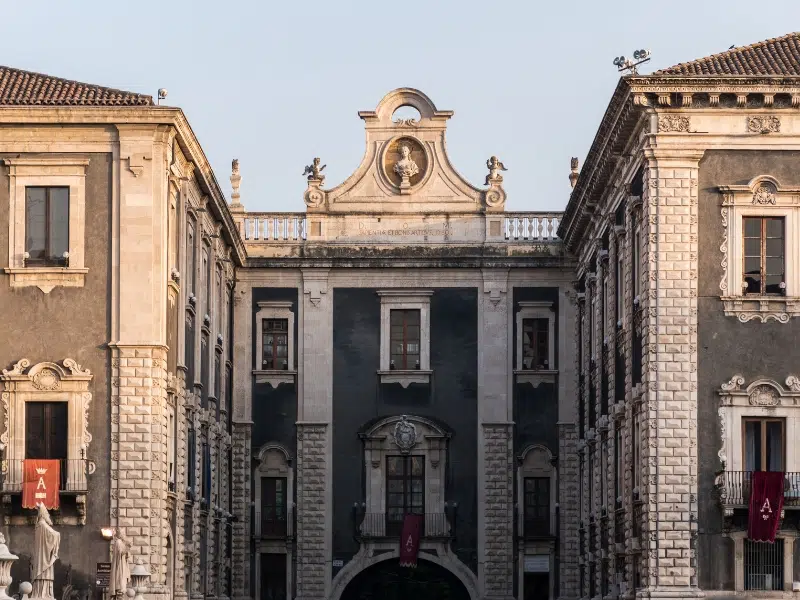
Porta Uzeda is the Baroque gateway at the southern end of Piazza Duomo in Catania, linking the cathedral square with the seafront street below the old city walls. It was built in 1695, just two years after an earthquake flattened most of the city, and it is a perfect small example of the black-lava-and-white-stone style of the rebuilt Catania. Stand in it and look north: the view runs straight up Via Etnea towards the volcano.
Porta Uzeda at a glance
- Where: the south side of Piazza Duomo, between the cathedral square and Via Dusmet, next to the Diocesan Museum.
- Built: 1695, during the reconstruction after the earthquake of January 1693.
- Named after: Juan Francisco Pacheco, Duke of Uceda (Uzeda in Italian), the Spanish viceroy of Sicily who backed the rebuilding of the city.
- What it is today: a passage for pedestrians and traffic between the old centre and the harbour side, with a walkway on top that can be visited through the Diocesan Museum.
- Time needed: 5 minutes to walk through; around 40 minutes if you visit the museum and the walkway.
A new gate for a rebuilt city
On 11 January 1693 a massive earthquake destroyed most of eastern Sicily, and Catania lost a large part of its population and nearly all its buildings. The Spanish authorities sent Giuseppe Lanza, Duke of Camastra, to lead the reconstruction, and the city was laid out again with broad, straight streets and open squares that would be safer in future earthquakes. Via Etnea, the main street running from the cathedral towards Mount Etna, was one of the results.
Porta Uzeda was opened in 1695 through the 16th-century walls that the Emperor Charles V had built along the shore, and it was named in honour of the viceroy. It joins the two halves of the old Seminary of the Clerics, today the Diocesan Museum on one side and the Palazzo dei Chierici on the other, linked by a covered bridge above the arch. Like the cathedral and the town hall around the square, it mixes dark lava stone, a material the volcano provided in abundance, with pale limestone and marble.
What to look for
- The colours: alternating bands and details of black lava stone and white stone, the signature of Catania's Baroque.
- The bridge above the arch: the upper level links the Diocesan Museum with the Palazzo dei Chierici, so the gate is also a passage between two buildings.
- The view up Via Etnea: from under the arch, look north across the square past the Elephant Fountain and along the straight street towards Etna.
- The old sea walls: on the seaward side you can see sections of the 16th-century walls of Charles V, which once stood at the water's edge.
Walking on top of the gate
The walkway over Porta Uzeda is part of the visit to the Diocesan Museum, which is housed in the former seminary. From the top you get one of the best views in the city: on one side the Baroque square with Mount Etna rising behind it, on the other the Archi della Marina, the long arcade of the 19th-century railway viaduct, and the sea beyond. If you only have time for one viewpoint in the old centre, this is a strong candidate.
Tips for your visit
- Go through the gate in the late afternoon, when the sun lights the cathedral facade and the lava stone looks its darkest against the white.
- Combine it with a morning walk through the Pescheria fish market, just around the corner, which is at its liveliest early in the day.
- Watch out for traffic on the harbour side: Via Dusmet is a busy road.
Nearby
- Catania Cathedral: the Cathedral of Sant'Agata on Piazza Duomo, dedicated to the city's patron saint, a few steps away.
- Elephant Fountain: the lava-stone elephant, known locally as u Liotru, carrying an Egyptian obelisk in the middle of the square.
- La Pescheria: Catania's noisy and colourful fish market, reached by steps beside the Amenano Fountain.
- Villa Pacini: a small public garden under the Archi della Marina, a minute's walk from the gate.
See Catania with World City Trail
Our Catania scavenger hunt turns the old town into a game you play on your phone. The route links 10 stops and takes around 2 hours, with about 34 minutes of walking, and it includes places such as the Roman Amphitheatre, Piazza Stesicoro and Via Etnea. You can play in English, German, French, Italian, Spanish and Dutch.
If you prefer a different format, Catania also has a self-guided walking tour and an outdoor escape game.
Play the Catania scavenger hunt →
Take the self-guided walking tour of Catania →
Play the outdoor escape game in Catania →
Facts checked in October 2026.