
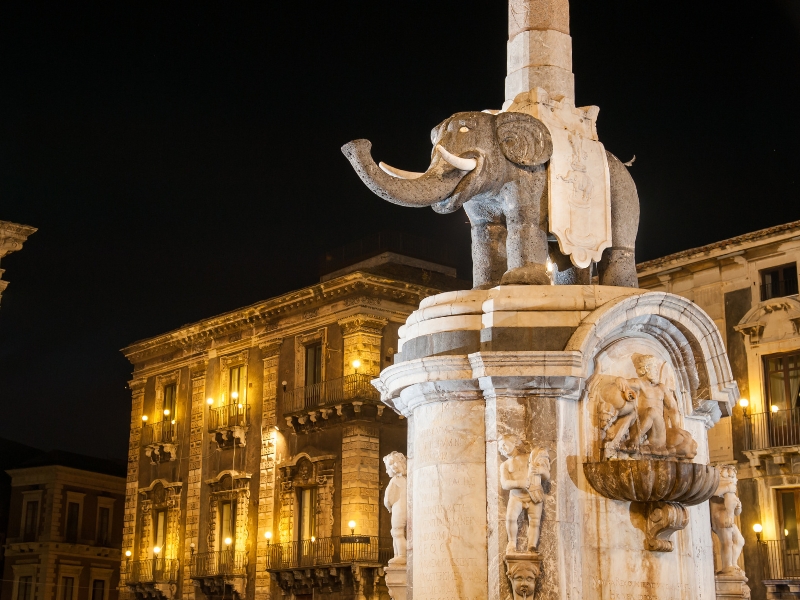
The Fontana dell'Elefante is the fountain in the middle of Piazza del Duomo in Catania, topped by a small black elephant carved from lava stone and carrying an Egyptian-style obelisk. Locals call the elephant u Liotru, and it is the symbol of the city: nobody knows exactly when it was made, but it was already ancient when the architect Vaccarini built the fountain around it in the 1730s.
The Elephant Fountain at a glance
- Where: in the centre of Piazza del Duomo, in front of Catania Cathedral and the town hall.
- Built: the fountain was designed by Giovanni Battista Vaccarini between 1735 and 1737; the elephant itself is much older, probably from late antiquity.
- By: Giovanni Battista Vaccarini, the Palermo-born architect who rebuilt much of Catania after the 1693 earthquake.
- What it is today: the emblem of Catania, a meeting point, and the centre of the city's main square.
From ancient statue to city emblem
Catania was flattened by the earthquake of 11 January 1693, and the city was rebuilt in baroque style with streets of dark lava stone and pale limestone. As part of the new Piazza del Duomo, Vaccarini set the old lava elephant on a white marble pedestal in a basin and placed an obelisk on its back, probably inspired by Bernini's elephant and obelisk in Rome. The obelisk, of granite and about 3.66 metres high, is decorated with Egyptian-style figures that do not form real hieroglyphic writing; it may once have stood in Catania's Roman circus.
The elephant's origins are a mystery. In the 12th century the Arab geographer al-Idrisi reported that the people of Catania saw it as a magic statue protecting the city from Etna, and dated it to Carthaginian or Byzantine times. Its place in the square has been defended before: in 1862, soon after the unification of Italy, the authorities planned to move the fountain to another square, and a popular protest stopped them. In 1998 the iron fence around it was removed, so you can now sit on the steps at its base.
What to look for
- The elephant itself, carved from black lava stone, with its trunk turned towards the cathedral of Saint Agatha, the city's patron saint.
- The obelisk on its back with its mysterious Egyptian-style figures.
- The top of the obelisk: a globe crowned with a palm (for martyrdom) and lilies (for purity), and a plaque with the letters MSSHDEPL, the motto of Saint Agatha.
- The two marble figures on the pedestal representing Catania's rivers, the Simeto and the Amenano.
- The water spouting from the pedestal into the marble basin below.
Why 'u Liotru'?
The elephant's nickname is usually explained by a legend about Heliodorus (Liodoro), an 8th-century nobleman who failed to become bishop, turned to magic and, so the story goes, rode the elephant from Catania to Constantinople, until Bishop Leo the Wonderworker had him burned at the stake. The tale is pure invention, but the name stuck: Liodoro became Liotru. Another explanation links the obelisk to its old role as the gnomon of a sundial, an instrument that worked by the sun, in Greek 'helios'.
Tips for your visit
- Sit on the steps around the fountain in the evening, when the square fills with people and the cathedral façade is lit.
- Walk round the fountain: the elephant looks different from each side, and the details of the pedestal are best seen up close.
- In early February the square is the centre of the festival of Saint Agatha, one of the largest religious festivals in the world; expect huge crowds.
- Combine it with the cathedral, the fish market and Via Etnea, all starting from this square.
Nearby
- Catania Cathedral: Saint Agatha's cathedral, rebuilt after 1693, with the façade by Vaccarini facing the elephant.
- La Pescheria: Catania's lively morning fish market, just behind the square towards the sea.
- Porta Uzeda: the baroque gate on the south side of the square, linking the city to the port.
- Via Etnea: Catania's main street, running north from the square with Mount Etna on the horizon.
See Catania with World City Trail
Our Catania scavenger hunt turns the old town into a game you play on your phone. The route links 10 stops and takes around two hours, with about 34 minutes of walking, and it includes places such as the Roman Amphitheatre, Piazza Stesicoro and Via Etnea. You can play in English, German, French, Italian, Spanish or Dutch.
If you prefer a different format, Catania also has a self-guided walking tour and an outdoor escape game.
Play the Catania scavenger hunt →
Take the self-guided walking tour of Catania →
Play the outdoor escape game in Catania →
Facts checked in October 2026.