
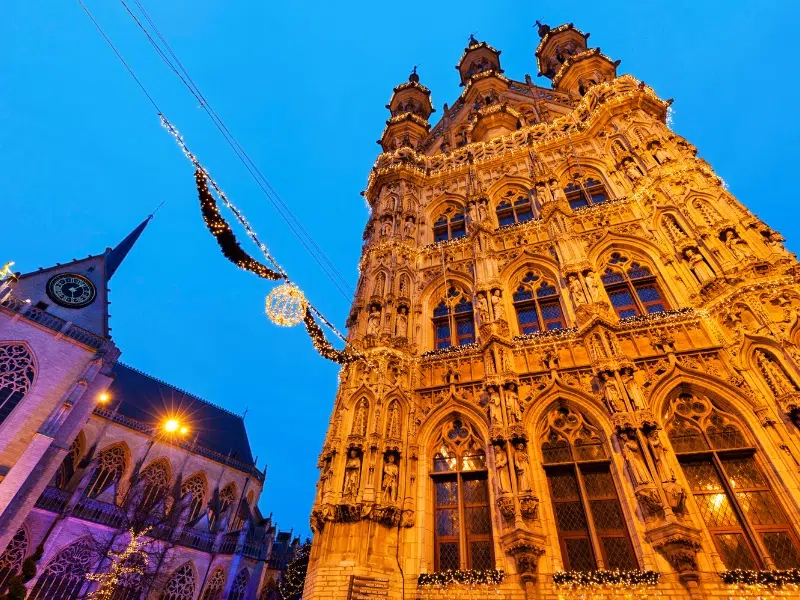
Leuven Town Hall stands on the Grote Markt, facing St Peter's Church, and is one of the most richly decorated Gothic town halls in Europe. Built between 1439 and 1469, it looks almost like carved lace, and its façades carry 236 statues of local figures, saints, counts and dukes, all standing on medieval corbels carved with Bible scenes.
Leuven Town Hall at a glance
- Where: on the Grote Markt in the centre of Leuven, directly opposite St Peter's Church.
- Built: 1439–1469, in the Brabantine late-Gothic style.
- By: started by Sulpitius van Vorst and Jan Keldermans II; the building as you see it was designed and completed by Matheus de Layens.
- What it is today: used for ceremonies since the city services moved out in 2009, and open to visitors on guided tours, with the tourist office in its left wing.
- Time needed: 15 minutes to study the façades, about an hour with a guided tour inside.
Three architects and a missing belfry
Leuven had two earlier town halls before this one. In 1439 the city decided to unite its municipal buildings behind a single new front, the Voirste Huys. The first architect, Sulpitius van Vorst, planned something inspired by Brussels Town Hall, including a belfry at one corner, but he died within months. Jan Keldermans II took over and also died, in 1445. When work resumed in 1448 under Matheus de Layens, he dropped the belfry and gave the building its symmetrical shape, with slender turrets at every corner. The outer walls and roof were finished in 1460 and the whole building in 1469.
Over the centuries the stone decayed, and the town hall was heavily restored in the 19th century. The statues you see today all date from after 1850. The building survived the burning of Leuven in 1914 with only minor damage, but a bomb that fell in front of it in the Second World War caused more harm, and repairs were only completed in 1983.
What to look for
- The statues on the first floor: people who mattered in Leuven's history, from scholars and artists to local benefactors.
- The second and third floors: patron saints and symbolic figures, and above them the Counts of Leuven and Dukes of Brabant.
- The corbels under the niches, carved in high relief with Bible scenes; unlike the statues, these are original 15th-century work.
- The steep roof with four rows of dormer windows and the octagonal corner turrets with narrow slits.
- Saint Peter and the Madonna and Child above the two central doors, with Saint Peter as a nod to the church across the square.
Medieval niches, 19th-century figures
The medieval builders carved the niches and their decorated corbels, but no medieval statues survive in them, and for a long time the façades stood largely empty. Only in the 19th century, when Belgium was a young country keen to celebrate its past, did the city commission the full set. That is why a 15th-century building is populated by figures carved in a 19th-century style.
Tips for your visit
- Come in the late afternoon or evening, when the low sun or the floodlights bring out the depth of the carving.
- Bring binoculars or use your phone's zoom to read the corbels; the Bible scenes are small and high up.
- Ask at the tourist office in the left wing about guided tours of the interior.
Nearby
- St Peter's Church: the Gothic church opposite, home to Dieric Bouts' Last Supper altarpiece.
- Oude Markt: the square lined almost entirely with cafés, often called the longest bar in Europe.
- Fonske: the statue of a student pouring water over his head from a book, a cheeky symbol of the university.
- Groot Begijnhof: the large béguinage south of the centre, a quiet World Heritage neighbourhood of red-brick houses.
See Leuven with World City Trail
Our Leuven scavenger hunt turns the city into a game you play on your phone. The route links 10 stops and takes around two hours, with about 25 minutes of walking. It includes places such as the M Leuven museum and Ladeuzeplein with the University Library. You can play in English, German, French, Italian, Spanish or Dutch.
If you prefer a different format, Leuven also has a self-guided walking tour and an outdoor escape game.
Play the Leuven scavenger hunt →
Take the self-guided walking tour of Leuven →
Play the outdoor escape game in Leuven →
Facts checked in October 2026.