
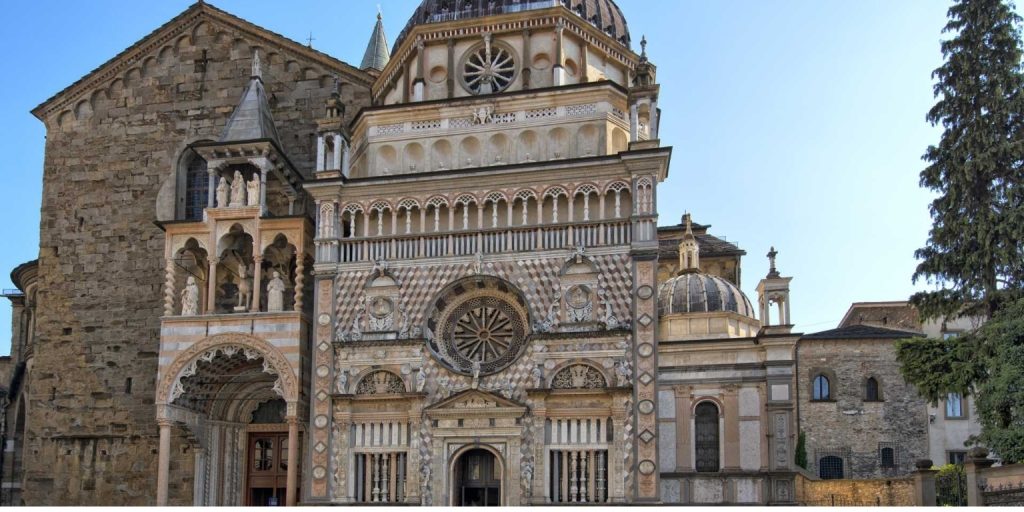
Nestled in the heart of Bergamo Alta, the captivating upper city of Bergamo, the Colleoni Chapel (Cappella Colleoni) stands as an unparalleled jewel of the Italian Renaissance. This exquisite funerary chapel, dedicated to Saints Bartholomew, Mark, and John the Baptist, is a vibrant testament to the ambition, artistic patronage, and personal legacy of one of Italy’s most renowned condottieri (mercenary captains), Bartolomeo Colleoni. Its ornate facade, rich polychrome marble, and breathtaking interiors make it a mandatory stop for anyone exploring the artistic and historical treasures of Lombardy.
A Condottiere’s Bold Vision and Defiance
The genesis of the Colleoni Chapel is as dramatic as its appearance. Bartolomeo Colleoni (c. 1400–1475), a native of Bergamo who served as Captain-General of the Republic of Venice, envisioned a magnificent mausoleum for himself and his beloved daughter, Medea, who tragically died in 1470 at a young age. Colleoni’s immense wealth and power were matched by his determined will.
Construction began in 1472 and was largely completed by 1476. The site chosen was the former sacristy of the adjacent Basilica di Santa Maria Maggiore. According to legend, the canons of the Basilica were initially reluctant to grant Colleoni permission to demolish their sacristy for his personal chapel. Undeterred, Colleoni reportedly had his soldiers dismantle the sacristy overnight, leaving the church authorities with no recourse but to accept his fait accompli. This bold act cemented his desire for a prominent and undeniable legacy.
The chapel was designed by the brilliant young architect and sculptor Giovanni Antonio Amadeo (c. 1447–1522), a leading figure of the Lombard Renaissance. Amadeo’s work on the Colleoni Chapel is considered one of his masterpieces, showcasing his innovative blend of classical Renaissance forms with a rich, almost sculptural, decorative style that defined the Lombard school.
A Kaleidoscope of Renaissance Artistry
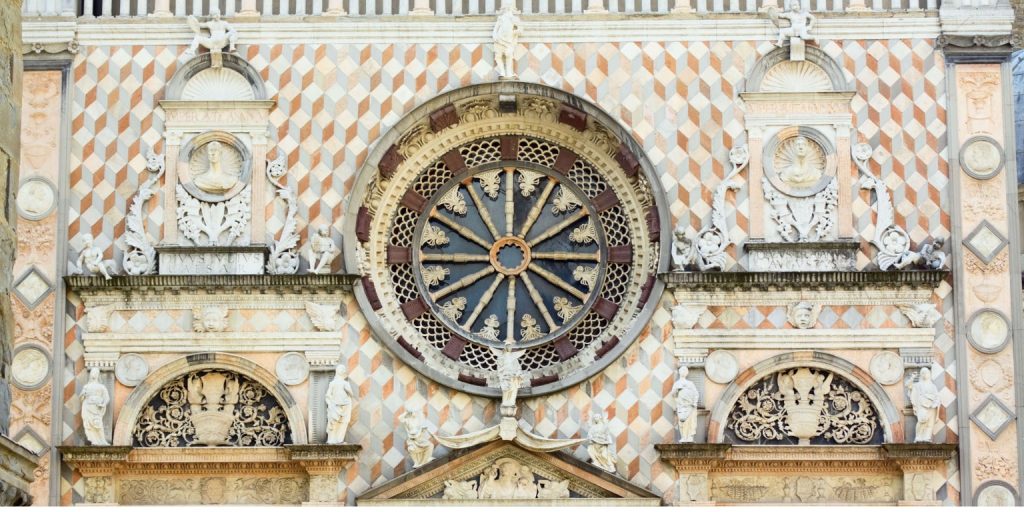
The exterior of the Colleoni Chapel is a true spectacle. Crafted from a striking combination of red, white, and black polychrome marble, its facade is adorned with an astonishing array of intricate details. Geometric patterns, classical motifs, sculpted figures, bas-reliefs depicting biblical scenes (such as the Annunciation and the Adoration of the Magi) and the Labours of Hercules, and medallions featuring Roman emperors like Julius Caesar and Trajan, all contribute to its visual richness.
The central rose window, flanked by sculpted busts, draws the eye upwards to the chapel’s elegant dome. The wrought-iron gate at the entrance, bearing the Colleoni family coat of arms (famously three testicles, often rubbed for good luck by visitors), is a later addition from 1912 but fits seamlessly into the chapel’s grandeur.
The interior is equally breathtaking. The light-filled space is dominated by the monumental tombs of Bartolomeo Colleoni and his daughter Medea. Colleoni’s tomb, a magnificent creation by Amadeo, is composed of two richly carved sarcophagi. Above the main sarcophagus, a striking gilded wooden equestrian statue of Colleoni, attributed to Sisto and Leonardo of Nuremberg (1493), portrays him in a heroic pose, riding a horse, emphasizing his military prowess and status. Medea’s tomb, also by Amadeo, is simpler but exquisitely carved, with a delicate recumbent effigy.
Adding another layer of artistic brilliance are the vibrant 18th-century frescoes that adorn the dome, painted by the celebrated Venetian master Giambattista Tiepolo. These frescoes, depicting scenes such as the “Life of St. Bartholomew,” bathe the interior in a dynamic light, creating a stunning contrast with the earlier Renaissance elements.

Unveiling a Hidden Burial and Enduring Legacy
For centuries, the exact burial place of Bartolomeo Colleoni remained a mystery, with his elaborate tomb believed to be merely a cenotaph. However, in 1969, a remarkable discovery confirmed his presence: Colleoni’s remains were found in a hidden crypt beneath his monument, in a wooden coffin, almost 500 years after his death. This discovery further cemented the chapel’s historical authenticity and allure.
Today, the Colleoni Chapel in Bergamo, built between 1472 and 1476 by Giovanni Antonio Amadeo, stands as one of the finest examples of Lombard Renaissance architecture. Located directly beside the Basilica di Santa Maria Maggiore, it continues to draw visitors who marvel at its artistic splendor and the fascinating story of the ambitious condottiere who commissioned it. It is a vital cultural landmark, preserving the memory of a powerful individual and showcasing the unparalleled artistic achievements of the Italian Renaissance.