
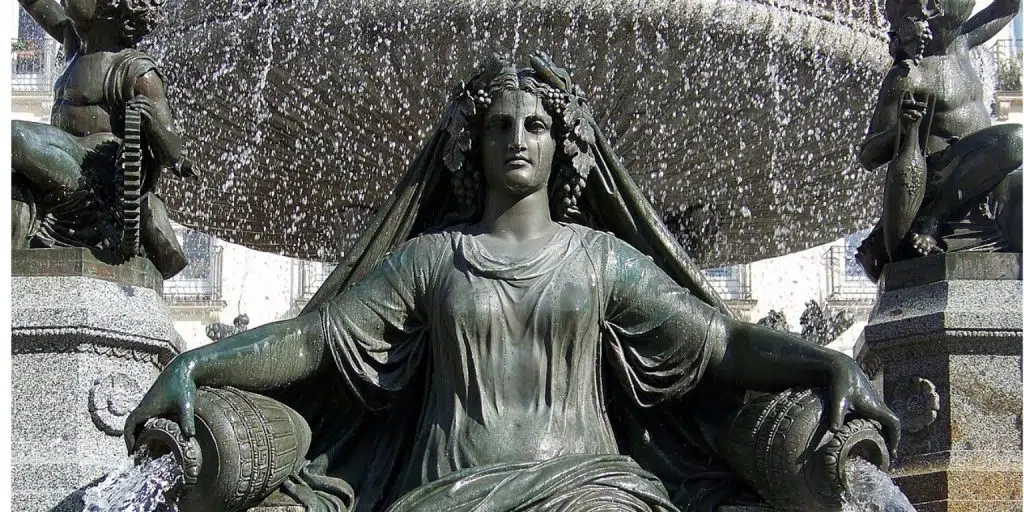
The fountain on Place Royale is Nantes's great monument to its rivers. Inaugurated in 1865, it stacks granite basins into a pyramid crowned by a marble figure of the city, with bronze statues of the Loire and four of its tributaries pouring water below. In January 2026 its statues returned after a full restoration, so you can now see the bronzes much as they looked when they were cast.
The Loire Fountain at a glance
- Where: in the centre of Place Royale, between the shopping street Rue Crébillon and the Bouffay quarter in central Nantes.
- Inaugurated: 16 March 1865.
- By: designed by the city architect Henri-Théodore Driollet; statues by Daniel Ducommun du Locle and Guillaume Grootaërs; bronzes cast by the Nantes founder Jean-Simon Voruz.
- What it is today: the centrepiece of one of the city's main squares, restored and back in full working order since early 2026.
- Time needed: 10–15 minutes.
A fountain for a river city
Place Royale itself was designed by Mathurin Crucy in 1786 and built from 1790 on land freed by the demolition of the medieval walls. In the 19th century the city decided to give it a monumental fountain celebrating Nantes and the waterways that made it rich. The city architect Henri-Théodore Driollet drew up the design but died in 1863, two years before it was finished. The fountain was inaugurated on 16 March 1865, with three superimposed basins of blue granite from Cuguen, in Brittany.
In September 1943 Allied bombing destroyed eight of the nine buildings around the square. They were rebuilt after the war under the architect Michel Roux-Spitz, and the fountain's basin was refurbished, with the work completed in 1961. More recently the statues suffered: the trident of the city figure was stolen several times after 1968, and in winter 2024 the marble statue lost its right arm. The bronzes were taken away to be cleaned at the Fonderie de Coubertin, the marble was repaired, and all the statues returned in January 2026.
What to look for
- At the top, the white marble figure of Nantes, a crowned woman; she now stands without the trident she once held.
- Below her, the bronze Loire, a woman pouring water from two amphorae.
- The four tributaries around the lower basin: the Erdre, the Sèvre nantaise, the Cher and the Loiret; three are women and one is a man.
- The eight bronze genii of industry and commerce sitting on dolphins that spout water.
- The three granite basins rising in a pyramid, the lowest one square.
Why the trident is missing
A city standing at the mouth of a great river naturally borrowed the symbols of the sea, and the marble Nantes originally held a trident like Neptune. After May 1968 it was stolen again and again, and each theft weakened the statue's hand. When the fountain was restored in 2025–2026, the city decided not to put the original back, to protect the figure from further damage. So if she looks as though she has lost something, she has.
Tips for your visit
- Walk all the way round the fountain to see each tributary figure and the genii from close up.
- Come in the evening, when the fountain is lit and the square is calmer.
- Look up at the buildings around the square: their post-war concrete fronts follow the lines of Crucy's 18th-century design.
- Combine it with a walk through the covered Passage Pommeraye nearby.
Nearby
- Passage Pommeraye: a 19th-century shopping arcade on several levels, a few minutes' walk away.
- Basilica of Saint-Nicolas: the neo-Gothic church with a tall spire, just north of the square.
- Bouffay quarter: the medieval streets with the Église Sainte-Croix and its belfry of trumpeting angels, a short walk east.
- Cathedral of Saint-Pierre-et-Saint-Paul: the Gothic cathedral with the tomb of Francis II of Brittany, about ten minutes' walk.
See Nantes with World City Trail
Our Nantes scavenger hunt turns the old town into a game you play on your phone. The route links 10 stops and takes around 2 hours, with about 36 minutes of walking. It includes the Cathedral of Saint-Pierre-et-Saint-Paul.
If you prefer a different format, there is also a self-guided walking tour and an outdoor escape game in Nantes.
Play the Nantes scavenger hunt →
Take the self-guided walking tour of Nantes →
Play the outdoor escape game in Nantes →
Facts checked in October 2026.