
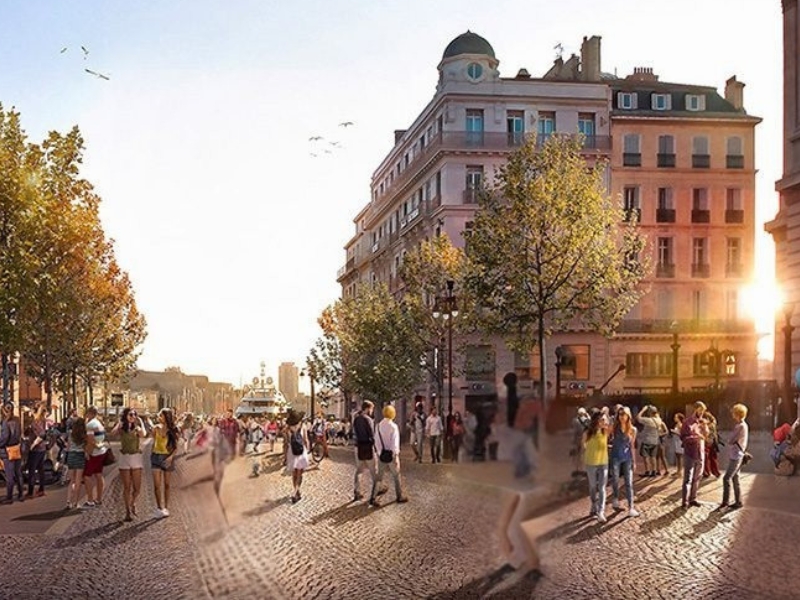
This guide follows one line through Marseille, from the top of the Canebière down to the sea: the church everyone calls Les Réformés, the Canebière itself, the Opéra, the Pavillon Daviel and the Vieille Charité in the old Panier quarter, and finally the Mucem on the waterfront. Together they span more than three centuries, from Pierre Puget's almshouse to Rudy Ricciotti's concrete lace.
Les Réformés (Église Saint-Vincent-de-Paul)
The neo-Gothic church at the top of the Canebière is officially dedicated to Saint Vincent de Paul, but almost nobody in Marseille calls it that. Its nickname comes from an earlier chapel of the Augustins Réformés, a reformed order of Augustinian friars, which stood here until it was pulled down after 1801. The first stone of the new church was laid on 22 April 1855. François Reybaud drew the first plans, the priest and architect Joseph Pougnet took over in 1862, and the long, costly building work was paid for largely by parishioners; the church was never entirely finished. The city restored it between 2019 and 2023.
- The two spires, 76 metres high, which close the view when you look up the Canebière from the Old Port.
- The west rose window, the stained glass by Édouard Didron and the bronze doors.
La Canebière
Marseille's best-known street runs from Les Réformés down to the Old Port. Its name comes from the Provençal word canebe, hemp: rope makers once worked in this area, supplying the ships in the harbour. The street took shape after Louis XIV ordered the city to expand in the 1660s, and in the 19th century it became the grand avenue of a booming port, lined with hotels, cafés, banks and shipping offices. Its fortunes have gone up and down since, but it remains the city's main axis, with the tram running along it.
- The Palais de la Bourse near the Old Port end, built in the mid-19th century for the Chamber of Commerce.
- The view straight down to the Old Port, with the masts of the boats at the bottom of the street.
Opéra de Marseille
A short detour south of the Canebière brings you to the Opéra. The first theatre on this site, the Grand-Théâtre, opened in 1787. In November 1919 a fire destroyed it, leaving only the outer walls and the stone colonnade. The city rebuilt it to plans by a team of three architects that included Gaston Castel, and the new house opened on 4 December 1924. Behind the 18th-century colonnade, the interior is a complete Art Deco design, with seats for about 1,800 people.
- The colonnade of the old theatre, the part that survived the fire of 1919.
- The Art Deco reliefs and lettering on the façade, a style that stands out in a city of older stone fronts.
Pavillon Daviel
Across the Old Port, behind the town hall, the Pavillon Daviel stands on a small square at the edge of the Panier, Marseille's oldest quarter. It was built between 1743 and 1747 by the Gérard brothers, on the site of an older courthouse, and served the city's courts. Its sculptures are by the artist Jean-Michel Verdiguier. The square in front is named after Jacques Daviel, an 18th-century surgeon who worked in Marseille and was a pioneer of cataract surgery. Today the building is used by the city administration and is not open to visitors, so you see it from the square.
- The wrought-iron balcony over the entrance, decorated with a marguerite (daisy) motif.
- The carved stone decoration of the façade, typical of 18th-century Provençal public buildings.
La Vieille Charité
Higher up in the Panier, the Vieille Charité was built as an almshouse, where the city's poor and beggars were taken in and made to work. Construction began in 1671 to plans by Pierre Puget, Marseille's great Baroque architect and sculptor, and was completed in 1749; after Puget's death in 1694 his son François finished the chapel. Later it became an asylum, a Foreign Legion barracks until 1922 and then housing for families who had lost their homes. After it was emptied in 1962, it was restored between 1970 and 1986 and is now a cultural centre with the Museum of Mediterranean Archaeology and the Museum of African, Oceanic and Amerindian Arts.
- The courtyard surrounded by three storeys of arcaded galleries in pink stone.
- The chapel in the middle of the courtyard, crowned by an oval dome and fronted by Corinthian columns.
Mucem
The Museum of Civilizations of Europe and the Mediterranean opened on 7 June 2013, the year Marseille was European Capital of Culture. Its main building, designed by Rudy Ricciotti with Roland Carta, is a square block wrapped in a lattice of fibre-reinforced concrete that filters the sunlight like a screen. A footbridge about 130 metres long links its roof to Fort Saint-Jean, the 17th-century fort at the harbour entrance, which is part of the museum. The collections cover the history and cultures of the Mediterranean.
- The concrete lattice, best seen from the inside ramps, where it throws patterns of light and shadow.
- The footbridge to Fort Saint-Jean, with views over the Old Port and the open sea.
How to see them in one walk
Start at Les Réformés and walk down the Canebière towards the sea. Before you reach the Old Port, turn left for a short detour to the Opéra, then return to the Canebière and the harbour. Cross to the north side of the Old Port and climb behind the town hall to the Pavillon Daviel, then go up through the lanes of the Panier to the Vieille Charité. From there, walk down past the Cathédrale La Major to the waterfront and finish at the Mucem and Fort Saint-Jean, ideally towards sunset.
See Marseille with World City Trail
Our Marseille scavenger hunt turns these streets into a game you play on your phone. The route links 10 stops, from Les Réformés to the Vieille Charité, and all six places in this guide are among them: Les Réformés, the Canebière, the Opéra, the Pavillon Daviel, the Mucem and the Vieille Charité.
If you prefer a different format, there is also a self-guided walking tour and an outdoor escape game in Marseille.
Play the Marseille scavenger hunt →
Take the self-guided walking tour of Marseille →
Play the outdoor escape game in Marseille →
Facts checked in October 2026.