
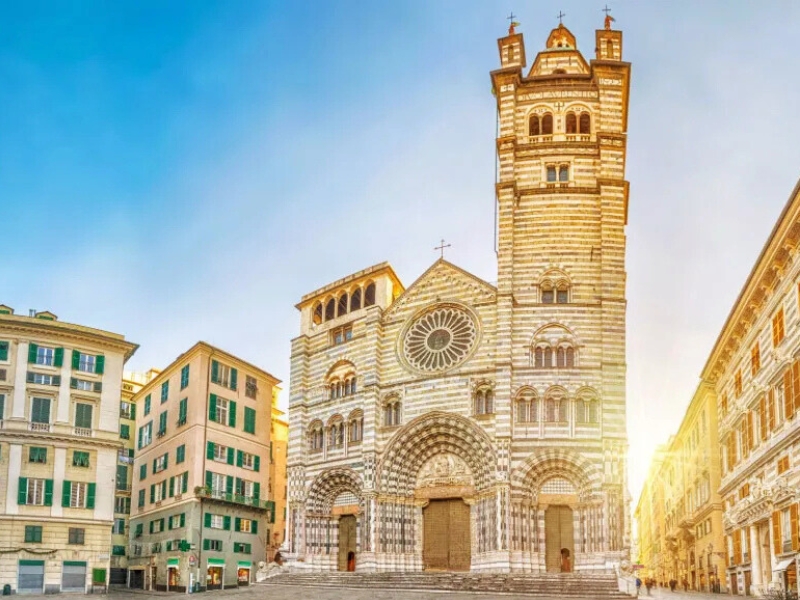
This guide crosses Genoa's old town from north to south through eight places: the old cathedral of San Siro, the Palazzo della Meridiana, Piazza Fontane Marose, the church of Santa Maria delle Vigne, the Cathedral of San Lorenzo, the Doge's Palace, Porta Soprana and the house linked to Christopher Columbus. Together they tell the story of the medieval Republic of Genoa, its bishops, bankers and doges, and they all lie inside the narrow lanes of the centro storico, close enough to see in one walk.
Basilica di San Siro
San Siro was Genoa's first cathedral, long before San Lorenzo took over that role. A church dedicated to the apostles stood here first; it was later named after Saint Syrus, an early bishop of the city, and a Romanesque church with a bell tower was built between the 10th and 12th centuries. In 1096 the crusade was preached here, and Genoa sent ships to the First Crusade. A fire in 1478 destroyed much of the building, and it was rebuilt in the Counter-Reformation style nearly a century later, which is why the interior looks so different from the plain medieval churches nearby.
- Look up at the nave vault, frescoed by Giovanni Battista Carlone, and at the high altar by the French sculptor Pierre Puget. The old Romanesque bell tower is gone: it was pulled down for safety reasons in 1904 and never rebuilt.
Palazzo della Meridiana
This palace was built between 1536 and 1544 for Gerolamo Grimaldi Oliva, a Genoese banker who had made his fortune in Spain and Portugal. In the decades that followed, his family had the rooms painted by leading artists of the time, among them Luca Cambiaso, whose cycle on the story of Ulysses includes the hero shooting the suitors. The palace is one of the Palazzi dei Rolli, the private houses chosen to host state guests of the Republic, which were listed as a UNESCO World Heritage Site in 2006.
- The large painted sundial on the south facade, which gave the palace its name. It was added in the late 18th century, when the new street now called Via Cairoli was opened beside the building.
Piazza Fontane Marose
Piazza Fontane Marose sits at the end of Via Garibaldi, the 16th-century Strada Nuova lined with the grandest palaces of the Rolli. The square takes its name from a fountain built in 1206 that no longer exists; in the Middle Ages it was called fons marosus, probably because of its rushing water. The fountain was demolished in 1849 to open a new street, but three marble plaques on Palazzo Interiano Pallavicini, at number 2, still record its history.
- Palazzo Spinola dei Marmi, at number 6, built in the mid-15th century: its facade is striped with alternating bands of white marble and dark grey stone, a pattern reserved in medieval Genoa for its most powerful families.
Santa Maria delle Vigne
The name means Saint Mary of the Vineyards: the church was founded in the late 10th century outside the city walls, among vines. It was consecrated in 1117 and became a parish in 1147. In the 17th century the architect Daniele Casella rebuilt the interior in baroque style and added a dome, and the neoclassical facade facing the square was built between 1841 and 1848 to a design by Ippolito Cremona. Pope John Paul II made the church a minor basilica in 1983, and the composer Alessandro Stradella is buried inside.
- The Romanesque bell tower from the 12th century, the only part of the medieval church that survives largely as it was.
- The cloister from the 11th century, with sturdy columns of black stone, and inside the church the 14th-century Madonna della Vita painted on a column of green marble.
Cattedrale di San Lorenzo
The Cathedral of San Lorenzo became Genoa's cathedral in place of San Siro and was consecrated by Pope Gelasius II in 1118. Building went on for centuries, so the church mixes styles: Romanesque side doors, a Gothic facade from the early 13th century, and a dome and bell tower from the 16th century. The facade is covered in bands of white and black stone, the same sign of rank you see on the noble palaces of the old town.
One chapel holds the relics of Saint John the Baptist, the patron saint of the city, which reached Genoa after the First Crusade. Below the church, the treasury museum keeps the Sacro Catino, a glass bowl of Islamic make from the 9th or 10th century that was brought back from the crusades; according to legend it was used at the Last Supper. In the right-hand aisle you can still see a British naval shell that crashed through the roof on 9 February 1941 and did not explode.
- The two marble lions on either side of the steps, carved by Carlo Rubatto in 1840.
- The small figure on a column on the right-hand side of the facade, known in local tradition as the Arrotino, the knife-grinder. It is actually a sundial, and it may show Saint John the Evangelist.
Palazzo Ducale
The Doge's Palace was the seat of government of the Republic of Genoa. It grew from medieval buildings bought by the city's leaders in the 1290s, and it took the name ducale after Simone Boccanegra became the first doge of Genoa in 1339. In 1591 the architect Andrea Ceresola, known as il Vannone, rebuilt it with a vaulted atrium and a grand staircase. After a fire on 3 November 1777, Simone Cantoni gave it the neoclassical marble facade on Piazza Matteotti, one of the first neoclassical works in Genoa.
The palace has two fronts: the Cantoni facade on Piazza Matteotti, near the cathedral, and a later facade on Piazza De Ferrari. After long use as courts and offices it was restored in 1992 and is now a museum and cultural centre that hosts exhibitions and events.
- The Torre Grimaldina, the medieval tower that served as a prison until the Second World War; the violinist Niccolò Paganini and the patriot Jacopo Ruffini were among its prisoners.
Porta Soprana
Porta Soprana, also called Porta di Sant'Andrea, is the most striking gate of the Barbarossa walls, built from 1155 to 1159 when Genoa feared an attack by the emperor Frederick Barbarossa. Two tall round towers frame a pointed arch. What you see today is largely the result of restorations: work began around 1890 under Alfredo d'Andrade, and the southern tower, hidden inside a block of houses until the 1930s, was freed and rebuilt in that decade.
- The two Latin inscriptions on the inner walls of the arch. One greets the traveller with a warning: if you come in peace, you may touch these gates; the other lists Genoa's victories and gives 1155 as the year the walls were begun.
Christopher Columbus' House
Just outside the gate stands a small house that is presented as the childhood home of Christopher Columbus. His father Domenico moved the family into a house here in 1455, when Christopher was about four, and they lived there until around 1470. The building you see is almost certainly not the original: the medieval house was probably destroyed in the French bombardment of Genoa in 1684, and the present one is a reconstruction from the early 1700s. The city bought it in 1887, and it is now a small museum.
- Next to it, the ruined 12th-century cloister of Sant'Andrea. It stood on a hill that was dug away in 1904; Alfredo d'Andrade saved the stones and they were later put back together here.
How to see them in one walk
Start at San Siro in the Maddalena quarter and walk up to the Palazzo della Meridiana and on to Piazza Fontane Marose at the end of Via Garibaldi. Turn back into the old town for Santa Maria delle Vigne, then head south through the lanes to the Cathedral of San Lorenzo. From the cathedral it is only a short walk to the Doge's Palace, and from Piazza De Ferrari another short walk brings you to Porta Soprana and Columbus' house. The lanes are steep and confusing in places, so keep a map open on your phone.
See Genoa with World City Trail
Our Genoa scavenger hunt turns the old town into a game you play on your phone. The route links 10 stops, from the Basilica di San Siro to Christopher Columbus' House, and all eight places in this guide are stops, along with Palazzo San Giorgio and Piazza De Ferrari. At each stop you solve a puzzle and learn a story, at your own pace.
There is also a self-guided walking tour and an outdoor escape game in Genoa, for people who prefer a different format.
Play the Genoa scavenger hunt →
Take the self-guided walking tour of Genoa →
Play the outdoor escape game in Genoa →
Facts checked in October 2026.